
Depot Charging Changes the Economics
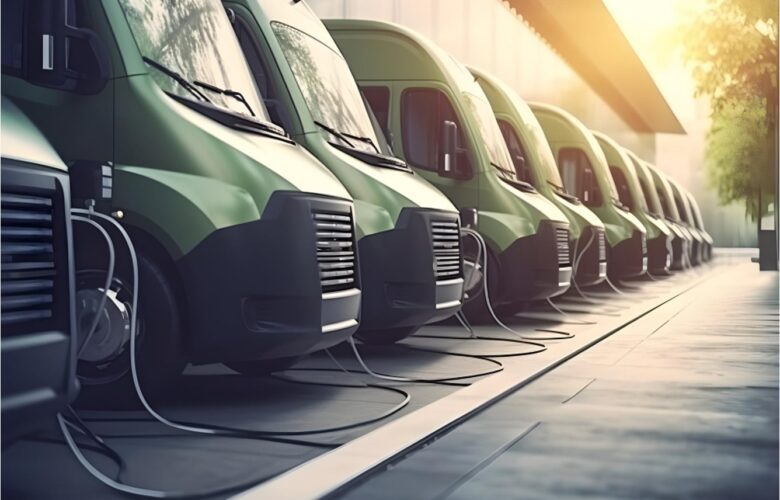
A fleet that charges on public infrastructure is paying retail for electricity, competing for bays with the general public, and sending drivers on detours that do not earn anything. A fleet that charges at its own depot pays closer to its commercial electricity tariff, controls availability completely, and charges during hours the vehicles were parked anyway.
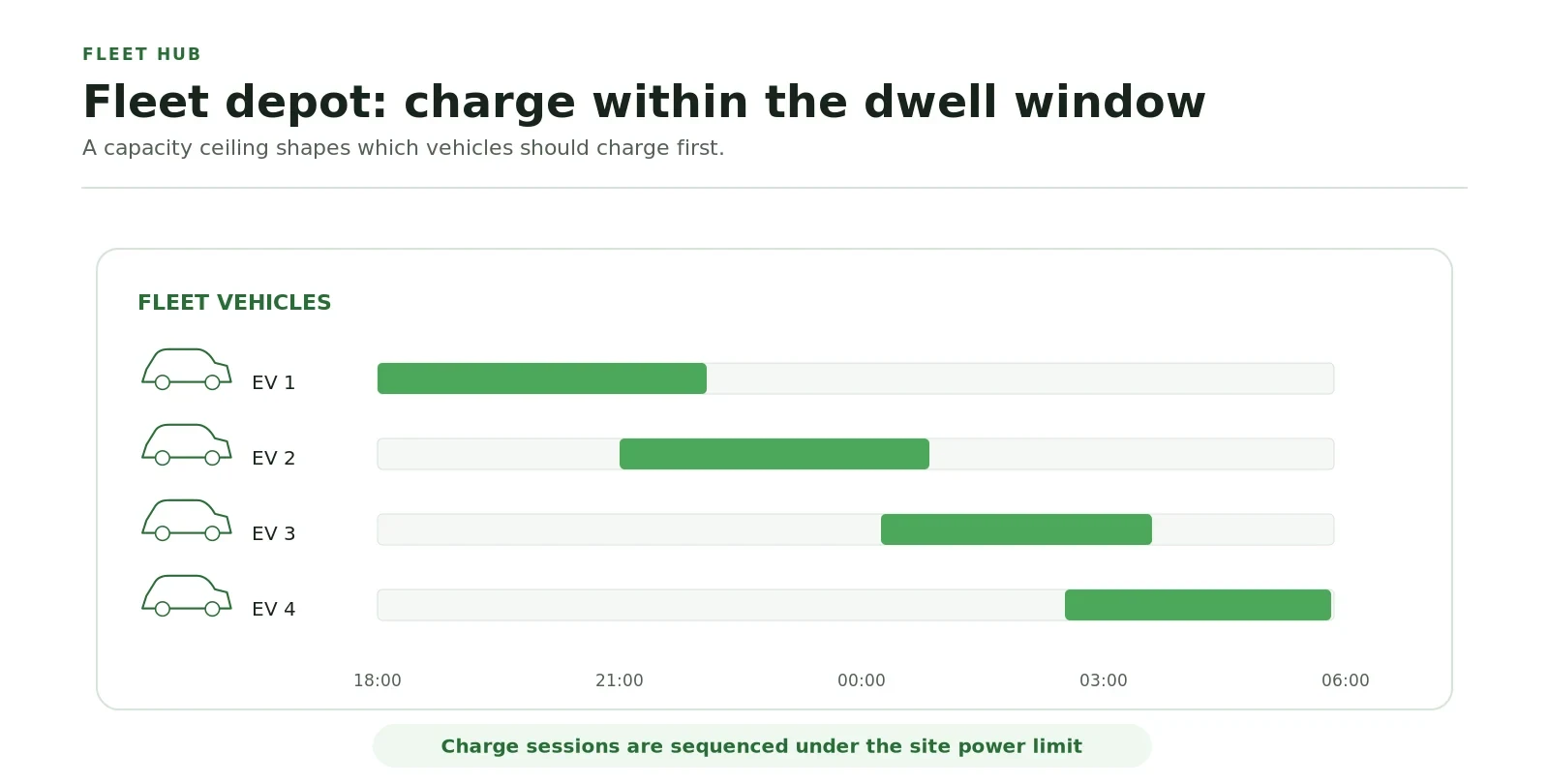
That last point is what makes depot charging work. Public charging has to be fast because the driver is waiting. Depot charging usually does not, because the vehicle sits idle overnight or between shifts. Slower charging over a long dwell is cheaper on hardware, far gentler on the grid connection, and better for battery life.
Size the Charging Around the Duty Cycle
The sizing question is not “how fast can we charge” but “how much energy does each vehicle need, and how many hours do we have to deliver it”. Work it in that order:
- Daily energy per vehicle. Distance driven per day multiplied by consumption per kilometre, plus a margin for air-conditioning, load and degradation.
- Available dwell window. The hours the vehicle is genuinely parked and connected — not the hours it is on site.
- Required power per vehicle. Daily energy divided by the dwell window. A vehicle needing 30 kWh across a ten-hour overnight window needs about 3 kW, which is an ordinary AC charge point, not a DC unit.
- Simultaneity. Whether every vehicle must charge at once, or whether they can be sequenced. This decides the grid connection more than anything else.
Fleets routinely over-specify at this step, buying DC fast chargers for vehicles that sit still for twelve hours. The result is capital spent on hardware and a sanctioned load far larger than necessary, which then carries demand charges every month for the life of the site.
| Fleet profile | Typical pattern | Charging that usually fits |
|---|---|---|
| Last-mile delivery, two and three wheelers | Return to depot nightly, long dwell | Many low-power AC points, sequenced overnight |
| Ride-hailing cars | Multiple shifts, short gaps in the day | Mixed: AC overnight plus a small number of DC units for shift turnaround |
| Staff and employee transport | Two defined peaks, idle mid-day and overnight | AC charging in the idle windows |
| Buses and heavy vehicles | Large battery, fixed schedule | Higher-power DC, tightly scheduled against the timetable |
| Mixed utility fleets | Unpredictable return times | AC base with DC available for exceptions, managed by priority |
Load Management Is Not Optional at a Depot
A depot is the clearest case for managed charging anywhere in the industry. Twenty vehicles plugged in at the same moment, each drawing full rated power, will exceed almost any sanctioned load. Managed charging spreads that demand across the dwell window instead, which means the site can run on a fraction of the connection capacity an unmanaged design would require.
That has three concrete effects: a smaller and far cheaper grid connection, lower monthly demand charges, and the ability to add vehicles without returning to the DISCOM. Where the electricity tariff varies by time of day, the same scheduling shifts consumption into the cheapest hours automatically. Smart charging with load management covers how this works in practice.
What a Fleet Operator Needs From the Platform
Fleet charging and public charging are different problems, and the software requirements differ accordingly. At a depot, nobody is paying at the charger — the question is internal allocation and control:
- Cost allocation by vehicle, driver, department or client contract, so charging cost can be attributed rather than absorbed as a single depot bill.
- Energy per vehicle over time, which is how consumption drift and a developing battery problem become visible.
- Charge-ready assurance — confirmation that every vehicle will have the state of charge its next duty requires before the shift starts, with alerts when one will not.
- Priority and sequencing, so the first vehicle out in the morning is not the last one charged.
- Driver authentication by RFID or app, so sessions attach to a vehicle and a person rather than to a bay.
- Opportunity charging on public networks billed back to the fleet account when a vehicle does have to charge away from the depot.
All of it runs on the same management platform as public charging, over OCPP, so a depot is not a separate system to operate. For the wider picture of running vehicles and chargers together, see our guide to EV fleet management solutions.
Building the Depot
The sequence is the same as any charging site, with one difference: the demand side is already known. You do not have to estimate utilisation, because the vehicles and their schedules are yours. That makes the business case considerably more certain than a public site, and it is why depot projects typically move faster from assessment to commissioning. EV consulting covers the duty-cycle analysis and depot design, and installation and setup covers delivery.