

What a Feasibility Study Actually Tells You
The decision that determines whether a charging site earns is made before anything is bought. A feasibility study exists to answer one question honestly: at this location, with this likely demand and this electricity cost, does the site pay back — and if so, how long does it take?
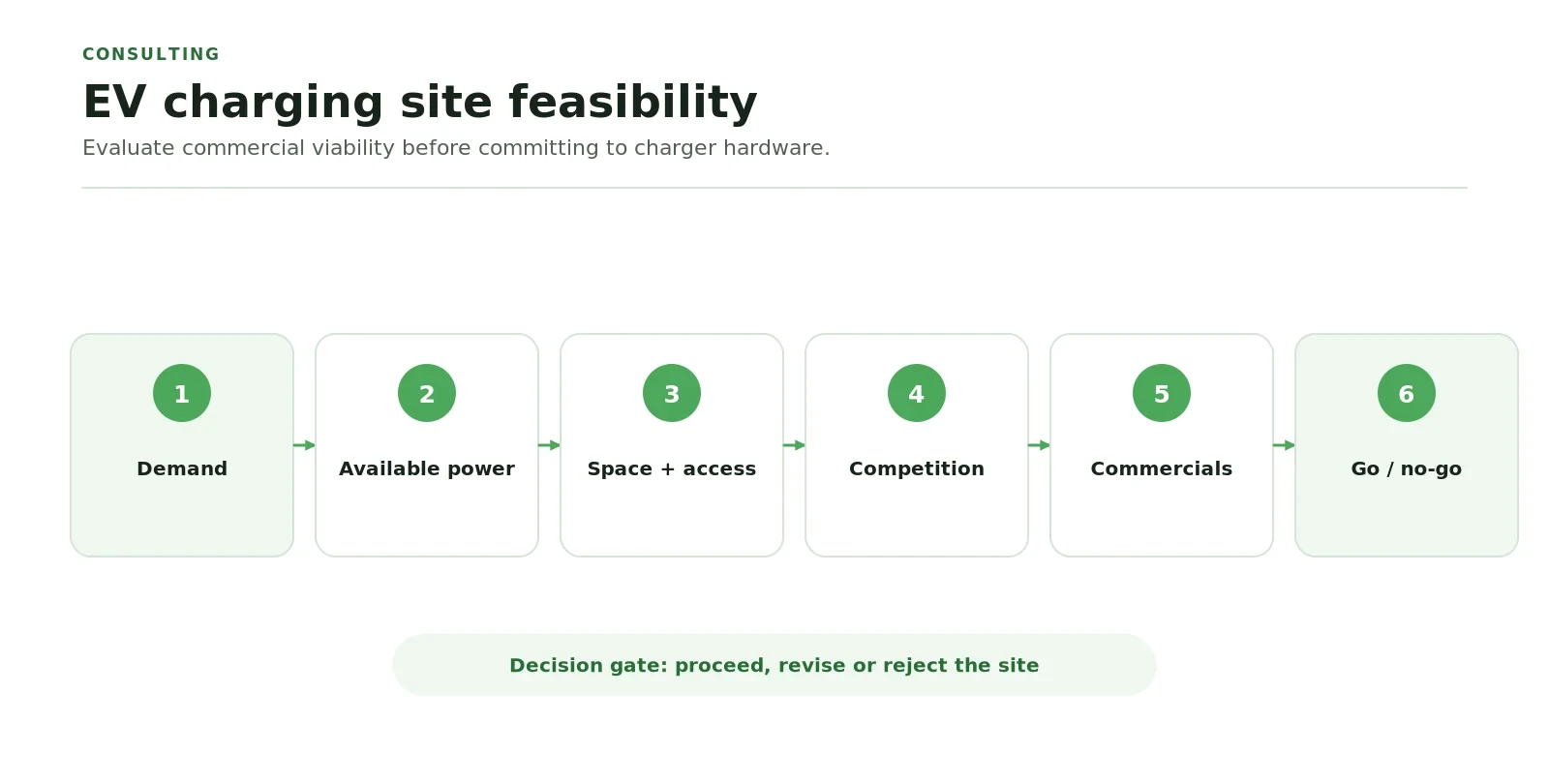
Answering it means establishing five things.
- Demand. Who charges here, and how often? A highway site serves transient long-distance traffic. A mall serves dwell-time charging measured in hours. A depot serves a known fleet with a known duty cycle. These produce completely different utilisation curves, and utilisation is the single most sensitive input in the whole model.
- Power. What load is sanctioned at the site today, what would need to be added, and what does the DISCOM charge to add it? Transformer and connection costs are the most commonly underestimated line in an EV charging budget.
- Space and access. Can vehicles queue without blocking the site? Is there room for the charger, the panel and safe circulation? Can the cable route reach from the supply point without crossing something expensive?
- Competition. What already exists within a realistic detour, on which networks, at what price?
- Commercials. Tariff you can charge, electricity cost including demand charges, rent, maintenance and platform cost — and from those, the payback period at a realistic utilisation rather than an optimistic one.
A study that returns “this site does not work” has done its job. It is dramatically cheaper than discovering the same thing after the civil work.
Why Utilisation Decides Everything
Operators tend to focus on charger price. The number that actually moves payback is how many hours a day the charger is delivering energy. Fixed costs — rent, maintenance, platform, demand charges, the capital itself — are incurred whether or not a vehicle is plugged in, so every additional point of utilisation drops almost straight through to the margin.
The practical consequence is that a cheaper charger at a weak site is a worse investment than a more expensive charger at a strong one. The arithmetic behind this, with worked payback periods across a range of utilisation rates, is set out in the EV charging station cost guide.
Engagement Types and What You Receive
| Engagement | Answers | Typical deliverables |
|---|---|---|
| Site feasibility | Should we build here? | Demand assessment, load availability, competitive position, financial model, go / no-go recommendation |
| Network strategy | Where should we build, and in what order? | Site shortlist and ranking, phasing plan, capital schedule, target network economics |
| Fleet electrification | Can our vehicles run on electricity? | Duty-cycle analysis, depot charging design, vehicle and charger specification, transition plan |
| Technology selection | What hardware and software should we buy? | Requirement specification, charger and platform evaluation, protocol and interoperability requirements, procurement support |
| Post-installation advisory | Why is the network underperforming? | Utilisation and downtime review, tariff and pricing assessment, operational recommendations |
Specify for Interoperability, Not for One Vendor
The most expensive avoidable mistake in charging infrastructure is buying hardware and software from a single vendor as a locked bundle. It looks simpler at procurement and it removes every option afterwards — you cannot change software without changing chargers, you cannot add a different manufacturer’s unit, and you have no leverage at renewal.
Insisting on OCPP compliance in the specification is what prevents that. If you are still deciding where you sit in the market, our explainer on what a Charge Point Operator does is the place to start. It is an open protocol, it is what the industry standardised on, and it means the management layer does not care whose charger is on the wall. For networks that will eventually share drivers with other operators, OCPI support matters for the same reason — it is the basis of roaming between networks. Both belong in the requirement document at the start, not in a renegotiation two years later.
Who This Is For
Consulting work generally comes from one of four places: an organisation with real estate wondering whether charging is a sensible use of it; a fleet operator working out whether electrification survives contact with their duty cycles (our guide to EV fleet management solutions covers that side); an existing operator whose network is built but underperforming; or an investor assessing someone else’s charging business before committing. The analysis differs, but in each case the output is the same — a decision supported by numbers rather than by enthusiasm.
Once a site is approved, installation and setup covers delivery from survey through DISCOM liaison to commissioning.

