


What Roaming Means in Practice
Roaming lets a driver registered with one network charge on another network’s hardware, and settles the money between the two operators behind the scenes. The driver sees one app, one account and one bill. The two operators see a reconciled statement at the end of the period.
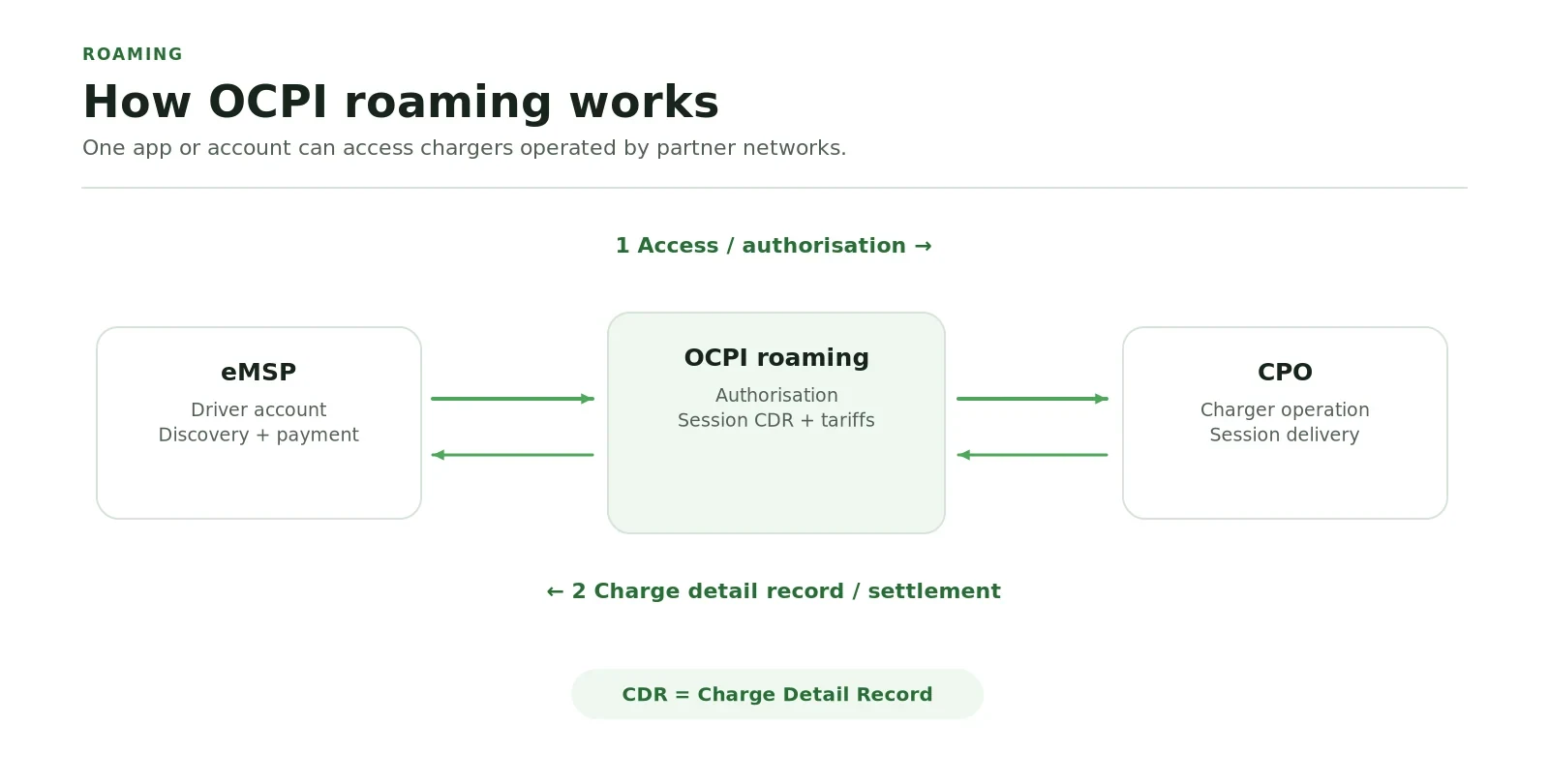
It matters because no single network in India covers the country, and a driver who has to hold six apps to complete a long journey will eventually stop making the journey. Roaming converts every participating network’s chargers into chargers your drivers can use, without you building any of them.
The Three Roles
Roaming discussions get confused because the same company often plays more than one role. The distinction is worth holding onto:
| Role | What it does | Owns |
|---|---|---|
| CPO — Charge Point Operator | Runs the physical chargers, sets the tariff, maintains the hardware | The chargers |
| eMSP — e-Mobility Service Provider | Holds the driver relationship, the app and the account | The customers |
| Roaming hub | Connects many CPOs and eMSPs through one integration instead of many bilateral ones | The connections |
A network that owns both chargers and drivers is acting as CPO and eMSP at once. Roaming is what happens when one party’s driver uses the other party’s charger, and the protocol that carries it is OCPI — the Open Charge Point Interface.
What OCPI Carries
OCPI is organised into modules, and knowing which ones a counterparty supports tells you what the integration will actually be able to do.
| Module | Purpose |
|---|---|
| Locations | Where the chargers are, connector types, power ratings, opening hours |
| Tariffs | What each charger costs, so a price can be shown before the driver commits |
| Sessions | Live and completed session data |
| CDRs | Charge Detail Records — the billable record of a completed session, the basis of settlement |
| Tokens | Driver identifiers, so a visiting driver can be authorised |
| Commands | Remote start and stop of a session initiated from the other party’s app |
Real-time status is the module operators most often skip and most regret skipping. A driver sent to a charger that is already occupied or out of service has a worse experience than one who was never shown it, and that reflects on both networks.
What a Roaming Agreement Has to Settle
The technical integration is the straightforward half. The commercial terms need to be explicit:
- Price to the visiting driver. Does the host CPO’s tariff apply, or the home network’s, and may the eMSP add a margin on top?
- Settlement between operators. What the CPO is paid per session, the period, and the currency of reconciliation.
- Dispute handling. What happens when a CDR is contested, a session is recorded twice, or energy delivered does not match what was billed.
- Who supports the driver. A driver whose session fails on a partner’s charger calls the network whose app they used. That network needs a route to the operator who can actually fix it.
- Data limits. What each party may do with the other’s session and location data.
Why Roaming Pays for a Smaller Network
The instinct is that roaming favours the larger party. In practice a smaller CPO usually gains more. Joining brings in drivers from every connected network — traffic the operator did not have to acquire — and fills chargers in hours when its own users are not charging. Since utilisation is the number that governs whether a charging site pays back at all, incremental sessions at an existing site are close to pure margin: the capital, the rent and the maintenance are already being paid.
For a network acting as eMSP, the gain is coverage. Drivers judge an app by whether it works on the route they are actually driving, and roaming extends that reach without capital expenditure.
Getting Connected
The prerequisite is a platform that speaks OCPI properly and an estate whose data is clean enough to publish — accurate locations, correct connector types, tariffs that match what the charger charges, and reliable status. Most of the work in a roaming project is in that data, not in the protocol. If the CPO and eMSP split is new to you, our explainer on Charge Point Operators covers it in full.
Our management platform handles the CPO and eMSP sides and the settlement reporting between them. For background on the protocol itself, see OCPI and its benefits and a deep dive into OCPI 2.2.1.

