


The Problem Load Management Solves
A charging site is limited by its sanctioned load — the capacity the DISCOM has agreed to supply. Without management, the number of chargers a site can run is simply the sanctioned load divided by the rated power of each charger, because every unit must be assumed to draw full power at once.
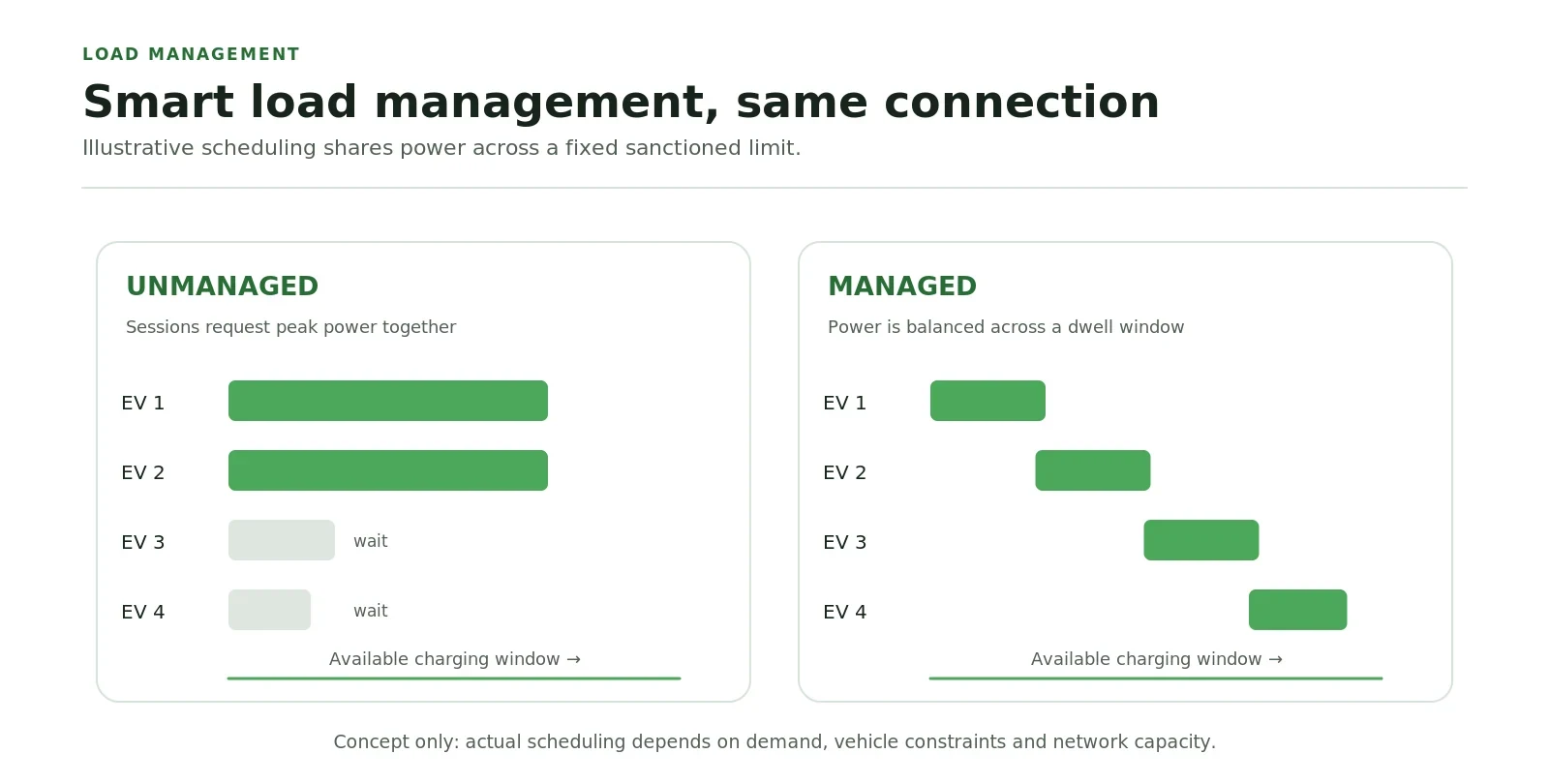
That assumption is almost always wrong, and it is expensive. Most chargers are idle most of the time, and a vehicle near a full battery tapers its draw well below the charger’s rating. Designing for a simultaneous worst case that rarely occurs means buying grid capacity that sits unused and paying demand charges on it every month.
Load management removes the assumption. The platform measures what is actually being drawn and allocates the available capacity between active sessions in real time, keeping the site’s total within its limit.
| Sanctioned load | Unmanaged 7.4 kW AC points | Energy available across a 10-hour window | Vehicles served if each needs 30 kWh |
|---|---|---|---|
| 50 kW | 6 | 500 kWh | About 16 |
| 100 kW | 13 | 1,000 kWh | About 33 |
| 150 kW | 20 | 1,500 kWh | About 50 |
The right-hand columns are the reason depot operators are so often over-sold hardware. A 50 kW connection supports six chargers if every one must be able to run flat out, but it delivers 500 kWh across an overnight window — enough for roughly sixteen vehicles needing 30 kWh each. The constraint is energy over the dwell time, not instantaneous power, which is why the duty cycle rather than the charger rating is the right starting point for sizing.
Static, Dynamic and Local
Three approaches are commonly described as load management and they are not equivalent. We go further into the underlying ideas in smart load management for EV charging.
- Static limiting caps each charger at a fixed output below its rating. Simple, requires nothing to be measured, and wasteful — a single car charging alone is still throttled.
- Local load management shares a fixed budget across the chargers at one site, giving each active session a share and reallocating as vehicles join and leave. One car alone gets full power; six cars share.
- Dynamic load management goes further by measuring the whole site’s consumption, including everything that is not charging, and gives the chargers whatever headroom is left. On a site where the building, lighting and cooling vary through the day, this is the only approach that uses the connection fully without ever exceeding it.
Dynamic is the right default for any site where the chargers share a supply with another load — which covers malls, offices, hotels, apartment blocks and most depots.
Demand Charges Are the Hidden Cost
Commercial electricity in India is billed on two components: the energy consumed, and a demand charge based on the maximum power drawn during the billing period. The second is the one that catches new operators out. A single fifteen-minute peak, on one day of the month, can set a demand charge that is then paid for the entire month.
Peak shaving targets exactly this. By holding the site’s maximum draw below a configured ceiling, load management keeps the billed demand down even when the site is busy. For a site with meaningful charging volume, this can be a larger saving than any tariff optimisation on the energy component — and it is invisible unless someone is managing for it.
Where the tariff also varies by time of day, scheduling shifts flexible charging into the cheaper hours. At a depot, where vehicles sit overnight and nobody is waiting, almost all charging is flexible.
Priority: Deciding Who Gets the Power
Once capacity is shared, something has to decide the allocation. Useful rules in practice include first-come-first-served as a neutral default; departure-time priority, where a vehicle leaving at six is served before one leaving at ten; state-of-charge priority, bringing every vehicle to a usable minimum before topping any to full; vehicle or user class, so operational vehicles outrank visitor parking; and paid priority on public sites, where a driver can buy a guaranteed rate.
For a fleet depot, departure-time priority is usually the right rule — what matters is that every vehicle is ready for its duty, not that any particular one charged quickly.
Grid Services and Demand Response
Beyond the site boundary, a managed charging estate is a flexible load, and flexible load has value to the grid. Under demand-response programmes an operator can agree to reduce consumption during constrained periods in exchange for a payment or a tariff benefit. Automated demand response, carried over OpenADR, is how that signal reaches the charging platform and is translated into reduced charging rates without anyone intervening manually.
This is at an early stage in India, but it is the direction of travel, and the prerequisite is the same control layer that delivers the site-level savings today. Building for managed charging now is what makes participation possible later. Our guides on OpenADR in EV charging and automated demand response in India cover this in more depth.
What It Needs to Work
Load management requires chargers that accept remote power-limit commands over OCPP, which our guide to implementing OCPP covers in practical terms, metering at the site boundary for dynamic control, and a platform that can act on both in real time. All three are straightforward to specify at the design stage and awkward to retrofit, which is the argument for settling the control strategy during site planning rather than after commissioning.

