Streamlined EV Charging Payments for a Hassle-Free Experience
At ElectreeFi, we understand the importance of providing seamless and versatile payment options for electric vehicle (EV) charging. Our comprehensive EV Charging Station Payment Solutions offer a range of convenient and secure methods for EV owners to pay for charging services, ensuring a smooth and user-friendly experience every time they charge their vehicles.
How it Works:
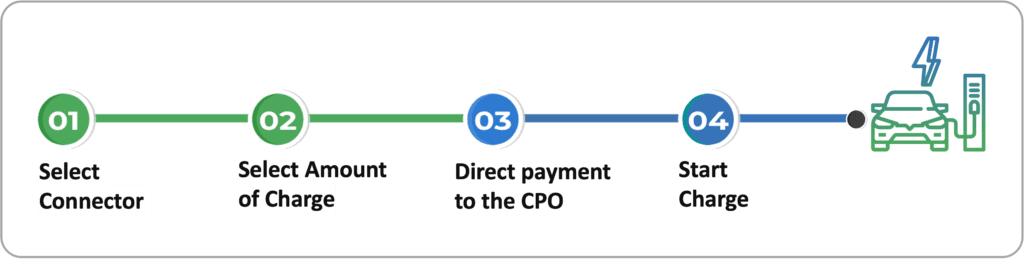
Select Connector
Select Amount of Charge
Direct Payment to CPO
Start Charge
Our Payment Solutions:
With ElectreeFi’s EV Charging Station Payment Solutions, you can take advantage of diverse and secure payment methods that cater to your preferences. Experience a new level of convenience and efficiency in EV charging while on the road with ElectreeFi!
Pay Using BHIM/UPI:
Pay Using Credit/Debit Card:
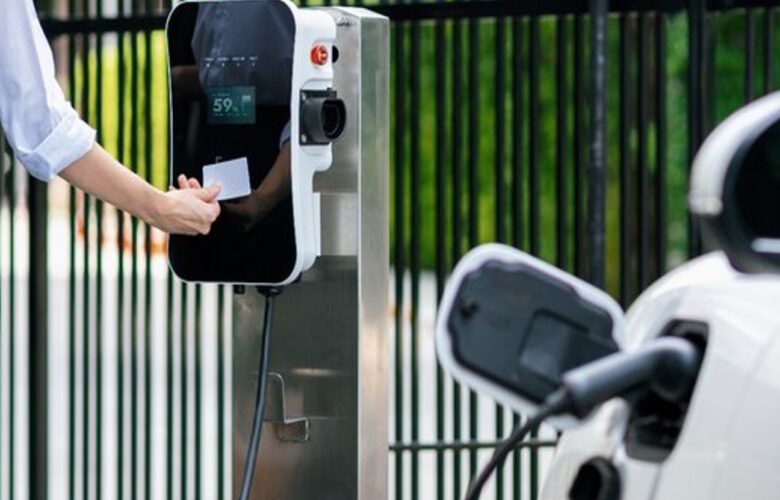
Tap and Pay:
Generate QR to Pay:
Where the Money Actually Goes
Choosing payment methods is the easy part. The question that decides whether a charging business works is what happens to a rupee between the driver tapping pay and it landing in the operator’s account — and how much of it survives the journey.
A charging session settles in four steps. The driver authorises payment at the charger or in the app. The payment gateway captures the funds and deducts its fee. The remainder settles to the Charge Point Operator’s account on the gateway’s settlement cycle, typically T+1 or T+2. The platform then reconciles each settled amount against the session record — energy delivered, duration, tariff applied — so that revenue reported and revenue received agree.
That last step is the one operators underestimate. Without automated reconciliation, a network of any size accumulates sessions that completed but never settled, and settlements that arrived with no matching session. Both are money, and both are invisible until someone reconciles by hand.
What Each Payment Method Costs You
Methods differ in more than convenience. The commercial characteristics are what should drive which you enable.
| Method | Driver experience | Operator consideration |
|---|---|---|
| BHIM / UPI | Scan or app, no card needed | The lowest-cost route in India and the dominant method by volume. Depends on the driver having mobile data at the site. |
| Credit / debit card | Familiar, works without an app | Carries a merchant discount rate, so the per-session cost is higher than UPI. Useful for visitors and corporate cards. |
| Tap and pay | Fastest at the charger | Needs a contactless reader on or beside the unit. Strongest where dwell time is short. |
| QR to pay | Works from any payment app | No extra hardware. The practical fallback when a reader fails, which is why it is worth enabling even on sites that lead with tap. |
| In-app wallet | One tap for repeat users | Pre-funded, so the transaction cost is incurred once on top-up rather than per session. Best economics for regulars and fleets. |
| RFID / fleet card | Tap a card, no phone | Billed to an account rather than per session. Standard for fleet depots and corporate users. |
The practical rule is to enable UPI and QR everywhere because they cost least and need least hardware, add cards and tap at sites with transient or premium traffic, and move regular users onto a wallet or account because that is where the per-session cost disappears.
Failed Sessions, Refunds and Part-Charges
Payment integration is judged on what happens when something goes wrong, not when it works. Four cases need an agreed answer before you go live:
- Payment taken, charging never started. The session must be voided and the amount refunded automatically rather than waiting for the driver to notice and complain.
- Charging interrupted part-way. If the driver pre-paid for a fixed amount, the unused balance has to be returned. Settling on metered energy delivered rather than the amount authorised is the cleaner model where the tariff allows it.
- Charger offline mid-session. Transactions are queued locally on the charger and synced to the platform once connectivity restores, so the session record is not lost and the driver is billed for what was actually delivered.
- Duplicate authorisation. A retry after a timeout can capture twice. Idempotent handling at the platform is what prevents that reaching the driver’s statement.
Tariffs: More Than a Price Per Unit
Indian charging tariffs are rarely a single number, and the payment layer has to carry whatever structure the site uses. In practice that means supporting energy-based pricing in rupees per kWh, time-based pricing per minute, a fixed session fee, or a combination; time-of-day rates that follow the operator’s own electricity cost; idle or overstay fees that free the bay once charging completes; and differential pricing by user group, so fleet and corporate accounts can be billed differently from walk-up drivers at the same charger.
Where state regulation sets or caps tariffs, those rules are applied at the platform rather than configured charger by charger, which is what keeps a multi-state network compliant without manual intervention at every site.
Reconciliation and Reporting
For an operator with more than a handful of chargers, the reporting that matters is the kind an accountant will accept: settled amounts matched to sessions, gateway fees separated from gross revenue, refunds and chargebacks tracked to their original session, revenue split by site and by charger, and tax treatment handled consistently across the network. The management platform holds the session and tariff data, so reconciliation runs against the system of record rather than against an export someone assembled by hand.
For the practical mechanics of putting payments live at a site, see our guide on implementing EV charging payment solutions.
Experience Seamless and Secure Payments for Your EV Charging Needs.

Frequently Asked Questions
ElectreeFi’s EV charging payment solutions accept BHIM/UPI, credit and debit cards, tap and pay, and QR code payments.
Yes. BHIM/UPI is one of the most popular payment options built into ElectreeFi’s charging stations for quick, secure transactions.
Drivers simply tap their card on the POS device to pay instantly, then start charging without entering any additional details.
Yes. The station generates a QR code that you scan with your preferred mobile payment app to complete the transaction.
All payments route directly to the Charging Point Operator through encrypted channels. Contact ElectreeFi to add secure payment solutions to your stations.