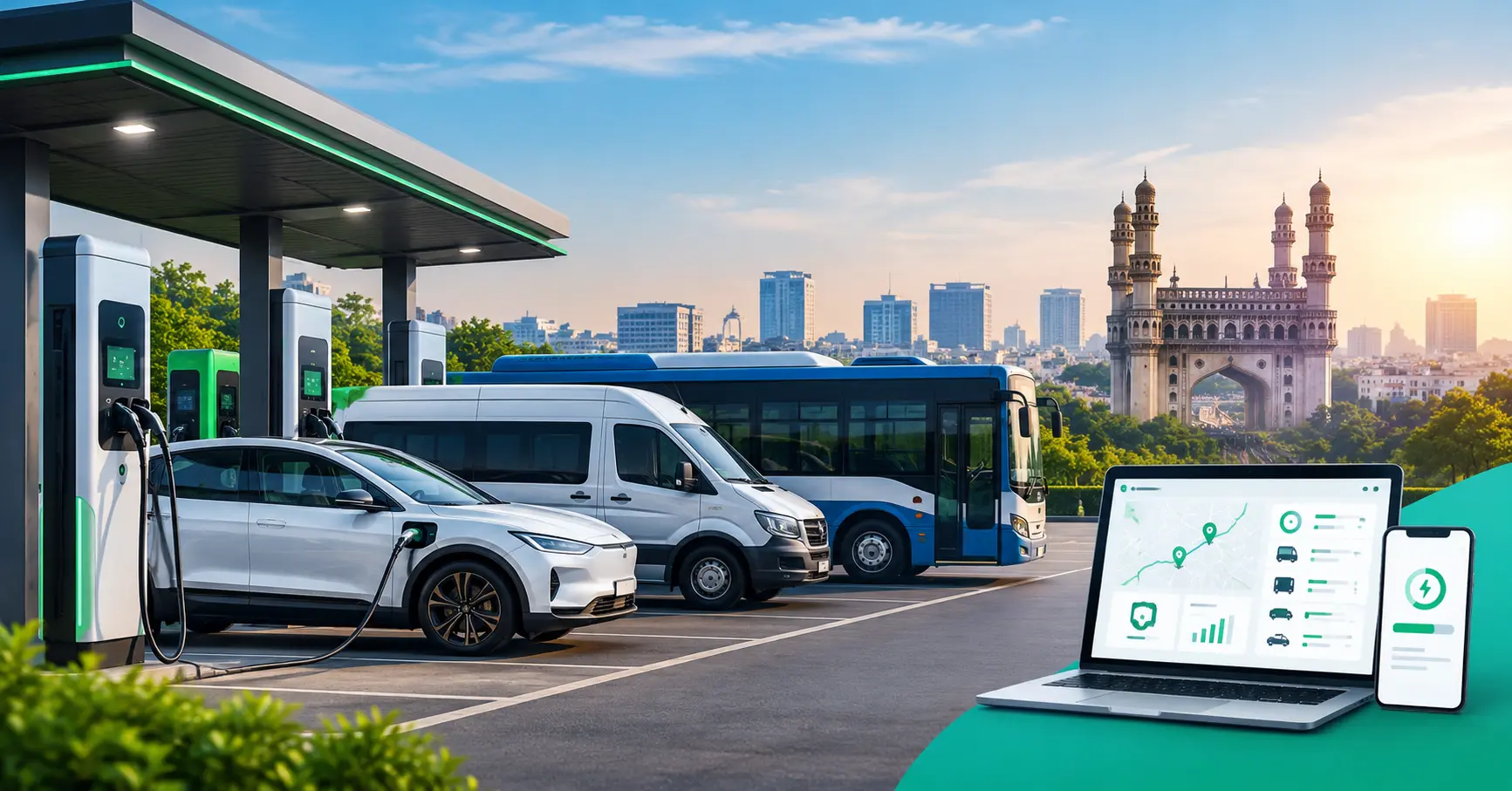
Hyderabad’s roads now carry more electric cabs, delivery scooters and city buses every month. Fleet owners want chargers that work on time, every time, and they will pay for that certainty. The demand for fleet EV charging infrastructure Hyderabad operators can trust now runs ahead of supply in many busy zones. That gap gives charge point operators a strong reason to act early and build smart.
This guide explains what fleets need, where the city’s opportunity lies, and how CPOs can plan, run and grow profitable fleet charging hubs.
Why Hyderabad Makes Sense for Fleet Charging
Telangana backs electric mobility with real policy muscle. The state’s Electric Vehicle and Energy Storage Policy plans fast charging stations in Hyderabad and other towns through both state bodies and private players. The state power regulator also offers a special tariff category for EV charging stations, which lowers your energy bill.
Growth targets look even bigger. The government aims to set up 6,000 public charging stations across Telangana by 2030. On top of that, Telangana waives road tax and registration fees for battery EVs registered until 31 December 2026, and the state removed the earlier cap on eligible vehicles. Cheaper vehicles mean faster fleet conversion, and every new fleet EV needs a reliable charging slot.
Public transport adds more momentum. TGSRTC already runs electric buses from depots such as Hayathnagar, Miyapur and Kukatpally, and it now builds new charging stations at its Ibrahimpatnam and Midhani depots. Add the ride hailing cabs in HITEC City, quick commerce riders in Kondapur, and logistics vans along the Outer Ring Road, and you get a city that needs depot charging at scale.
What Fleet EV Charging Infrastructure Really Includes
Many new CPOs think of a fleet hub as a parking lot with a few chargers. In practice, fleet EV charging infrastructure covers five connected layers, and each one affects your uptime and margins.
Charging hardware. Fleets usually need a mix. DC fast chargers handle quick turnarounds between shifts, while AC chargers top up vehicles that park overnight. Two wheeler and three wheeler fleets often need their own connector types too.
Power supply. You need a dedicated connection from the local DISCOM, the right transformer capacity, and room to add load later. Smart operators plan for double their launch capacity from day one.
Management software. An OCPP compliant platform connects every charger, tracks every session and flags faults before drivers notice them.
Payments and access. Fleet drivers need simple authentication through RFID cards, apps or fleet accounts, with clean monthly billing for the fleet owner.
Operations and maintenance. Preventive checks, quick repairs and a live support line keep the hub running through peak hours.
Planning Fleet EV Charging Infrastructure Hyderabad CPOs Can Scale
Good planning starts with the vehicles, not the chargers. Study each fleet’s duty cycle first. Ask how many kilometres each vehicle covers per shift, when drivers take breaks, and how long vehicles sit idle at night. These numbers tell you exactly how many chargers you need and what power rating each one should carry.
Next, pick the location with care. Fleet hubs work best near demand clusters, such as the IT corridor around Gachibowli, the airport belt near Shamshabad, and warehouse zones along the ORR. Drivers lose money on every empty kilometre, so a hub within a short drive of their routes wins loyalty fast.
Then, size your power and load. Many CPOs overspend on grid capacity because they assume every charger runs at full power together. Smart load management spreads available power across vehicles based on their state of charge and departure time. You serve more vehicles on the same connection and keep demand charges under control.
Finally, sign clear service agreements with fleet clients. Define guaranteed charging slots, uptime targets and pricing tiers. Long term contracts give you predictable revenue and make it easier to raise funds for your next site.
The Software Layer That Keeps Fleets Moving
Hardware gets the vehicle charged, but software decides whether your business makes money. Without the right platform, even well built fleet EV charging infrastructure loses money through idle chargers and missed faults. Fleet hubs often run chargers from several brands, so you need a platform that speaks open standards. Our OCPP guide for CPOs explains why vendor freedom matters so much.
A strong platform gives you live dashboards for charger status, session data and revenue per point. It sends instant alerts when a connector fails, so your field team fixes problems before a shift starts. It also links charging data with vehicle data. Our EV fleet management solution tracks vehicle location, driver schedules and journey insights, which helps fleet managers plan charging around real routes.
Roaming adds another revenue stream. When your hub joins a wider network through OCPI, outside EV drivers can find and pay at your chargers during idle hours. That simple step lifts utilisation without any new hardware.
How to Cut Costs and Raise Utilisation
Energy usually forms the largest running cost of any fleet hub. Schedule heavy charging for off peak hours whenever duty cycles allow, and let the software throttle power during peak tariff windows. Our smart charging with load management service handles this automatically.
Maintenance comes next. A charger that fails at 6 AM can strand twenty vehicles before the first trip. Preventive and predictive maintenance catches worn cables, loose connectors and firmware issues early. A professional EV charging station O&M contract keeps uptime high without forcing you to build a large in house team. For more savings ideas, read our guide on how to reduce EV charging station operating costs.
Utilisation decides your payback period. Mix fleet contracts during the day with public or roaming users at night, and you keep chargers busy around the clock.
Common Mistakes CPOs Should Avoid
New operators often repeat the same errors. Some buy chargers before they study fleet routes, and then they end up with the wrong power ratings. Others lock themselves into closed software that only works with one hardware brand.
Many CPOs also ignore future load. Fleets grow quickly once they see results, and a site without spare capacity forces costly upgrades within a year. Lastly, some operators skip support planning. Fleet drivers work odd hours, so your helpline must run 24 hours a day, every day of the year.
Build Smarter Fleet Hubs With a Proven Partner
Fleet EV charging infrastructure rewards operators who plan with data, choose open technology and treat uptime as their top promise. Hyderabad offers the policy support, vehicle growth and demand clusters you need to build a strong network.
ElectreeFi brings over seven years of EV ecosystem experience, more than 70,000 charging points across India, and integration with 48 charger OEMs. Our team supports site selection, charger supply, installation, software and round the clock maintenance through a single partnership. Explore our EV fleet hub solution to see how we design depots for high turnover fleets.
Ready to launch or expand your fleet EV charging infrastructure Hyderabad network? Contact our team today for a free site consultation and a detailed ROI plan built around your fleet clients.
Frequently Asked Question
How much does it cost to set up a fleet EV charging hub in Hyderabad?
The cost depends on charger type, number of points, transformer needs and civil work. DC fast chargers cost far more than AC units. A detailed site survey gives you an accurate budget and payback estimate.
Do I need a license to open an EV charging station in Telangana?
No. Central guidelines let anyone set up a charging station without a separate license. You still need a power connection from the local DISCOM and must meet safety standards.
Does Telangana offer incentives for EV charging stations?
Yes. The state regulator offers a special power tariff for EV charging stations. Telangana also waives road tax and registration fees for EVs until December 2026, which speeds up fleet adoption.
Which chargers work best for an EV fleet depot?
Most depots use a mix. DC fast chargers handle quick turnarounds between shifts, while AC chargers serve vehicles that park overnight. Fleet duty cycles decide the right ratio.
Why should CPOs use OCPP compliant software for fleet charging?
OCPP lets you manage chargers from different brands on one platform. You avoid vendor lock in, monitor every session live and switch suppliers as you grow.