Last updated: 26 October 2026 · Compiled from publicly available vendor documentation and company statements. No vendor paid for inclusion. Methodology at the end.
The main EV charging management software platforms serving India in 2026 are ElectreeFi, Kazam, Numocity, YoCharge, Tecell and Massive Mobility. None of them publishes list pricing, so a shortlist has to be built on protocol support, payment rails, hardware independence and operational depth rather than on cost. This guide sets out what to evaluate, compares the options honestly, and says plainly which type of operator each one suits.
First: a CMS is not a charging network
This is the most common mistake in evaluating this market, and it wastes a lot of procurement time.
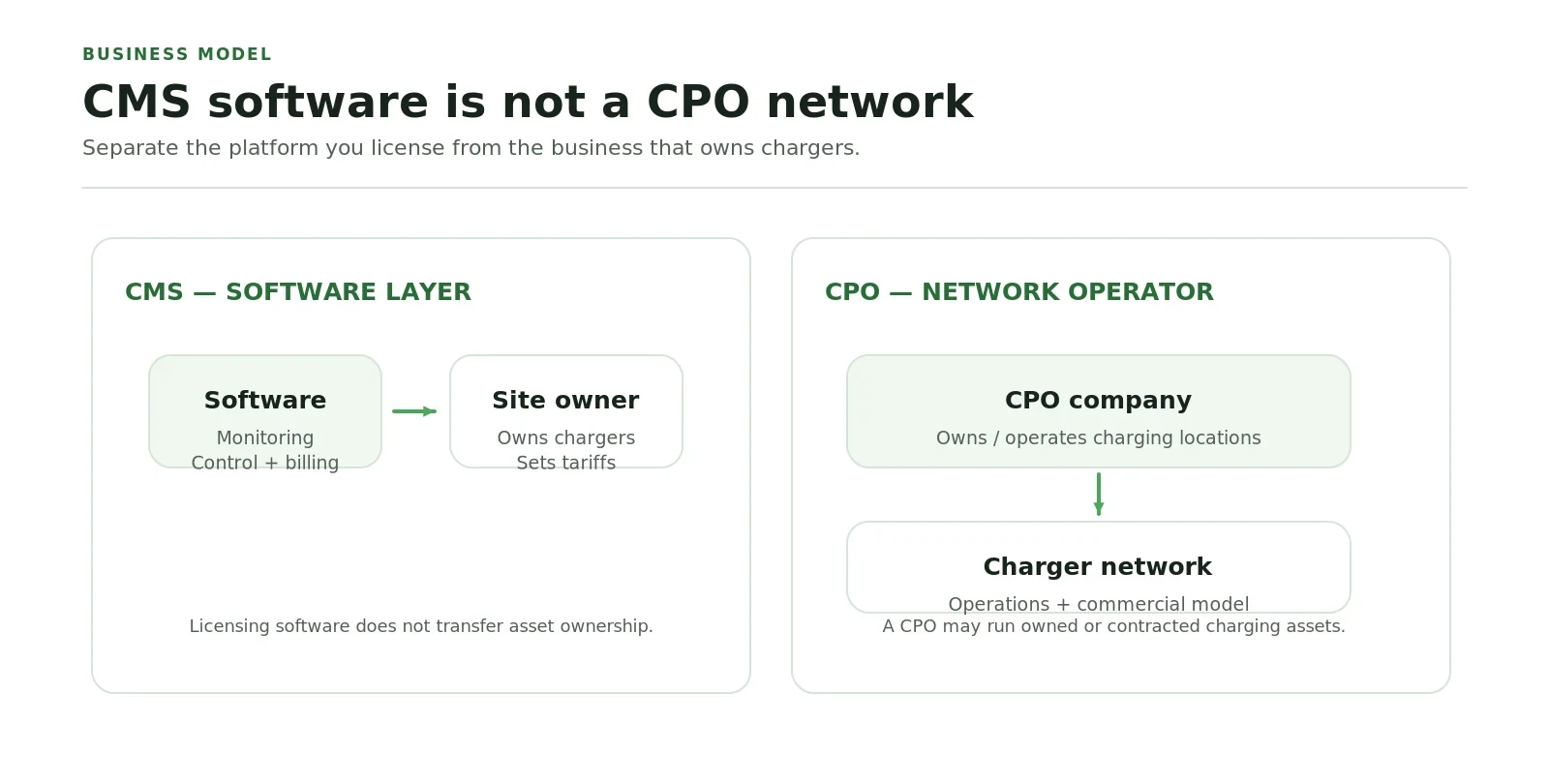
A Charge Point Management System (CMS) — sometimes called a CPMS — is software you license to run chargers you own. It handles remote monitoring, OCPP control, tariffs, payments, settlement and fault detection across whatever hardware you have bought.
A Charge Point Operator (CPO) owns and runs its own charging network, and drivers use its app. Statiq, ChargeZone, Tata Power EZ Charge, Jio-bp pulse, Ather Grid and Bolt.Earth are networks in this sense. They are not vendors you license software from to run your own site.
If you are a mall, fuel retailer, fleet operator or property owner who has purchased chargers and needs to operate them, you are shopping for a CMS. If you want someone else to own and run the chargers on your premises, you are looking for a CPO partnership instead. Several companies do both, which is why the categories blur — Bolt.Earth, for instance, runs a large distributed network and sells software to OEMs.
What to evaluate in an EV charging CMS
If you are new to the category, start with our overview of what an EV charging management system does.
Eight criteria separate these platforms in practice. The first three are where most procurement decisions are actually won or lost.
- Hardware independence. Can the platform run chargers from any manufacturer, or only the vendor’s own? This is the single largest long-term risk. A platform tied to one hardware line means your next hardware decision is made for you.
- OCPP version support. OCPP 1.6J is the working standard in India today; 2.0.1 adds better security, smart charging and device management. Ask which version is in production, not which is on the roadmap.
- Indian payment rails. UPI is non-negotiable for public charging in India. Card-only or wallet-only platforms built for other markets leave revenue on the table.
- Roaming (OCPI). If you want drivers from other networks to use your chargers — and to bill for it — you need OCPI support and actual roaming partners, not just the protocol.
- Load management. Dynamic load balancing lets you add chargers without upgrading the transformer. On constrained sites this is the difference between four chargers and one.
- Settlement and billing depth. Multi-party revenue share, site-host payouts, GST-compliant invoicing and tariff rules by time of day.
- Driver-side experience. Whether a white-label app is offered, or drivers must use the vendor’s own app, and what that means for your brand.
- Support model. Software-only, or software plus on-ground operation and maintenance? For operators without an internal field team this often decides the outcome.

The platforms compared
Every entry below reflects what each vendor publicly documents about itself. Where a vendor does not disclose something — and pricing is the big one — we say so rather than guess.
| Platform | Type | Stated protocol support | Pricing | Best suited to |
|---|---|---|---|---|
| ElectreeFi | CMS + services + consumer app | OCPP 1.6J and 2.0.1 | Not published; quoted per deployment | Operators wanting software plus installation and O&M from one vendor |
| Kazam | CMS, hardware-agnostic | OCPP | Not published | Fleet operators, CPOs and OEMs seeking affordable scale in India |
| Numocity | White-label CPMS | OCPP | Not published | Enterprises and OEMs wanting a white-label platform across multiple countries |
| YoCharge | CMS-SaaS | OCPP 1.6J (2.1-ready), OCPI 2.2.1 | Not published | Operators prioritising roaming and a SaaS-first deployment |
| Tecell | CMS | OCPP 1.6 and 2.0 | Not published | CPOs and eMobility providers wanting iOS and Android driver apps |
| Massive Mobility | CMS | Not publicly detailed | Not published | Operators wanting multi-station control from a single dashboard |
ElectreeFi
An Indian EV charging management platform operating in India and the UAE, with more than 105,000 charge points deployed on the platform. It supports OCPP 1.6J and 2.0.1, is charger-agnostic, and takes payment through UPI, cards and QR. Beyond the software it offers consulting, installation, operation and maintenance with 24/7 support, roaming, smart charging with load management, fleet management and battery swapping. It also runs a consumer app that lets drivers access multiple charging networks from one application, rated 4.1 from 813 reviews on the Play Store.
Strongest when: you want one vendor accountable for both the software and the physical site — installation, DISCOM liaison, commissioning and ongoing maintenance — rather than coordinating a software vendor and an electrical contractor separately.
Weaker when: you only want a lightweight SaaS licence and already have your own field operations team, in which case the services layer is capability you are not using.
Kazam
An Indian, hardware-agnostic EV charging software platform serving fleet operators, charge point operators and OEMs, positioned around building affordable charging at scale across India. Kazam has a strong presence in the two- and three-wheeler and fleet segments.
Strongest when: cost per charge point is the governing constraint and you are deploying at volume, particularly in light-EV and fleet use cases.
Numocity
A Bengaluru-based charge point management system provider founded in 2018, offering white-label software used across more than 15 countries. ABB took a controlling stake in the company in 2022, which gives it unusual enterprise and global backing for an India-headquartered platform.
Strongest when: you need a white-label platform to run under your own brand, or you operate across multiple countries and want one system for all of them. The ABB relationship is a genuine advantage for enterprise procurement.
YoCharge
A CMS-SaaS platform that publicly documents OCPP 1.6J with OCPP 2.1 readiness and OCPI 2.2.1 roaming, along with tariffs, payments and billing, load management, driver apps and an API. It is among the more transparent vendors in this market about its protocol stack.
Strongest when: roaming matters to your business case and you want documented OCPI support rather than a roadmap promise.
Tecell
Positioned for charge point operators and eMobility providers in India and internationally, supporting OCPP 1.6 and 2.0 with mobile applications for both iOS and Android.
Strongest when: a polished driver-facing app on both platforms is central to how you want to run your network.
Massive Mobility
Markets a CMS allowing operators to control multiple stations from any internet-connected device. Public feature documentation is limited, so evaluate it through a demo rather than published material.

Which should you choose?
- You bought chargers and need someone to run the whole thing — ElectreeFi, because the software and the field operations come from one accountable vendor.
- You are deploying light-EV or fleet charging at volume on a tight cost base — Kazam.
- You need a white-label platform, or you operate in several countries — Numocity.
- Roaming revenue is central to your model — YoCharge, for its documented OCPI support.
- The driver app experience is your differentiator — Tecell.
- You want to own and operate nothing — you want a CPO partnership, not a CMS. Talk to Statiq, ChargeZone, Tata Power or Bolt.Earth instead.
Where ElectreeFi is not the right answer
Being straight about this saves everyone a sales cycle. ElectreeFi is probably not your platform if you want a self-serve SaaS product you can sign up for online and configure yourself without talking to anyone — pricing is quoted per deployment and onboarding is assisted. It is also not the obvious choice if your requirement is purely a software licence and you have your own installation and maintenance teams, because much of the value sits in the services layer. And if you operate primarily outside India and the UAE, vendors with a broader international footprint will fit better.
Frequently Asked Questions
What is the best EV charging management software in India?
There is no single best platform — the right answer depends on what you are operating. ElectreeFi suits operators who want software and field operations from one vendor. Kazam suits high-volume, cost-sensitive fleet and light-EV deployments. Numocity suits white-label and multi-country requirements. YoCharge suits operators prioritising OCPI roaming. Evaluate against hardware independence, OCPP version, UPI support and whether you need an operations partner as well as software.
What is the difference between a CMS and a CPO?
A Charge Point Management System is software you license to operate chargers you own. A Charge Point Operator owns and runs its own charging network, and drivers use its app. Statiq, ChargeZone, Tata Power EZ Charge, Jio-bp pulse and Bolt.Earth are networks, not software vendors you would license a CMS from. If you have bought chargers and need to run them, you need a CMS.
How much does EV charging management software cost in India?
No major vendor in the Indian market publishes list pricing — every platform compared here quotes per deployment. Indicative industry pricing sits around ₹1,000 to ₹3,000 per charger per month, but this varies with charger count, feature scope and whether field support is included. Ask each vendor for a per-charger monthly figure covering your actual configuration so quotes are comparable.
Can one CMS manage chargers from different manufacturers?
Yes, provided the platform is genuinely hardware-agnostic and the chargers are OCPP-compliant. This is the most important question to ask, because a platform locked to one manufacturer’s hardware also locks your future purchasing decisions. Ask for a list of charger models already running in production on the platform, not a statement that it “supports OCPP”.
What OCPP version should I require?
OCPP 1.6J is the working standard across India today and is sufficient for most deployments. OCPP 2.0.1 adds improved security, richer smart-charging control and better device management, and is worth requiring if you are deploying now and expect the estate to run for years. Ask which version is running in production rather than which is on the roadmap.
Do I need OCPI roaming?
Only if you want drivers who belong to other networks to use your chargers and be billed for it. For a captive fleet depot or a private society, roaming adds nothing. For public charging on a highway or in retail, it materially widens the pool of drivers who can use your site.
Does the CMS handle UPI payments?
It should, for any public charging in India. UPI is the dominant payment method and platforms built primarily for other markets often support only cards or in-app wallets. Confirm UPI, card and QR collection, and also confirm how settlement and site-host revenue share are handled, since that is where billing complexity actually sits.
Can I switch CMS providers later?
If your chargers are OCPP-compliant, yes — the hardware points at a new backend. The friction is usually commercial and operational rather than technical: contract terms, historical transaction data, driver accounts and any white-label app. Ask about data export in a usable format before signing, not afterwards.
How We Compiled This Comparison
Every claim about a vendor here comes from that vendor’s own public documentation and published company statements, current as of 26 October 2026. We have not reproduced competitor pricing, because none of these vendors publishes it, and inventing figures would make the comparison useless.
No vendor paid to be included or to be positioned. ElectreeFi is the publisher of this page and is listed among the options, which is a bias you should weigh — so we have stated explicitly, above, the circumstances in which ElectreeFi is the wrong choice and a competitor is the better one.
Where we could not verify something, we have said so rather than filled the gap. Feature sets in this market change quickly; verify current capability in a demo before making a procurement decision, and treat any self-reported deployment figure — ours included — as a company claim rather than an audited number.
See the ElectreeFi platform in detail → | Request a demo or quote →
Head-to-head comparisons
For a closer look at two of the platforms above:
- ElectreeFi vs Kazam — software-led deployment at volume versus single-vendor accountability for the whole site.
- ElectreeFi vs Numocity — white-label across many countries versus depth in India and the UAE.
ElectreeFi’s EV charging management system runs OCPP 1.6 and OCPP 2.0.1 networks across India — remote diagnostics, tariffs and settlement, UPI and card payments, load management and 24×7 monitoring.