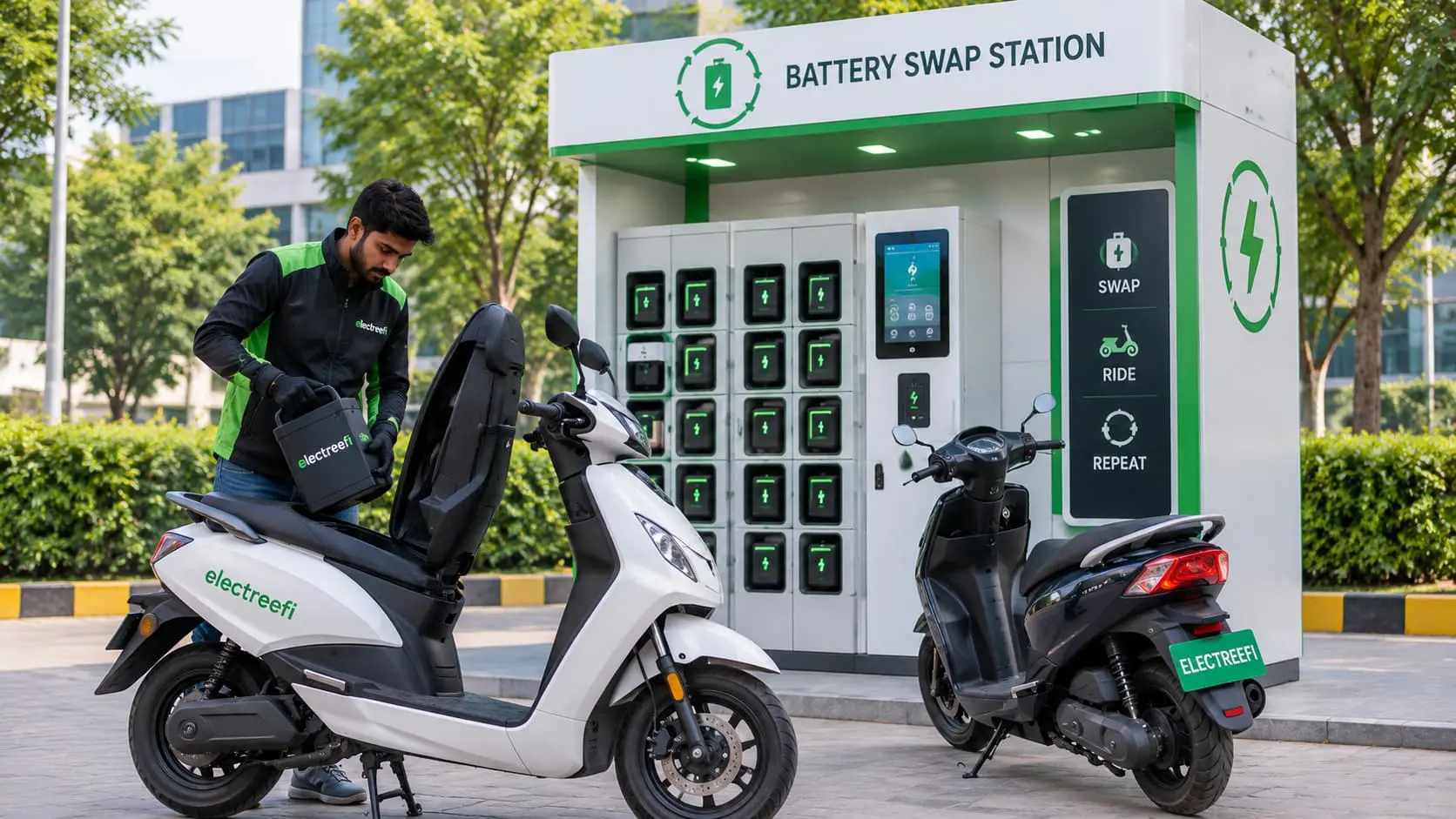
A delivery rider in Delhi ends a busy morning with 15% battery left. Plugging in means waiting an hour or more, and every idle minute costs orders. This is the everyday problem that battery swapping in India aims to solve. The rider drives into a station, hands over the empty pack, and rides out with a full one.
Swapping is gaining attention because two-wheelers and three-wheelers make up a large share of India’s EV fleet, and many work long shifts. The Ministry of Power also covered swapping stations in its January 2025 guidelines. This guide explains how swapping works, what it costs, and who should consider it.
What Is Battery Swapping?
Battery swapping is a way to power an EV by exchanging a discharged battery for a charged one at a station. The Ministry of Power’s January 2025 guidelines describe it as the quick replacement of a discharged battery. The station recharges the old pack while the next customer rides away on a fresh one.
Conventional charging works differently. The battery stays in the vehicle, and a charger refills it. Swapping moves the charging step into a shared station. That helps most when packs are small and easy to remove. IRENA notes that swapping is easiest with lightweight batteries, such as those in electric two- and three-wheelers.
Swapping often pairs with Battery as a Service (BaaS). Under BaaS, a provider owns the battery and rents it to the user.
How Does Battery Swapping Work?
A typical swap follows six steps:
- Arrival: The rider reaches a station, often after finding it in an app.
- Identification and compatibility check: The rider signs in through an app or RFID tag, and the system confirms that the pack fits the vehicle.
- Removal: The rider or an attendant takes out the discharged battery.
- Installation: A charged battery goes in.
- Health and safety checks: The system records charge level, temperature, cycle count, and faults for each pack.
- Payment and departure: The rider pays per swap or through a plan, then leaves. The visit usually takes a few minutes.
Meanwhile, the station recharges returned packs, ideally when power is cheaper.
Where Is Battery Swapping Used in India?
Most swapping in India today serves light vehicles. Gig delivery riders on electric two-wheelers use swap stations to stay on the road through long shifts. E-rickshaw and electric three-wheeler drivers do the same, since they earn only while they drive. Last-mile delivery and city logistics fleets fit too, because their routes repeat. Heavy vehicles are an early-stage area, though the Ministry of Power’s guidelines allow liquid-cooled swappable batteries for trucks and buses.
High utilisation matters because a vehicle that runs most of the day loses income during every charging stop. A private scooter that sits at home overnight has no such problem.
Battery Swapping Policy in India: What Is Official?
The NITI Aayog draft Battery Swapping Policy of April 2022 proposed interoperability rules, unique battery identification numbers, and BaaS support for light electric vehicles of category L, e-rickshaws, and e-carts. It stayed a draft, and official information shows no notified final policy.
The Ministry of Power’s guidelines of 10 January 2025 are the working framework. They cover swappable battery providers and the owners and operators of swapping and charging stations. They let stations use an existing electricity connection. They do not set swap tariffs or interoperability rules.
Funding support exists as well. Under PM E-DRIVE, the Ministry of Heavy Industries backs public swapping stations that follow the Ministry of Power guidelines. The support covers 80% of upstream infrastructure only.
How Much Does Battery Swapping Cost in India?
Battery swapping in India has no single national price. The cost depends on battery capacity, vehicle type, city, network, and business model. Industry reports put a swap for commercial two-wheelers and e-rickshaws at roughly ₹120 to ₹250, or about ₹1.2 to ₹1.7 per kilometre. Treat these as indicative ranges, not fixed tariffs, and confirm the current rate with your provider.
Costs fall into two separate groups.
What riders and fleet owners pay
- Per-swap charges: The fee for each exchange, usually covering energy and service.
- Subscription or leasing plans: A recurring fee for battery access, often under BaaS.
- Battery ownership: If you buy the pack, you carry its price and replacement risk. Under BaaS, you can buy the vehicle without the battery, which lowers the upfront cost.
What station operators spend
- Battery inventory: Usually the largest item. IRENA points out that swapping needs many more packs in circulation, which raises overall cost.
- Equipment and site work: Chargers, racks, wiring, grid connection, and fire safety.
- Software and operations: Management systems, staff, rent, maintenance, and battery replacement.
A fixed station cost would mislead, because it changes with the number of batteries, slots, site, and grid load. ElectreeFi quotes station costs per site rather than as a standard price. Also, a swap fee includes battery use and service, so do not compare it directly with a charging tariff.
Battery Swapping vs Traditional EV Charging
| Factor | Battery swapping | Traditional EV charging |
|---|---|---|
| Refuelling time | A few minutes | Minutes to hours |
| Infrastructure | Stations with battery stock and racks | Chargers at homes, depots, or public points |
| Battery ownership | Often operator-owned under BaaS | Usually the vehicle owner |
| Operating cost | Swap or plan fee that includes battery use | Electricity tariff, plus battery cost on the owner |
| Vehicle compatibility | Needs packs built for the system | Any vehicle with a matching connector |
| Fleet suitability | Long-shift fleets on busy routes | Depot fleets that park overnight |
| Convenience | Fast, but needs nearby stations | Flexible, but slower |
| Battery management | Central, by the operator | By the owner or manufacturer |
Swapping is not better in every case. A depot fleet that parks overnight can often charge at lower cost per unit of energy.
Who Needs Battery Swapping?
Delivery and logistics companies run long shifts on repeat routes, so short stops matter more than the lowest energy price. E-rickshaw operators earn by the trip, and a subscription plan avoids a large battery purchase. Electric two-wheeler fleets can keep vehicles moving across shifts. ElectreeFi’s guide on the electric vehicle battery swap system for fleet operators covers fleet needs in more detail.
Other commercial mobility operators with high daily kilometres and limited depot space can test swapping on one route first.
Conventional charging may suit you better if your vehicles return to a depot every night, if you charge a private vehicle at home, or if your vehicle has a fixed battery. Most electric cars in India use fixed batteries.
Benefits of Battery Swapping
Swapping offers several possible benefits, though results depend on the vehicle, the route, and the network.
- Less downtime: A swap takes minutes, while a charge can take hours.
- Better fleet utilisation: Vehicles spend more of the day earning.
- Flexible ownership: BaaS can lower the upfront price of the vehicle.
- Central battery management: One operator tracks health, charging, and replacement.
These gains are not automatic. A poorly placed station or thin battery stock can erase them.
Challenges of Battery Swapping in India
- Standardisation and interoperability: Packs from different makers rarely fit different vehicles, and the 2025 guidelines set no interoperability rules.
- Compatibility: A vehicle must match the pack’s size, voltage, and connector.
- Safety and battery health: Stations charge many lithium-ion packs, so operators must track each pack and manage fire risk.
- Investment and availability: A station needs a large battery stock, which ties up capital.
- Business model and network: Stations need steady swap volumes, and riders cannot swap where no station exists.
What Should Businesses Consider Before Adopting Battery Swapping?
Fleet owners should ask four questions. Do your vehicles support swappable packs? Do they run long enough each day to justify swapping? Do stations sit along your actual routes? What will you pay per kilometre, compared with depot charging?
Station operators should also plan the location, grid load, and fire safety first. Choose battery management software that connects with your payment and fleet tools, and test long-term viability before you scale. ElectreeFi’s article on battery swapping station setup services explains the planning steps for two-wheeler fleets.
How EV Management Software Supports Battery Swapping Operations
A swapping network runs on data. Software shows how many charged packs each station holds, which packs show poor health, and when a station may run short. It also records transactions, manages riders and fleet accounts, and tracks station performance.
ElectreeFi’s battery swapping platform is a cloud-based system for station operators and battery makers. Its page lists reservations and swap history, battery status, subscriptions, inventory, station management, and battery logistics. It is battery-agnostic and shares a management layer with ElectreeFi’s EV charging products.
Conclusion
Battery swapping in India works best for vehicles that cannot afford to wait. Delivery riders, e-rickshaw drivers, and busy city fleets gain the most, while overnight depot fleets may do better with charging. Costs vary widely, so compare cost per kilometre, station coverage, and contract terms before you commit.
If you plan to run swapping stations or manage a mixed fleet, contact the ElectreeFi team to discuss your EV infrastructure and software requirements.
Frequently Asked Questions
What is battery swapping in India?
Battery swapping is a way to power an EV by exchanging a discharged battery for a charged one at a station. In India, it mainly serves electric two-wheelers, three-wheelers, and e-rickshaws. The Ministry of Power recognised swapping and Battery as a Service in its January 2025 guidelines.
How does an EV battery swapping station work?
The rider verifies the vehicle and battery, removes the empty pack, and fits a charged one. The station logs battery health data, takes payment, and recharges the returned pack for the next user. A swap usually takes a few minutes.
How much does battery swapping cost in India?
India has no single national swap price. Industry reports put a swap for commercial two-wheelers and e-rickshaws at roughly ₹120 to ₹250, depending on city, battery size, and network. Check the current rate with your swap provider.
Is battery swapping cheaper than EV charging?
Not always. Charging at home or at a depot often costs less per unit of energy, but a swap fee includes the battery and the service. Swapping makes sense when the income from saved downtime outweighs the extra cost.
Which electric vehicles support battery swapping?
In India, swapping mainly supports electric two-wheelers, three-wheelers, and e-rickshaws built with swappable packs. Compatibility depends on the vehicle model, pack design, and network. Most electric cars in India use fixed batteries.
Who should use battery swapping services?
Delivery riders, e-rickshaw drivers, logistics fleets, and ride operators that run vehicles for long hours gain the most. They lose income whenever a vehicle waits for a charge. Private owners who park overnight can often charge at home instead.
What are the disadvantages of battery swapping?
Swapping needs compatible batteries, enough stations on your route, and a large battery stock, which raises costs. Standards and interoperability are still developing, and operators must track every pack for safety. Relying on one network can also limit your choices.
Is battery swapping a good option for commercial EV fleets?
It can be, if your vehicles run long hours on routes with station coverage. Compare cost per kilometre, uptime, and contract terms against depot charging. A short pilot on one route helps test the numbers before you scale.
