Empowering eMobility with Cutting-Edge Battery Swapping Solution
Introducing an advanced Battery Swapping cum Monitoring Solution, meticulously engineered to operate on a robust cloud-based service and operations platform. This comprehensive solution is tailored to meet the diverse needs of Battery Charging Station Operators, Battery Swapping Outlet Operators, EV Owners, Utilities, and Battery OEMs.
With the global electric vehicle market projected to grow from 10 million vehicles in 2020 to nearly 145 million by 2030, the demand for efficient and scalable battery swapping solutions is more critical than ever. (Source :Licarco)
Our solution ensures seamless integration and real-time monitoring, enabling stakeholders to optimize performance, enhance operational efficiency, and contribute to a more sustainable energy ecosystem. Whether you’re managing a single outlet or an entire network of stations, our platform provides the tools you need to streamline operations, reduce downtime, and deliver exceptional service to your customers.
Key Features of Our Battery Swapping Solution:
Reservation & Swapping History
View Battery Status
Subscriptions
Inventory Management
Swapping Station Management
Logistics Management
Benefits of Battery Swapping Solutions for Electric Vehicles
ElectreeFi’s innovative battery swapping solutions for electric vehicles are designed to revolutionize the way you manage energy. By minimizing downtime and ensuring seamless operations, our technology enhances the sustainability and efficiency of your EV fleet.
Our solutions are quick, reliable, and scalable, offering you the flexibility to meet your energy needs while contributing to a greener future. With ElectreeFi, you can trust that your EVs will be powered up and ready to go, whenever and wherever you need them.
Why Battery Swapping Works in India
Battery swapping replaces a depleted battery with a charged one in two to three minutes, instead of holding a vehicle at a charge point for an hour or more. For privately owned cars that is a convenience. For commercial two- and three-wheeler fleets it is the difference between a vehicle that earns and a vehicle that waits.
The structural case is specific to India. Two-wheelers account for roughly 70–80% of all private vehicles here, and three-wheelers carry a disproportionate share of last-mile freight and passenger transport. These are duty-cycle vehicles: a delivery rider or e-rickshaw driver loses income for every minute spent charging. Swapping converts a long downtime into a refuelling stop, and it removes the single largest cost from the vehicle purchase — the battery — when paired with a Battery-as-a-Service model.
Battery Swapping vs Charging
| Factor | Battery swapping | Plug-in charging |
|---|---|---|
| Turnaround | 2–3 minutes | 45 minutes to 8 hours |
| Upfront vehicle cost | Lower — battery can be leased, not bought | Higher — battery included in purchase |
| Battery health risk | Carried by the operator | Carried by the vehicle owner |
| Charging control | Centralised, off-peak, temperature controlled | Uncontrolled, often at peak hours |
| Grid load | Smoothed across the day | Peaky |
| Best suited to | 2W and 3W commercial fleets | Private cars, buses, depot charging |
| Main constraint | Needs standardised battery packs | Needs dwell time |
The two are complements, not rivals. Most fleet operators end up running swapping for their 2W and 3W duty cycles alongside managed charging for larger vehicles and overnight depot top-ups.
How a Swapping Station Operates
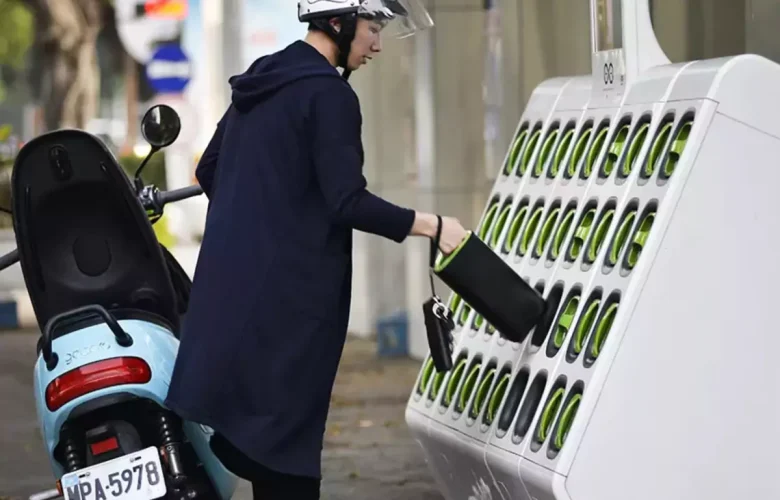
A station holds a rack of charged batteries, each monitored individually. A rider arrives, authenticates through an app or RFID, the system releases a charged pack matched to the vehicle, and the depleted pack goes back into the rack to charge under controlled current and temperature. Every event — state of charge, cycle count, temperature, fault history — is logged against the individual battery, not the vehicle.
That battery-level telemetry is what makes the model financially viable. Packs are an operator’s largest asset, and without per-pack history it is impossible to know which are degrading, which are being abused, or when to retire one before it fails in service.
What ElectreeFi Provides
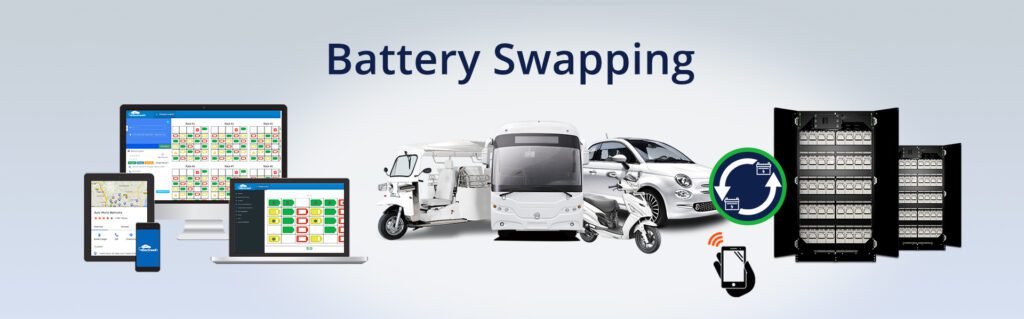
Our platform runs the commercial and operational layer of a swapping network: reservations and swap history, live battery status and state of charge, subscription and billing plans, inventory management across racks and stations, station-level performance monitoring, and logistics for moving packs between locations. Operators get network-wide visibility; riders get an app that shows where a charged pack is available before they ride there.
The platform is battery-agnostic and integrates with the same management layer used across our charging deployments, so operators running both swapping and charging see one network rather than two systems.
Setting Up a Swapping Station
A swap station needs less electrical capacity than a DC fast charger of equivalent throughput, because packs charge slowly and continuously rather than in bursts. The practical requirements are a secure covered footprint with space for the rack plus rider queueing, a commercial power connection sized to the rack, ventilation and fire safety provision, connectivity for telemetry, and a pack inventory sized to peak demand — typically more packs than vehicles served at peak.
Capital cost varies widely with rack size, pack chemistry and inventory depth, and is quoted per site rather than from a price list. The significant lever is public funding: under PM E-DRIVE, support extends to battery swapping stations at up to 80% of infrastructure cost depending on location, rising to 100% at government premises, calculated against the benchmark cost published by BEE or the Ministry of Power, or actual cost, whichever is lower.
Standards and Regulation in 2026
This is widely misreported, so it is worth being precise. The NITI Aayog Battery Swapping Policy released in April 2022 was a draft and was never notified as final policy. Pages still describing it as India’s battery swapping policy are out of date.
The operative framework today consists of:
- Ministry of Power guidelines for the establishment and operation of battery swapping and battery charging stations, which set technical, operational and safety requirements and formally recognise Battery-as-a-Service. Any entity may set up a swapping station provided these standards are met.
- AIS 156 and AIS 038 Rev 2 for battery testing and certification, with additional tests prescribed for swappable packs that undergo repeated coupling and decoupling.
- MoRTH’s allowance for registration of battery-less electric vehicles, which is what gives BaaS its legal footing — a vehicle can be sold and registered without the pack.
- Battery Waste Management Rules, 2022, administered by the CPCB under an Extended Producer Responsibility framework, placing collection, recycling and end-of-life obligations on operators and producers.
Station-side standards are still being developed by BIS, so operators should design to the MoP guidelines and keep specifications adaptable.
Read More on Battery Swapping
- Electric vehicle battery swap system: a simple guide for Indian fleet operators
- Why battery swapping station setup services matter for two-wheeler fleets
- The rise of the battery swapping network for Indian EV fleets
- How battery swapping is fast-tracking EV adoption
- EV battery swapping as an efficient charging solution
Enhanced Convenience
Improved Battery Performance
Optimized operations
Flexibility and Scalability
Contact us today to learn more about our solutions and how we can help you drive towards a cleaner, greener future with electric mobility
Frequently Asked Questions about Battery Swapping
Battery swapping is a process that allows electric vehicle (EV) owners to exchange their depleted batteries for fully charged ones at designated swapping stations. This method significantly reduces charging time, enabling quicker transitions for EV users.
Yes, battery swapping provides a convenient and efficient solution for electric vehicle (EV) users. It reduces downtime by allowing drivers to quickly exchange depleted batteries for fully charged ones, enhancing the overall EV experience.
- Time Efficiency: Battery swapping drastically reduces the time needed to recharge EVs, often taking just a few minutes.
- Extended Battery Lifespan: Centralized charging facilities can optimize battery health through controlled charging environments.
- Flexibility for EV Owners: With subscription models, users can access batteries without the need to own one, lowering the cost of entry for EV adoption.
While battery swapping offers many benefits, it may require significant infrastructure investment and standardization across manufacturers. Additionally, the technology might not be as widely available in all regions, limiting accessibility for some EV owners.
By enabling faster transitions to electric mobility and reducing reliance on slow charging, battery swapping promotes a greener energy ecosystem and accelerates the adoption of EVs.
The NITI Aayog Battery Swapping Policy published in April 2022 was a draft and was never notified as final policy. The operative framework is the Ministry of Power’s guidelines for the establishment and operation of battery swapping and battery charging stations, which set technical, operational and safety standards and formally recognise Battery-as-a-Service. Any entity may set up a swapping station provided those standards are met.
In practice, electric two-wheelers and three-wheelers. Their packs are small enough to be handled manually and their commercial duty cycles make downtime expensive. Swappable packs for these categories are tested to AIS 156 and AIS 038 Rev 2, with additional tests for the repeated coupling and decoupling that swapping involves.
Under PM E-DRIVE, support extends to battery swapping stations at up to 80% of infrastructure cost depending on location, rising to 100% at government premises. The subsidy is calculated against the benchmark cost published by BEE or the Ministry of Power, or actual cost, whichever is lower.
Swapping exchanges a depleted pack for a charged one in two to three minutes, while fast charging holds the vehicle for 45 minutes or more. Swapping also moves charging off the vehicle and into a controlled rack, which extends pack life and smooths grid load, and it allows the battery to be leased rather than bought, lowering the vehicle’s purchase price.
Usually the swapping operator, under a Battery-as-a-Service arrangement. This is legally possible because MoRTH permits the registration of battery-less electric vehicles, so a vehicle can be sold and registered without its pack. Operators carry the battery asset, the degradation risk and the end-of-life obligations under the Battery Waste Management Rules, 2022.