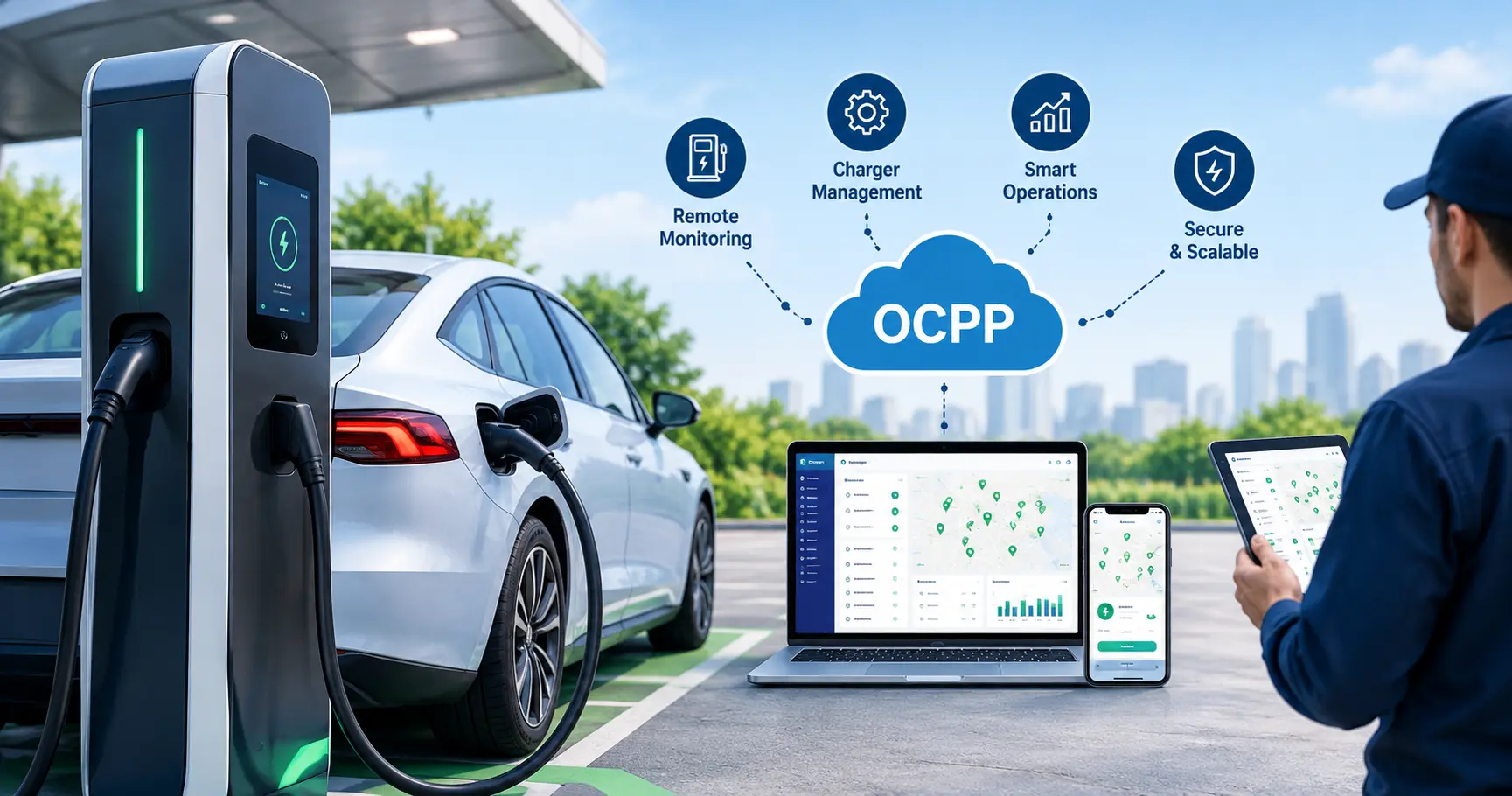
Running a charging network in India sounds simple until your chargers come from five different brands. Each brand ships its own software, its own app, and its own rules. Modern OCPP EV charging solutions fix this mess by giving every charger one common language. Your team then manages everything from a single screen, and your drivers get a smoother experience. This guide explains how that works and why every Charge Point Operator (CPO) should care.
What Is OCPP EV Charging?
OCPP stands for Open Charge Point Protocol. The Open Charge Alliance, a global industry group, maintains it. The protocol lets a charger talk to a central management system over the internet. Think of it as a shared language between hardware and software. A charger from any maker can report its status, start a session, and send billing data in the same format.
Without a common protocol, every charger brand needs its own backend. That locks you into one vendor. With OCPP EV charging, you pick chargers on price, power, and quality, and you manage them all together. The management software, which the industry calls a CSMS, sits at the center and controls the network.
OCPP 1.6 and 2.0.1: Which Version Fits Your Network?
Most chargers in India today run OCPP 1.6. It covers the core jobs: authorization, start and stop of sessions, status updates, firmware updates, and basic smart charging. It works well, and the market knows it well.
OCPP 2.0.1 goes further. It adds stronger security, better device management, and support for ISO 15118, the standard behind Plug and Charge. Drivers plug in, and the car authenticates itself without a card or app. The newer version also improves smart charging controls, which helps when you manage many chargers on one grid connection. Many new chargers now support both versions, so ask your vendor which one you get on day one.
How OCPP EV Charging Solutions Work
The flow is simple. A charger connects to the internet and opens a link with the central platform. It then sends messages, and the platform sends commands back. Here are the key messages you will see every day.
- Boot notification: the charger announces itself when it powers on.
- Heartbeat: the charger checks in so the platform knows it is alive.
- Authorize: the platform confirms whether a driver can charge.
- Start and stop transaction: the charger reports every session and its energy use.
- Meter values: the charger sends live power and energy readings.
- Remote commands: you reset a charger, unlock a connector, or change its charging limit from your desk.
Every message follows the same format, so the platform treats a charger from one brand exactly like a charger from another. Your operations team does not need to learn five tools. One login shows uptime, faults, energy, and revenue across every site.
Why CPOs Need OCPP EV Charging Solutions
You avoid vendor lock in. A closed system ties you to one charger maker. If that maker raises prices or stops support, your network suffers. Open standards give you the freedom to switch hardware without replacing your software. You negotiate from a position of strength.
You scale faster. A new site with a new charger brand should not mean a new project. With an open protocol, you plug the charger into your existing platform and go live. That speed matters when you race to claim good locations in Delhi NCR, Bengaluru, Pune, or Mumbai.
You raise uptime. Live alerts tell you the moment a charger fails. Your team fixes the fault before drivers complain, and every minute of downtime you save is revenue you keep. Remote resets solve many faults without a technician visit, which cuts your field costs.
You control energy costs. Smart charging lets you cap power per charger or per site. You protect your grid connection, avoid peak demand charges, and still serve every vehicle. Fleet hubs and apartment complexes benefit most, because many vehicles charge at the same hour.
You open new revenue through roaming. Drivers hate juggling apps. Roaming through OCPI connects your chargers to partner networks, so a driver from another network can use your station and pay through the app they already trust. More drivers means higher utilization on the same hardware.
You keep your billing clean. Every session record arrives in the same structure. Your finance team reconciles payments faster, your reports stay accurate, and your investors see numbers they trust.
OCPP in India: What CPOs Should Know
India keeps adding public chargers, and the market rewards operators who stay flexible. Indian guidelines for public charging stations encourage open and interoperable systems, and OCPP 1.6 or higher is the common reference. Many tenders and site partners now ask for it. OCPP EV charging also suits India’s mixed hardware market, where CPOs run chargers from Indian and global makers side by side.
India’s conditions add their own tests. Voltage swings, patchy mobile networks, and heat all affect chargers. OCPP chargers store session data when the network drops and send it once the connection returns, which protects your revenue records. Local support matters too, because a fault in Pune at 9 pm needs a fast answer.
What to Check Before You Choose a Platform
Not every platform treats the standard the same way. Use this checklist when you compare vendors.
- Version support: confirm OCPP 1.6 today and OCPP 2.0.1 on the roadmap.
- Charger coverage: ask how many charger brands the platform has already integrated.
- Smart charging: check for load management and dynamic power limits.
- Roaming: confirm OCPI support for partner networks.
- Payments: check that payment goes straight to you, not through a middleman.
- Monitoring: look for live dashboards, alerts, and custom reports.
- Support: ask about AMC contracts and 24/7 call support.
Electreefi, a charging management platform for Indian operators, shows what a mature setup looks like. Its cloud platform talks to chargers through OCPP, works with OCPI for roaming, and integrates with 48 charger makers across more than 70,000 charge points in India. Operators also get smart charging with load management, live dashboards, and round the clock support. The team backs this with more than seven years in the EV ecosystem, so you gain experience along with software.
Three Mistakes to Avoid When You Adopt OCPP
Many CPOs buy chargers first and think about software later. That order creates trouble. Check protocol support before you place the hardware order, not after.
Another mistake is trusting the label alone. A charger that claims OCPP support may still behave oddly with your platform. Run a pilot on one or two chargers, test every message, and only then roll out across sites.
The third mistake is ignoring security. Open protocols need strong setup. Use secure connections, unique credentials for each charger, and regular firmware updates.
Final Thoughts for CPOs
OCPP EV charging solutions give CPOs freedom, control, and growth. You pick the best hardware, manage every site from one place, and cut downtime and energy costs. You also prepare your network for roaming and future standards. Start with a clear checklist, run a small pilot, and choose a partner with proven Indian experience. Ready to move your network to OCPP EV charging? Talk to a specialist, share your site plan, and map your next 12 months today.
Frequently Asked Questions
What is OCPP in EV charging?
OCPP stands for Open Charge Point Protocol. It is an open standard that lets chargers and management software exchange data. Any compliant charger works with any compliant platform, which gives CPOs the freedom to mix brands.
What is the difference between OCPP 1.6 and 2.0.1?
Version 1.6 covers core charging functions and runs on most chargers today. Version 2.0.1 adds stronger security, better device management, and ISO 15118 support for Plug and Charge.
Is OCPP free to use?
Yes. The Open Charge Alliance publishes the specification for free. You pay for chargers and platform services, not for the protocol. Ask vendors to confirm support in writing.
What is a CSMS in EV charging?
A CSMS, or Charging Station Management System, is the software that controls chargers, tracks sessions, handles payments, and reports faults across your network.
Do all EV chargers support OCPP?
No. Many do, but some low cost chargers use closed systems. Confirm the supported version before you buy, and test one unit with your platform.