India’s charging networks grow every month, yet many operators still fight with chargers that refuse to talk to their software. Operators who invest in OCPP EV charging solutions fix this problem at the root and gain full control over mixed hardware from a single dashboard. The protocol gives every charger a shared language, so your team runs the whole network from one screen.
Before you order your next batch of chargers, you need to understand how this protocol works and why it matters so much in the Indian market. This guide explains it in plain terms.
What Is OCPP?
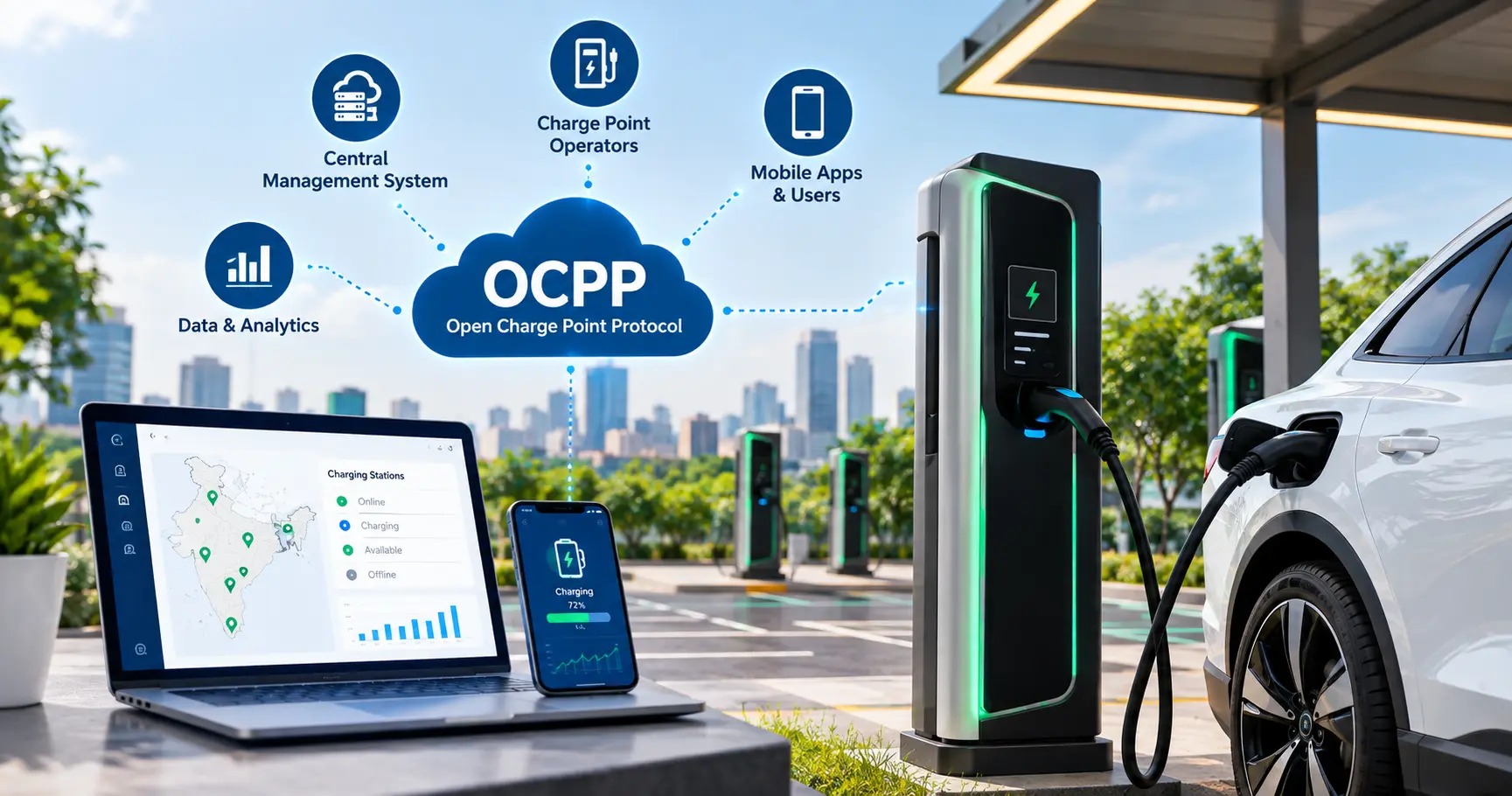
OCPP stands for Open Charge Point Protocol. The Open Charge Alliance, a global group of charging companies, maintains it as a free and open standard. It defines how a charger and a central management system (CMS) exchange messages over the internet. The protocol began in Europe over a decade ago and now serves as the most widely used charger communication standard worldwide.
Think of it as a common language. The charger reports its status, energy use, and faults. The CMS sends back commands such as start a session, stop a session, change a tariff, or install new firmware. Because the standard stays open, any compliant charger works with any compliant software, no matter which company built it.
How OCPP Works Inside a Charging Station
Every OCPP setup has two sides. The charge point sits on site, and the central system runs in the cloud. They hold a live, secure connection through a WebSocket link.
A typical charging session follows five quick steps:
- The driver plugs in and signs in through an app, RFID card, or QR code.
- The charger sends an authorization request to the CMS.
- The CMS approves the user and tells the charger to start.
- The charger streams meter values throughout the session.
- The CMS closes the transaction, calculates the bill, and stores the data.
This whole exchange takes only seconds. Your drivers never notice it, yet it decides how smooth their experience feels. When the exchange fails, drivers walk away and rarely come back.
OCPP 1.6J vs OCPP 2.0.1: Which Version Should You Choose?
Most chargers in India run on OCPP 1.6J today. The J means it uses JSON messages, which keeps communication light and fast. It covers the core needs of any operator, including remote start, smart charging profiles, and firmware updates.
OCPP 2.0.1 adds stronger security, richer device monitoring, and support for Plug and Charge through ISO 15118. It also handles complex smart charging for large depots and fleet hubs. If you plan a big network, pick a CMS that supports both versions. That way, your older chargers keep earning while you add newer hardware at your own pace.
Why Indian Charge Point Operators Need OCPP
The Indian market brings its own challenges. Operators buy hardware from many brands, grid capacity changes from city to city, and policy keeps evolving. OCPP helps you handle all three.
Freedom From Vendor Lock In
Proprietary chargers tie you to one supplier’s software. If that supplier raises fees or shuts down, your chargers turn into costly metal boxes. With OCPP, you switch software or hardware whenever your business needs change. Our platform already works with chargers from 48 OEMs in India, which shows how much choice an open standard unlocks.
Alignment With Government Guidelines
The Ministry of Power released revised EV charging infrastructure guidelines in September 2024. These guidelines advise public operators to adopt open protocols such as OCPP, OCPI, UEI, and OpenADR for data sharing and demand response. They also ask operators to share live charger data with the national database that BEE maintains. An OCPP backend makes this reporting simple and keeps you ready for future rules.
Remote Control and Less Downtime
A dead charger costs you money every hour. OCPP sends instant fault alerts to your dashboard, so your team resets, reconfigures, or updates the unit without a site visit. Your support staff can also pull diagnostic logs remotely and spot a failing unit before drivers complain. Fewer field trips mean lower costs and happier drivers.
Smart Load Management
Grid limits create real headaches at malls, apartments, and fleet depots. OCPP lets your CMS set power limits on each charger and spread load across the site. Our smart charging with load management feature uses these commands to cut peak demand charges and delay costly grid upgrades.
Roaming and Wider Reach
OCPP manages your chargers, while OCPI connects your network to other networks. Together, they let drivers from partner apps find, use, and pay at your stations. Our EV roaming solution builds on this pairing to lift utilization without new hardware.
Common Mistakes Operators Make With OCPP
Many operators assume that an “OCPP ready” label guarantees smooth integration. It does not. Chargers often carry vendor quirks, so your CMS must prove a real integration, not just a spec sheet claim.
Watch out for these common errors:
- Buying chargers before you confirm CMS compatibility
- Skipping firmware updates, which leaves security gaps open
- Ignoring network quality at remote sites, which breaks the live link
- Choosing a platform that supports only one OCPP version
A short pilot with five to ten chargers exposes these gaps early. It costs little and saves you from expensive fixes after a full rollout.
How to Choose OCPP EV Charging Solutions for Your Network
Not every platform delivers the same value. Use this checklist when you compare vendors:
- Support for OCPP 1.6J and 2.0.1 on the same backend
- Proven integrations with many charger brands
- Native UPI, wallet, and card payments
- Smart charging and load management tools
- OCPI roaming readiness
- Live dashboards, alerts, and custom reports
- Round the clock technical support
The right partner also handles installation, maintenance, and field service. Explore our end to end ev charging solutions to see how hardware, software, and service fit together under one roof.
Why Operators Trust Our Platform
ElectreeFi has worked across the EV ecosystem for over seven years. Our cloud CMS talks to chargers through OCPP and links networks through OCPI. Today, it powers over 70,000 charging points across India and has handled more than 15 million charging transactions.
Operators use our EV charging management platform to monitor chargers, set tariffs, collect payments, and track revenue in real time. If you want to push usage even higher, read why every CPO in India needs a route planner with EV charging points.
Final Thoughts
OCPP forms the foundation of every scalable charging network. It protects your investment, keeps you aligned with national guidelines, and gives you real control over every charger you own. Operators who delay this shift risk stranded assets and lost revenue.
Start with a clear audit of your current chargers, then pick a platform that grows with you. Choose ev charging solutions that rest on open standards today, and your network stays ready for whatever tomorrow brings.
Ready to run a smarter, open charging network? Talk to our team and book a platform demo to see how OCPP can grow your charging business.
Frequently Asked Questions
What is OCPP in EV charging?
OCPP, or Open Charge Point Protocol, is a free and open standard that lets EV chargers talk to a central management system. Operators use it to start sessions, track energy use, set tariffs, and fix faults remotely, whatever the charger brand.
Is OCPP mandatory in India?
The Ministry of Power’s 2024 guidelines advise public charge point operators to adopt open protocols such as OCPP and OCPI. Many public tenders and charger partners now expect OCPP support, so public operators should treat it as a baseline requirement.
What is the difference between OCPP 1.6 and OCPP 2.0.1?
OCPP 1.6J covers core needs like remote start, metering, and basic smart charging. OCPP 2.0.1 adds stronger security, better device monitoring, and Plug and Charge support. A good CMS runs both, so mixed fleets work together.
What is the difference between OCPP and OCPI?
OCPP connects a charger to its operator’s own software. OCPI connects one operator’s network to other networks and roaming apps. Operators use OCPP to manage their stations and OCPI to reach drivers outside their own app.
Can OCPP chargers work with any CMS?
In principle, yes. Any OCPP compliant charger can link to any OCPP compliant CMS. In practice, vendor quirks exist, so pick a platform with proven integrations across many OEMs and test a few units before a full rollout.