24 Sep, 24

Last updated: 26 October 2026  ·  Figures reflect the PM E-DRIVE scheme and state EV tariffs current at that date. Sources are listed at the end of this guide.

An EV charging station in India costs between ₹25,000 and ₹40 lakh in 2026. A single AC wall box for a home or office bay sits at the bottom of that range. A 30 kW DC fast charger — the most common choice for public and retail sites — typically lands at ₹12 lakh to ₹18 lakh all-in. A 120 kW highway charger runs from ₹25 lakh upwards.

The charger itself is only about half the bill. Transformer capacity, the DISCOM load sanction, civil work and the management software make up the rest — and they are the items most quotations leave out. This guide breaks down every line item, the running costs, and what payback actually looks like at realistic utilisation.

Table of Contents

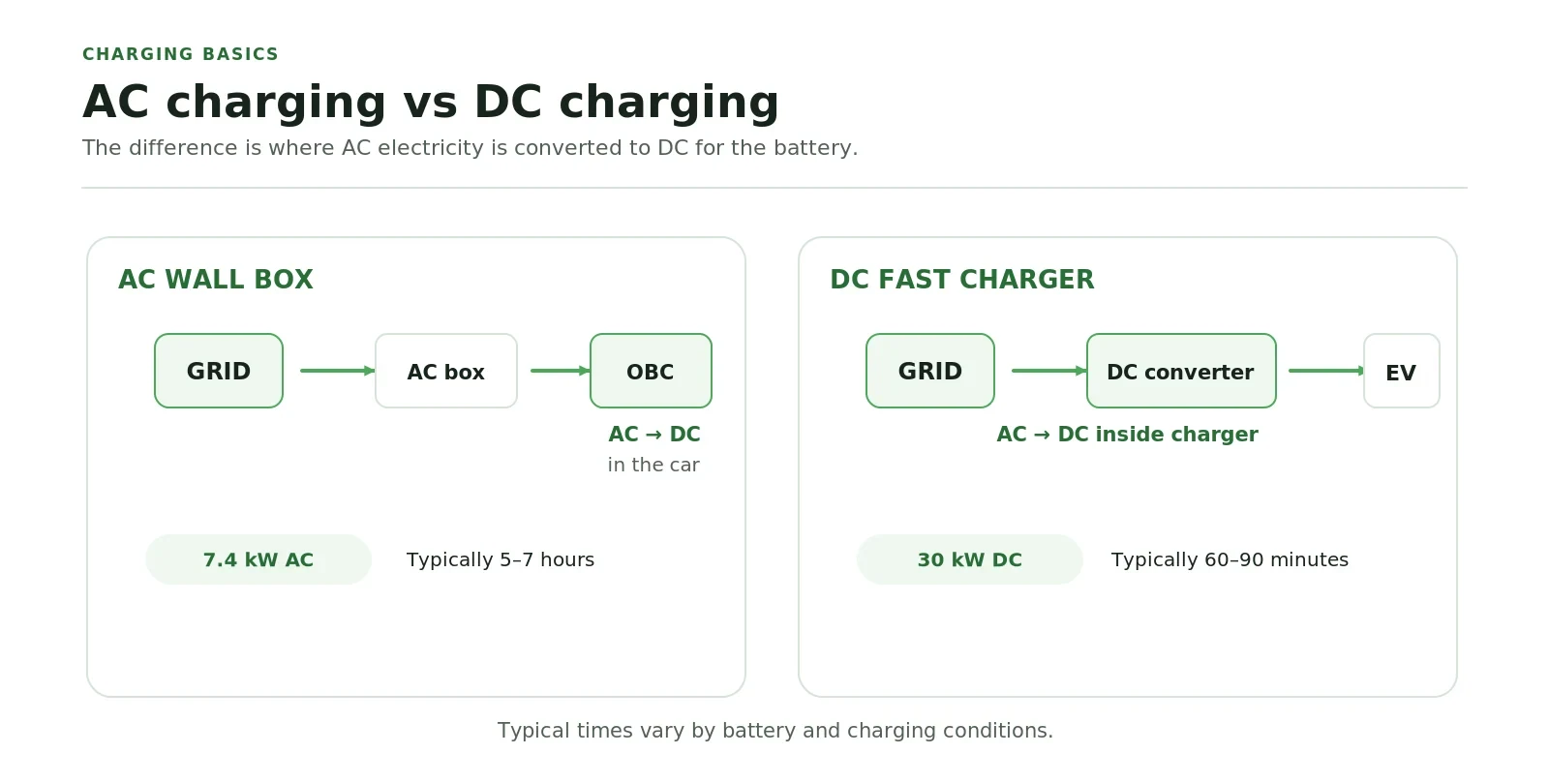
AC charging converts power inside the car using the onboard charger; DC charging converts power in the station, with illustrative times.
Where the conversion happens — and why DC hardware costs more.

EV Charging Station Cost in India: At a Glance

Charger type Typical all-in cost Charge time (typical car) Best suited to
AC 3.3 kW (Bharat AC-001)₹25,000 – ₹45,0008–10 hoursHomes, small societies, 2W/3W
AC 7.4 kW wall box₹35,000 – ₹80,0005–7 hoursHomes, office parking bays
AC 22 kW (commercial, 2 guns)₹1.5 – ₹3 lakh2–4 hoursMalls, hotels, offices, destination charging
DC 15 kW₹2.5 – ₹5 lakh1.5–2.5 hoursFleet depots, 3W hubs, small sites
DC 30 kW₹12 – ₹18 lakh60–90 minutesUrban public charging, retail, fuel stations
DC 60 kW₹15 – ₹25 lakh35–50 minutesHigh-traffic urban hubs, fleet charging
DC 120 kW+₹25 – ₹40 lakh+20–30 minutesHighway corridors, intercity routes

Ranges reflect hardware plus installation at a site with a reasonable existing power connection. Sites needing a new transformer or a long cable run from the nearest substation will sit above these figures. Always take written quotations from two or three suppliers and your DISCOM before committing.
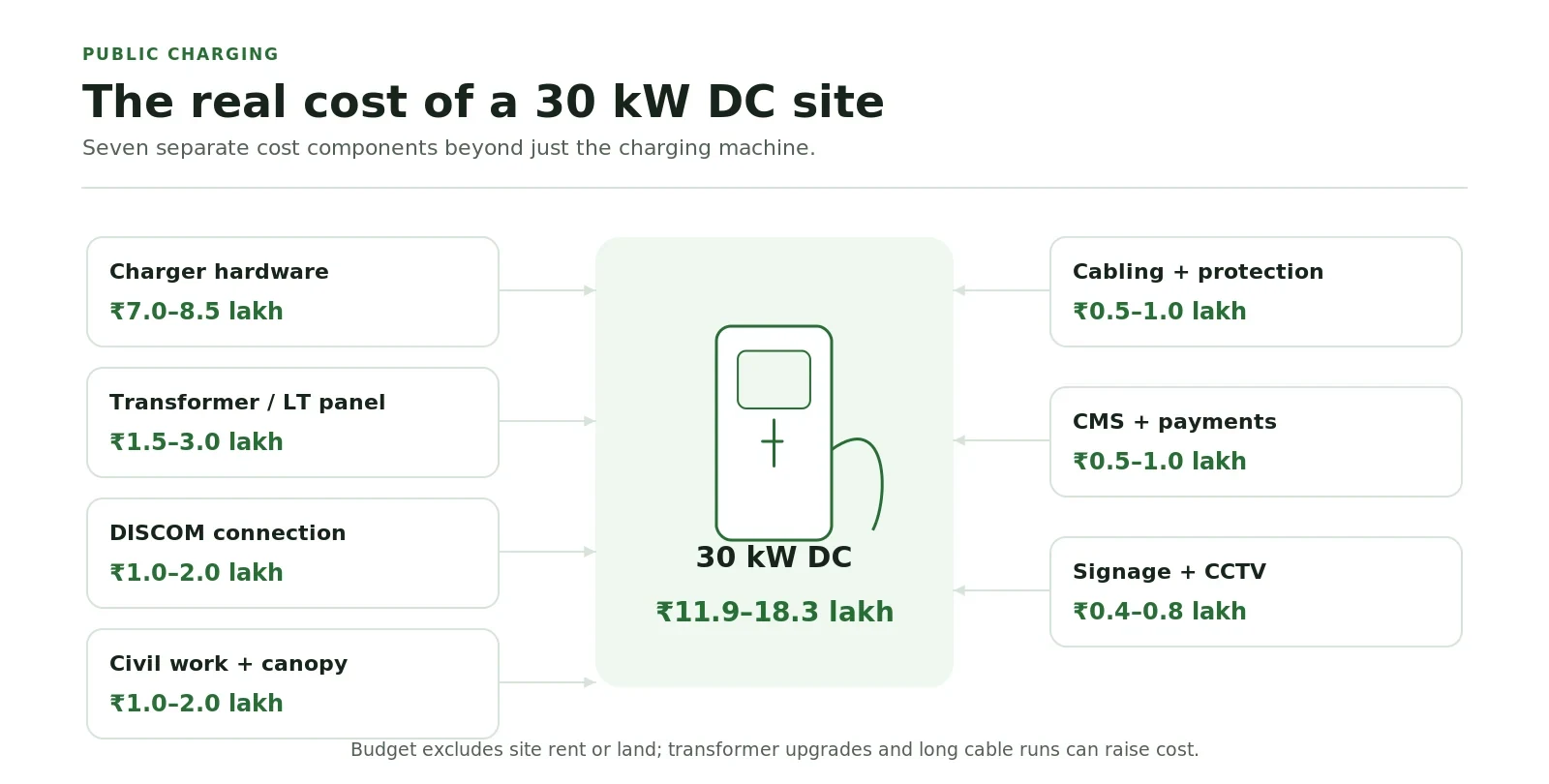
Seven-component cost breakdown for 30 kW DC charging station with published ranges and total ₹11.9–18.3 lakh.
The seven cost blocks behind a 30 kW DC site.

What You Are Actually Paying For: Full Cost Breakdown

Below is the line-by-line cost of a single 30 kW DC fast charging station — the configuration most operators start with. This is where the gap between a charger price list and a real project budget becomes obvious.

Cost component Cost range What it covers
Charger hardware₹7,00,000 – ₹8,50,000The 30 kW DC unit with CCS-2 gun, display and OCPP support. Usually 50–60% of the project.
Transformer / panel upgrade₹1,50,000 – ₹3,00,000Added transformer capacity, LT panel, metering cubicle. The single biggest variable between sites.
DISCOM load sanction & connection₹1,00,000 – ₹2,00,000Commercial load application, security deposit, service line and meter from the utility.
Civil work, foundation, canopy₹1,00,000 – ₹2,00,000Charger plinth, bollards, cable trenching, weather canopy, parking markings.
Cabling, earthing, protection₹50,000 – ₹1,00,000HT/LT cable, dedicated earth pits, SPD, MCCB/RCCB, lightning protection.
CMS software & payments₹50,000 – ₹1,00,000Charge point management system onboarding, app listing, UPI/card payment integration. Recurring fee after year one.
Signage, lighting, CCTV₹40,000 – ₹80,000Site branding, LED lighting, surveillance, fire extinguisher, safety signage.
Total project cost₹11.9 – ₹18.3 lakhExcluding land cost or rent.

You will often see a 30 kW station quoted at ₹11–15 lakh. That figure usually assumes the site already has adequate sanctioned load and needs no transformer work. Once a transformer upgrade enters the scope, ₹18 lakh is the more realistic planning number.

Three Real-World Scenarios

1. Housing society or office parking — ₹1.5 to ₹3 lakh

Two AC 22 kW units serving residents or staff overnight. Usually no transformer work is needed because the existing sanctioned load can absorb 44 kW, and the chargers mount on an existing wall. Civil work is minimal. This is the cheapest way to offer genuine charging rather than a 15 A plug point, and it suits residential complexes where cars sit parked all night.

2. Retail, hotel or fuel station — ₹12 to ₹18 lakh

One 30 kW DC charger with a CCS-2 gun, plus an AC 22 kW unit for longer dwell times. This is the standard public charging configuration in Indian cities. Expect a commercial load sanction, a transformer review, a canopy and full CMS integration with app listing and UPI payments.

3. Highway corridor site — ₹25 to ₹40 lakh+

A 120 kW or 240 kW charger, often with two guns, serving intercity traffic. Costs rise sharply here: HT connection, dedicated transformer, substantial civil work and in many cases a diesel or battery backup. Land rent on a highway frontage is a significant ongoing cost that does not appear in hardware quotations.

Running Costs: What It Costs to Operate

Capital cost is the question most people ask. Running cost is the one that determines whether the site makes money.

Electricity tariff

Most states have created a separate, concessional EV charging tariff. These are the input rates operators pay — not the retail price charged to drivers.

State EV charging tariff (LT) Notes
Delhi₹4.50 / kWh₹4.00 / kVAh at high tension. Among the lowest in India.
Karnataka₹4.50 / kWhEnergy charge fixed by KERC through FY 2027-28.
Maharashtra₹6 – ₹9 / kVAhVaries by tariff category and time of day. Electricity duty waived for EV charging. Check the current MERC order.
Tamil Nadu₹6.50 – ₹9.75 / kWhTime-of-day slabs; off-peak charging is materially cheaper.
Madhya Pradesh₹7.44 / kWhEnergy charge per unit.

Tariffs are revised annually by each state regulator. Confirm the current rate with your DISCOM before modelling returns — a ₹2/unit difference changes payback by years.

Recurring operating costs

  • Electricity — the largest variable cost, typically ₹5–8 per unit all-in once fixed charges and duty are added.
  • Annual maintenance (AMC/CAMC) — roughly 5–10% of hardware value per year, so ₹35,000–₹85,000 for a 30 kW unit.
  • CMS subscription — ₹1,000–₹3,000 per charger per month for management software, app listing, remote diagnostics and settlement.
  • Site rent — highly location-dependent, and often the deciding factor on highway sites.
  • Manpower and housekeeping — unmanned sites still need periodic cleaning and attendance for faults.
  • Payment gateway charges — typically 1–2% of transaction value.
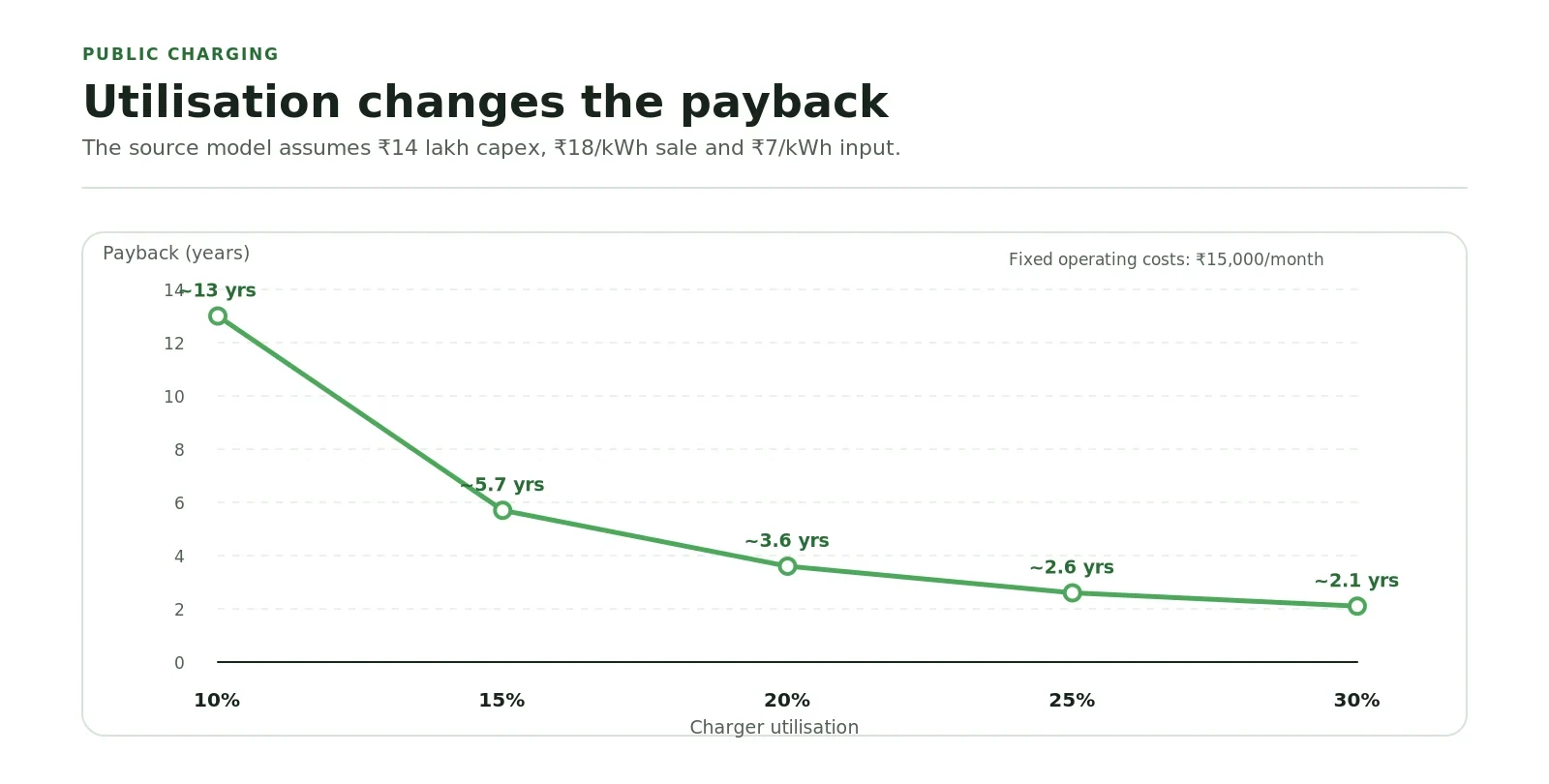
Line chart of 30 kW charging-station payback: 10% utilisation ~13 years, 15% ~5.7, 20% ~3.6, 25% ~2.6, 30% ~2.1.
Payback against utilisation, from the table below.

Payback: Honest Numbers

Vendor brochures commonly promise payback in 20–26 months. For the rules, approvals and siting that sit around this, see our guide to public EV charging stations in India, and our explainer on what a Charge Point Operator does. That is achievable, but only at utilisation levels most sites do not reach in their first two years. Utilisation here means the share of the day the charger actually delivers its rated power.

The table below assumes a ₹14 lakh project, a retail price of ₹18/unit, an input cost of ₹7/unit, and ₹15,000 a month in fixed operating costs.

Utilisation Units sold / month Net monthly profit Payback period
10%2,160 kWh₹8,760~13 years
15%3,240 kWh₹20,640~5.7 years
20%4,320 kWh₹32,520~3.6 years
25%5,400 kWh₹44,400~2.6 years
30%6,480 kWh₹56,280~2.1 years

The lesson is simple: location decides the return, not the charger. A ₹12 lakh station at 25% utilisation outperforms a ₹9 lakh station at 10% by a wide margin. Before buying hardware, study the traffic, the dwell time and the EV density around the site.

Subsidies and Government Support in 2026

FAME II closed on 31 March 2024. Any cost estimate still quoting FAME II subsidies is out of date. The scheme now in force is PM E-DRIVE.

  • PM E-DRIVE runs from 1 April 2024 to 31 March 2028, with a total outlay of ₹10,900 crore.
  • ₹2,000 crore is earmarked specifically for public EV charging stations, against a target of roughly 72,000 chargers nationwide.
  • As of mid-2026, proposals worth about ₹689 crore had been sanctioned covering some 6,562 stations, though the government has reported that disbursement against the charging component was still at an early stage.
  • Funding is routed through nodal government entities, state governments and oil marketing companies rather than paid directly to private operators — so most private CPOs should budget without assuming a central subsidy.

Several states run their own EV policies with capital subsidies, electricity duty exemptions and concessional tariffs. Maharashtra, for example, waives electricity duty on EV charging for up to ten years. State policies change frequently, so verify the current notification for your state rather than relying on a summary.

What Pushes the Cost Up or Down

Costs rise when: the site needs a new or upgraded transformer; the nearest substation is far away and cable runs are long; you choose higher power or multiple guns; the location requires a canopy, backup power or heavy civil work; or land is rented at a premium frontage.

Costs fall when: existing sanctioned load is already sufficient; the site has usable covered parking; you begin with AC charging and add DC later as demand proves out; you standardise on one charger model across sites; or you share infrastructure across several chargers on one connection.

How ElectreeFi Helps You Budget Accurately

Most cost overruns come from the electrical side, not the charger. ElectreeFi provides end-to-end EV charger installation and setup — site assessment, load study, charger selection, DISCOM liaison, commissioning and handover — so the budget reflects the actual site rather than a price list.

After commissioning, our EV charging management platform runs the commercial side: real-time monitoring, OCPP-compliant control across any charger brand, tariff management, settlement and automated fault detection. Our operation and maintenance services cover 24/7 support and CAMC, and our payment solutions handle UPI, cards and QR so revenue collection is not an afterthought. Station accessories such as canopies, CCTV and smart metering can be specified at design stage, where they cost far less than retrofitting.

ElectreeFi has supported more than 105,000 charge points deployed across India, which means the cost benchmarks we give you come from completed projects rather than estimates.

Request a site-specific cost estimate →

Frequently Asked Questions

How much does it cost to set up an EV charging station in India?

Between ₹25,000 and ₹40 lakh in 2026, depending on charger type. A single AC wall box costs ₹35,000–₹80,000. A 30 kW DC fast charging station — the most common commercial configuration — costs ₹12–18 lakh all-in, including transformer work, civil work, DISCOM connection and software. A 120 kW highway charger starts around ₹25 lakh.

What does a 30 kW DC fast charger cost?

The hardware alone is ₹7–8.5 lakh. Adding transformer capacity (₹1.5–3 lakh), the DISCOM load sanction (₹1–2 lakh), civil work and canopy (₹1–2 lakh), cabling and protection (₹50,000–₹1 lakh), CMS and payments (₹50,000–₹1 lakh) and signage (₹40,000–₹80,000) brings the project to ₹11.9–18.3 lakh.

Why is a DC charger so much more expensive than an AC charger?

An AC charger simply supplies mains power and lets the car’s onboard charger do the conversion. A DC charger contains the power conversion equipment itself — rectifiers, cooling, high-current switchgear — and draws far more power, which usually triggers a transformer upgrade and a higher sanctioned load. The charger is more expensive and so is everything around it.

Is an EV charging station profitable in India?

Yes, but profitability depends almost entirely on utilisation. At 10% utilisation a 30 kW station earns roughly ₹8,760 a month and takes over a decade to repay. At 25% it earns about ₹44,400 a month and repays in around two and a half years. Site selection matters more than the hardware you buy.

How long does it take to recover the investment?

Realistically two to six years for a 30 kW DC station. Vendor claims of 20–26 months assume utilisation above 25%, which few sites achieve in their first two years. Model your returns at 15% utilisation to be safe, and treat anything higher as upside.

Do I need a separate electricity connection?

For public charging, yes. You need a commercial connection with sanctioned load matched to the charger rating, and most states have a dedicated concessional EV tariff category. Budget ₹1–2 lakh for the load sanction, security deposit, service line and meter. Private AC charging in a home or society can often run on the existing connection if spare load is available.

What subsidy is available for EV charging stations in 2026?

PM E-DRIVE is the scheme currently in force; FAME II ended on 31 March 2024. PM E-DRIVE allocates ₹2,000 crore for public charging stations within a ₹10,900 crore total outlay, running to 31 March 2028. Funding is channelled through nodal government bodies, state governments and oil marketing companies rather than paid directly to private operators, so most private projects should be budgeted without assuming central support. Many states offer additional capital subsidies and electricity duty waivers.

What are the ongoing costs of running an EV charging station?

Electricity at ₹5–8 per unit all-in, annual maintenance at 5–10% of hardware value, CMS software at ₹1,000–₹3,000 per charger per month, payment gateway charges of 1–2% of revenue, plus site rent and housekeeping. For a 30 kW station, fixed monthly costs excluding electricity typically total ₹12,000–₹18,000.

How much space does an EV charging station need?

A single DC charging bay needs roughly 15–18 square metres including the parking space, charger footprint and safe circulation. Allow additional room for the transformer and LT panel, which are usually placed a few metres away with their own access clearance.

Can I start small and expand later?

Yes, and it is usually the better approach. Sanction the electrical load for your eventual configuration but install only one or two chargers initially. Trenching, cabling and transformer capacity are far cheaper to build once than to retrofit, while chargers themselves can be added as demand is proven.

Sources and Methodology

The figures in this guide come from three places: published government notifications, state electricity regulator tariff orders, and cost benchmarks from charge points deployed on the ElectreeFi platform across India.

Where each figure comes from

  • Charger hardware and installation ranges — benchmarked against commissioned projects on the ElectreeFi platform, cross-checked against publicly quoted Indian supplier pricing. Hardware pricing moves with import duties and order volume, so treat these as planning ranges and obtain written quotations.
  • Subsidy figures — the PM E-DRIVE scheme, Ministry of Heavy Industries. The scheme runs 1 April 2024 to 31 March 2028 with a total outlay of ₹10,900 crore, of which ₹2,000 crore is allocated to public EV charging stations.
  • FAME II status — FAME II closed to new applications on 31 March 2024 and was succeeded by PM E-DRIVE. Cost guides still quoting FAME II subsidies are out of date.
  • Electricity tariffs — the relevant state regulator’s current order in each case: DERC for Delhi, MERC for Maharashtra, KERC for Karnataka, TNERC for Tamil Nadu. Tariffs are revised annually, so confirm the current rate with your DISCOM before modelling returns.
  • Payback calculations — our own model, stated transparently so you can substitute your own assumptions: ₹14 lakh project cost, ₹18/unit retail price, ₹7/unit all-in input cost, ₹15,000/month fixed operating costs. Utilisation is expressed as the share of a 24-hour day the charger delivers its rated power.

What we deliberately do not claim

We do not publish a single headline figure for a battery swapping station or quote a fixed “cost per charger”, because neither is meaningful without a site. Transformer capacity, distance from the nearest substation and civil scope move the total by several lakh rupees on otherwise identical hardware. Any guide offering one number for an EV charging station is describing hardware, not a project.

Where sources disagree — and on Indian EV charging costs they frequently do, because most published figures come from vendors selling the equipment — we give the wider range and say what it depends on.

About ElectreeFi

ElectreeFi is an Indian EV charging management platform. More than 105,000 charge points have been deployed across India on the platform, spanning public charging, fleet depots, residential societies and highway corridors. The cost benchmarks above are drawn from that deployment base rather than from list pricing.

Sumit Ahuja is the Founder and Director (Strategy, Innovation, Technology) at ElectreeFi, which he founded in December 2017 to build EV charging management infrastructure for Indian charge point operators, fleets and property owners. He is also Founder and Director at TechPerspect Software Pvt. Ltd., which he started in April 2014. Before founding both companies, Sumit spent over a decade delivering enterprise technology projects — as Senior Delivery Manager and Technical Project Manager at Mascon Global between 2006 and 2012, Technical Lead at Algorism Softech, and Senior Software Engineer at Nagarro. He writes here on EV charging infrastructure, the economics of operating charge points in India, and the platforms that run them.

What drivers say about ElectreeFi

3.7
★★★★★
from 831 Google Play ratings

Reviews below are reproduced from the app's Google Play listing, where you can read all of them, including the critical ones.

★★★★★
My overall experience with the ElectreeFi EV Charging Station at Majestica, Casa Bella, Palava has been excellent. The charging facility is user-friendly, reliable, and affordably priced, making it very convenient to use. I also appreciate the support extended by the society manager and the individual responsible for the EV charging installation and related queries. They have been prompt, helpful, and cooperative throughout.
Rakesh Bhave Aug 2026 · Google Play
★★★★★
I have been using ElectreeFi to locate EV charging stations around Noida and Delhi NCR and it works pretty well. The app is clean, easy to use, and covers most public chargers. I especially like the real-time session tracking and payment integration. It would be even better if the UI could load a bit faster and show live charger availability more clearly. Still, a solid app for EV owners in India.
Vansh Dhiman Jul 2025 · Google Play
★★★★★
ElectreeFi helps me plan trips by showing nearby charging stations and optimizing my route for energy efficiency. Super convenient and reliable.
Mayank Chaudhary Aug 2025 · Google Play
★★★★★
It is a very helpful app for electric vehicle owners. The plus point is that you can use this application anywhere and on any device, whether it is a mobile or a laptop.
Sharma Ab May 2025 · Google Play