
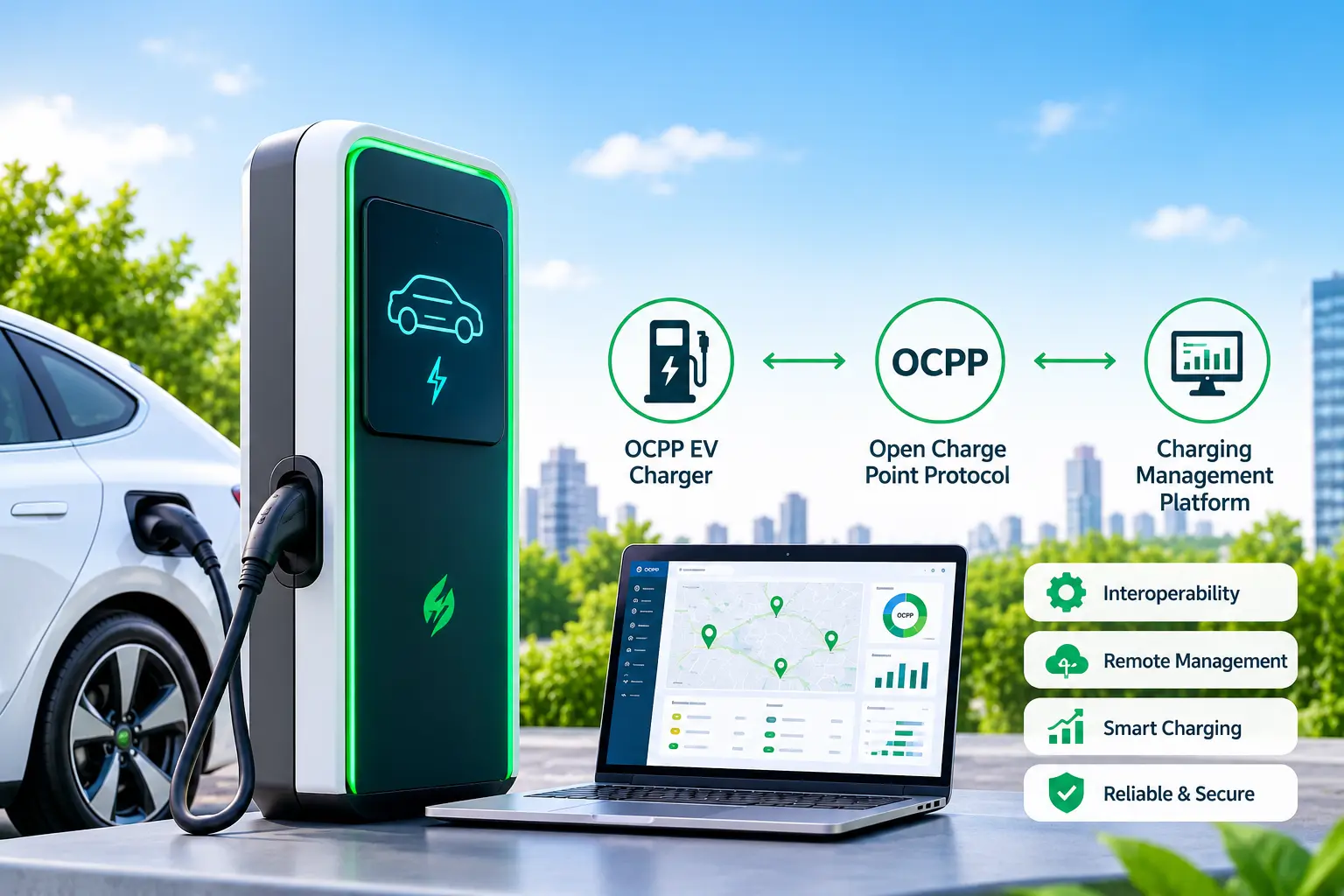
A site owner installs twenty new chargers, only to find that half of them will not talk to the software already running the network. Sessions fail to start, faults stay invisible, and technicians drive out to reset hardware. An OCPP EV charger is built to prevent exactly this problem, because it speaks a shared language with the platform that manages it. This guide explains how that language works, how the versions differ, and what to check before you buy.
What Is an OCPP EV Charger?
An OCPP EV charger is a charging station that uses the Open Charge Point Protocol to communicate with a central charging management software. In short, it is a charger that can be managed remotely by any compatible platform instead of only by its own maker’s tools.
The charger still delivers power as usual. OCPP only handles the data side, so operators can choose hardware and software separately.
What Is the Open Charge Point Protocol?
The Open Charge Point Protocol (OCPP) is an open standard for communication between charging stations and charging management systems. The Open Charge Alliance (OCA) maintains it. The goal is to build interoperable, scalable infrastructure that depends less on proprietary systems.
The OCA notes that OCPP 2.0.1 edition 3 was approved as an IEC standard, IEC 63584, in 2024.
Do not confuse OCPP with OCPI. OCPP connects a charger to its management system. OCPI connects separate networks and service providers, mainly for roaming. A network often uses both, but they solve different problems.
How Does an OCPP EV Charger Work?
The charger opens a connection to the Charging Station Management System (CSMS), which is the backend software. OCPP 1.6 offers both SOAP and JSON versions, and the JSON version, often written as OCPP 1.6J, runs over WebSockets. That persistent link lets both sides send messages at any time.
A typical flow looks like this:
- The charger powers up and announces itself to the CSMS.
- It sends regular status updates for each connector.
- A driver presents a card, app or QR code, and the CSMS authorises the session.
- The charger records the transaction and sends meter readings while charging.
- When the session ends, the CSMS receives the final record for billing.
The backend can also send commands, such as reset, change availability or set a power limit. Each command is a defined message, so any compliant charger and platform understand it the same way.
Key Features of OCPP-Enabled EV Chargers
Protocol features come first, platform features second. OCPP defines what a charger and a backend can say to each other. What the operator sees on a dashboard depends on the platform.
- Remote monitoring: Chargers report status and faults, so operators see problems without a site visit.
- Session management: Authorisation, start, stop and meter data follow defined messages.
- Smart charging: Operators can send charging profiles that cap or schedule power.
- Device management: Configuration can be read and changed remotely, with deeper control in newer versions.
No charger supports every feature in every version. Always check the specific feature list of the model you plan to buy.
OCPP 1.6 vs OCPP 2.0.1: Understanding the Differences
OCPP 1.6 arrived in 2015. It added smart charging for load balancing and charge profiles, local list management and better status reporting. The OCA notes it is still widely implemented, though the industry is moving toward the 2.x line.
OCPP 2.0.1 followed in 2020. It adds device management, improved transaction handling, extra security features, expanded smart charging, ISO 15118 support, and display and messaging functions.
The most important fact is this: OCPP 1.6 and OCPP 2.0.1 are not compatible with each other. A charger built for one version needs a backend that supports that same version. The OCA also released OCPP 2.1 in 2025, building on 2.0.1 with features such as bidirectional charging and battery swapping support.
| Point | OCPP 1.6 | OCPP 2.0.1 |
|---|---|---|
| Release | 2015 | 2020 |
| Smart charging | Charge profiles and load balancing | Expanded smart charging |
| Device management | Basic configuration | Dedicated device management |
| Security | Limited in the core spec | Added security features |
| ISO 15118 | Not part of the spec | Supported |
| Installed base | Widely implemented | Growing |
Why OCPP Matters for Charge Point Operators
A Charge Point Operator (CPO) runs chargers and earns from sessions. Downtime costs revenue, and vendor lock-in costs flexibility. With OCPP, a CPO can add chargers from different makers to one network and still manage them from one place.
It also protects past investments. If a CPO changes software, OCPP chargers can usually point to the new backend instead of being replaced.
Benefits of Using OCPP-Compatible EV Chargers
The practical gains for operators fall into three groups.
Less dependence on one vendor. Mixed hardware becomes realistic, so procurement can follow price, availability and local support.
Faster fault handling. Status messages let a team spot a stuck connector or offline unit early. Many faults can then be fixed remotely, which cuts site visits.
Better use of power. At a depot or a building with a fixed electrical connection, smart charging profiles share limited capacity across vehicles instead of letting every charger run at full power at once.
OCPP and EV Charging Management Software
The charger is only half the system. An OCPP charging management system receives the messages, decides what to do with them and presents the results to people. Think of the protocol as the phone line and the software as the control room.
Here the difference between protocol and product matters. OCPP defines that a charger can accept a power limit. A platform decides who gets that power, when, and at what price. Pricing rules, user accounts, payment routes, dashboards and alerts are platform features, not protocol features.
Limits of OCPP Interoperability
Compatibility does not guarantee smooth interoperability. Several gaps still appear in real projects:
- Many features are optional, so two chargers can both claim OCPP support while offering different capabilities.
- Manufacturers can add custom behaviour through vendor-specific extensions.
- Version mismatches stop communication entirely, as 1.6 and 2.0.1 cannot talk to each other.
- Firmware quality varies, so identical messages may behave differently across models.
The OCA runs a certification program with accredited test laboratories and a list of certified products. Ask suppliers for certification evidence, and test a sample charger against your platform before a large order.
What Should Businesses Consider When Choosing an OCPP EV Charger?
Use this checklist when you evaluate hardware:
- Version support. Confirm whether the charger supports OCPP 1.6J, 2.0.1 or both, and whether your software supports the same one.
- Feature coverage. Ask for a written list of supported functions, especially smart charging, remote start and stop, and firmware updates.
- Certification and testing. Request proof of OCA certification, or run your own integration test.
- Connectivity behaviour. Ask what the charger does when the network drops, including whether it stores sessions and sends them later.
- Payment and metering hardware. Check that the charger supports the authorisation methods your drivers will use.
- Backend fit. Confirm that your OCPP charging management system has already integrated that charger model.
- Support and updates. Learn who provides firmware fixes and how long the warranty runs.
Fleet operators should also check that the charger accepts remote power limits, which depot charging often needs.
How ElectreeFi Supports OCPP-Based EV Charging Infrastructure
ElectreeFi provides an EV charging management platform for operators. Its site states that the platform supports OCPP 1.6 and 2.0.1 hardware and works with more than 80 charger manufacturers, so operators are not tied to one hardware brand.
Day to day, the platform page describes live status for each charge point and connector, remote diagnostics and reset, and fault alerts. Operators see charger status and transactions in one dashboard, which fits the remote monitoring that OCPP makes possible.
Load control builds on the protocol as well. ElectreeFi’s smart charging with load management service balances power across chargers and sites. It also notes that this needs chargers that accept remote power limits over OCPP, so confirm that point during site planning.
On the payment side, ElectreeFi’s EV charging payment solutions cover UPI, cards, contactless taps and QR codes, with payments going directly to the CPO.
Every network differs, so confirm charger models, protocol versions and features for your project.
Conclusion
An OCPP EV charger gives operators a shared language between hardware and software, and that is the foundation for remote monitoring, session handling and smart charging. Still, OCPP support is a starting point, not a guarantee. Match versions, verify features, test early and choose a platform that can use what your chargers offer.
If you are planning or expanding a network, explore ElectreeFi’s charging management capabilities at electreefi.com and speak with the team about your chargers, sites and goals.
Reference Link Table
| Reference / Resource | Relevance | Link |
|---|---|---|
| Open Charge Alliance: Open Charge Point Protocol | Official overview of OCPP versions, features, IEC 63584 status and certification | https://openchargealliance.org/protocols/open-charge-point-protocol |
| ElectreeFi: EV Charging Management Platform | Platform capabilities including OCPP 1.6 and 2.0.1 support and monitoring | https://electreefi.com/ev-charging-management-platform/ |
| ElectreeFi: Smart Charging with Load Management | Explains how load control depends on OCPP-capable chargers | https://electreefi.com/service/smart-charging-with-load-management/ |
| ElectreeFi: What Is a Charge Point Operator | Context on CPO roles, remote monitoring and open standards | https://electreefi.com/charge-point-operators/ |
Frequently Asked Questions
What is an OCPP EV charger?
An OCPP EV charger is a charging station that uses the Open Charge Point Protocol to talk to charging management software. It lets operators monitor and control the charger remotely through any compatible platform.
What is the purpose of OCPP in EV charging?
OCPP gives chargers and management systems a shared, open way to exchange data and commands. This reduces dependence on proprietary systems and supports scalable networks.
How does an OCPP charger communicate with charging software?
The charger connects to the backend, called a CSMS, and exchanges defined messages for status, authorization, transactions and commands. In OCPP 1.6J these messages travel in JSON over WebSockets.
What is the difference between OCPP 1.6 and OCPP 2.0.1?
OCPP 2.0.1 adds device management, improved transaction handling, added security features, expanded smart charging and ISO 15118 support. The two versions are not compatible, so the charger and software must support the same one.
Why do Charge Point Operators need OCPP?
OCPP lets operators mix chargers from different makers and manage them from one platform. It also supports remote monitoring and makes a future software change easier.
Are all OCPP-compatible EV chargers interoperable?
No. Many features are optional and manufacturers may add custom extensions, so two chargers can differ in practice. Certification and integration testing reduce the risk.
Can OCPP chargers support remote monitoring?
Yes. Chargers report status and faults to the backend, and operators can send commands such as reset. The depth of monitoring depends on the charger and the management platform.
How do businesses choose an OCPP-compatible EV charger?
Check protocol version, supported features, certification, offline behaviour, payment options and whether your software already supports the model. Test a sample charger before you place a large order.
