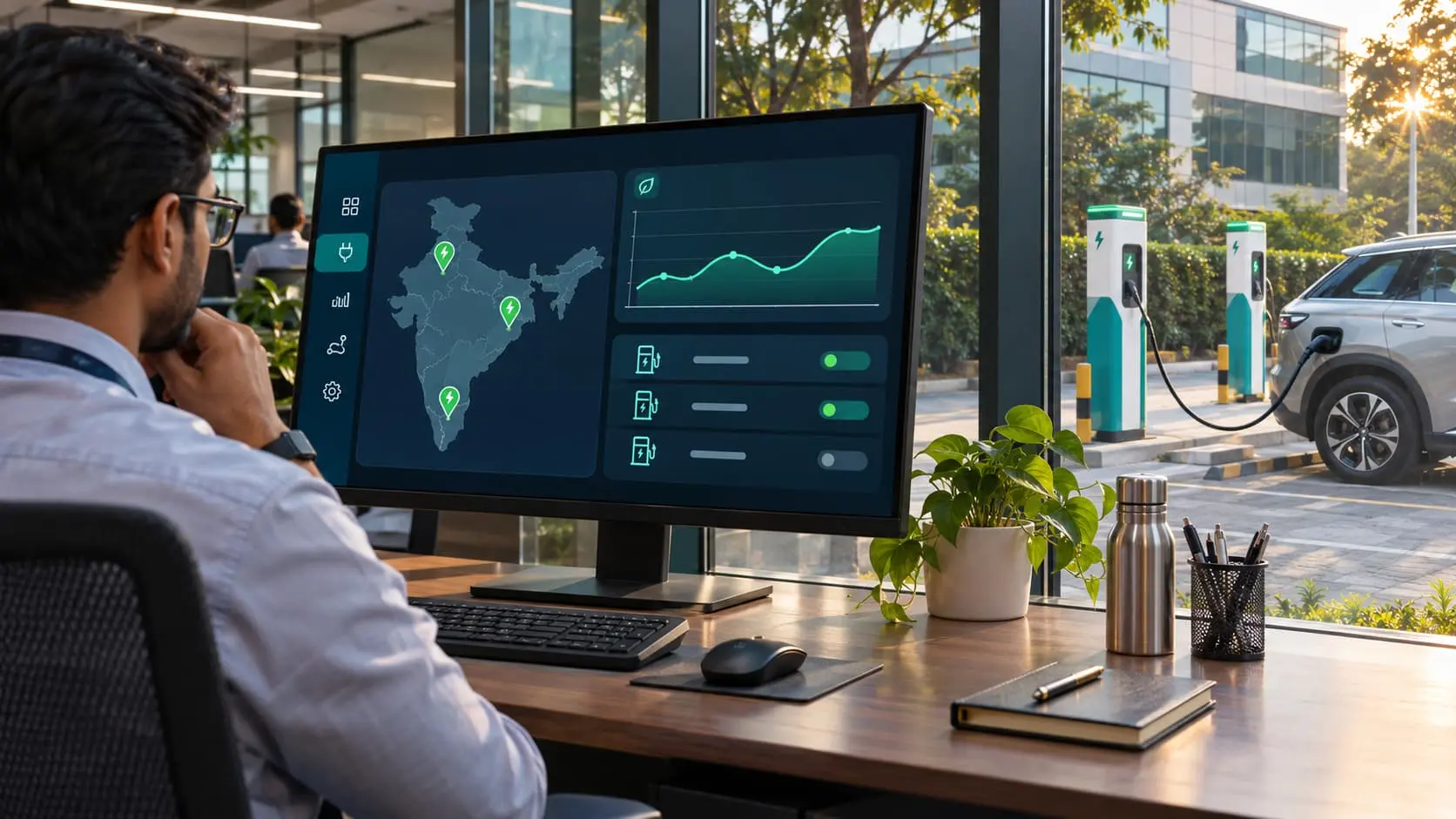
A charge point operator with five chargers can run the business on phone calls and a spreadsheet. At fifty chargers across several cities, that method stops working. Nobody can say which connector has faulted, which session failed to start, or which payment has no matching charging record. A charging management system (CMS) fixes this by bringing every charger, session and payment into one software platform. This guide explains what a CMS does, how it works, and what Indian EV charging businesses should check before they choose one.
What Is a Charging Management System?
A charging management system is cloud software that lets an operator monitor, control and bill EV chargers from one place. The charger is the hardware that delivers power. The CMS is the software that decides who can charge, at what price, and what happens when something goes wrong.
Think of the charger as a vending machine and the CMS as the head office. The head office sees its status, sets its prices, collects the money and sends a technician when it breaks.
You will meet other names for the same idea: EV charging management platform, charging station management system (CSMS) and charge point management system. A later section explains how these terms relate.
Why Do EV Charging Businesses Need a CMS?
Small networks hide problems. Larger ones expose them. Once chargers sit at several sites, manual tracking leaves gaps that cost time and customers. A CMS helps operators handle these challenges:
- Managing many stations from one dashboard instead of site by site
- Checking which chargers are available, busy or offline
- Spotting faults before drivers report them
- Handling charging sessions, including failed starts and interruptions
- Collecting payments and matching them to sessions
- Tracking charger usage and network performance
Picture a CPO with chargers in a mall, an office park and a highway stop. Without central software, a faulted highway charger may stay dark until someone complains. With a CMS, the operator sees the alert and can try a remote reset before sending a technician.
How Does an EV Charging Management System Work?
The exact flow differs between products, but most follow the same path:
- The charger connects to the management platform over the internet, usually through OCPP.
- The platform receives charger status and session data.
- Operators watch station and connector activity on a dashboard.
- Drivers start a session with a method the platform supports, such as an app, RFID card or QR code.
- The platform records the transaction and handles payment through its integrations.
- Operators review sessions, revenue and faults, then act on what they see.
Not every CMS supports every step or every payment method. Ask each vendor for a written feature list instead of assuming.
Key Features of a Charging Management System
Most platforms group their features around a few jobs.
Monitoring and control. Centralised monitoring shows the live state of each charger and connector. Remote management lets staff reset a unit or run diagnostics without a site visit. Fault detection sends alerts so teams can start troubleshooting early.
Sessions and payments. Session management tracks when charging starts, stops or fails. Payment integration links each session to UPI, cards, wallets or RFID. Many platforms also produce an invoice for every session.
Access and structure. User and role management controls what each team member can see or change. Multi-location management lets one operator run many sites under one account.
Reporting and energy. Reports show usage, revenue and charger performance. Some platforms also add energy monitoring and load management to protect a site’s power limit.
These are general capabilities, and depth varies, so test the ones your business needs.
Role of OCPP in Charging Management Systems
The Open Charge Point Protocol (OCPP) is the common language between chargers and management software. The Open Charge Alliance describes it as the global open communication protocol between charging stations and charging management systems. It helps operators build infrastructure that stays interoperable and depends less on proprietary systems.
In practice, an OCPP charger sends its status and meter readings to the CMS and asks it to authorise drivers. The CMS sends commands back, such as a reset or a power limit. Because both sides use a shared standard, an operator can mix charger brands without building a new integration for each one.
Versions matter. OCPP 1.6 dates from 2015 and remains widely used. OCPP 2.0.1 arrived in 2020 with stronger device management and security, and it does not work with 1.6. OCPP 2.1 followed in 2025 and builds on 2.0.1. So the charger and the software must support the same version. India’s September 2024 Ministry of Power guidelines also encourage open protocols such as OCPP, OCPI and UEI to build connected, interoperable charging infrastructure. For a deeper technical view, read this guide to how an OCPP EV charger works.
Benefits of a CMS for EV Charging Businesses in India
CPOs, fleet owners, housing societies and commercial property owners can all gain from a CMS, though results depend on the business and the platform.
Operators gain visibility. They see charger status, sessions and faults in one place instead of phoning site staff. Several locations become easier to manage because every site follows the same dashboard and rules. Staff spend less time on manual checks, and maintenance becomes more organised because faults arrive as alerts.
Usage data helps too. When an operator sees which chargers sit idle, it can make better decisions about pricing and placement. Payment records tied to sessions give finance teams a clearer view of what came in and why. Drivers benefit as well, since they can find a working charger, pay in a familiar way and receive an invoice.
None of this happens automatically. A CMS gives you information and tools. Your team still has to act on them.
Charging Management System vs Charging Station Management Software
The two terms overlap heavily. Both describe software that manages EV chargers. OCPP 2.x documents use “charging station management system” (CSMS) for the backend that chargers connect to. Business teams more often say “charging management system” or “CMS.” Vendors also use charge point management system (CPMS), charger management system or management platform.
Treat these as labels, not separate products. When you compare vendors, check what the software does, which protocol versions it supports and which chargers it works with.
How to Choose the Right Charging Management System
Start with your chargers, then work outward. Use these checks:
- Charger compatibility: Confirm the software works with your charger models, including the ones you plan to buy.
- OCPP support: Check the supported versions and get the list of supported functions in writing.
- Scalability: Make sure the platform can add chargers and sites without a rebuild.
- Remote monitoring: Look for live status, fault alerts and remote actions.
- Payments: Indian drivers expect UPI and QR options, so check supported methods, settlement and refund handling.
- Reporting and users: Confirm which reports you get and whether roles and permissions fit your teams.
- Security: Ask about hosting, access controls and independent security testing.
- Support and integrations: Check support hours and how the platform connects with gateways, roaming networks and your own systems.
- Pricing: Compare per charger fees, transaction charges and setup costs.
Then pilot the platform on a few chargers before you move the whole network.
How ElectreeFi Supports EV Charging Businesses
ElectreeFi offers an EV charging management platform for charge point operators, fleet operators, property owners and other charging businesses. Based on its website, the platform includes:
- Live status for each charge point and connector, fault alerts, and remote diagnostics and reset
- Support for OCPP 1.6 and 2.0.1 hardware, with integration across 80+ charger manufacturers
- Payments through an in-app wallet, payment gateways, RFID cards and QR codes
- Tariffs by site, time of day, connector type or customer group
- Automated settlement and an invoice for every session
- User and role management, plus corporate account management
- Load management for smart charging, and OCPI-based roaming
ElectreeFi’s EV charging station payment solutions page covers UPI, card, tap and QR payments, with money going directly to the CPO. Load management needs chargers that accept remote power limits over OCPP, so check your hardware first. Ask the team to confirm compatibility for your exact charger models before you commit.
Final Takeaway
A charging management system turns separate chargers into a network you can see, control and bill. As your network grows, your choice of CMS shapes daily work: how fast you spot faults, how cleanly payments match sessions, and how easily you add new sites. Pick one that supports your chargers and OCPP version, covers the payment methods your drivers use, and comes with dependable support.
Planning to build or grow a charging network? Explore the ElectreeFi platform above, or contact the ElectreeFi team to discuss your requirements.
Reference Links
| Relevant Topic/Resource | Why It Is Relevant | Link |
|---|---|---|
| EV Charging Management | Explains ElectreeFi’s charging management platform and modules | https://electreefi.com/ev-charging-management-platform/ |
| OCPP Documentation | Official Open Charge Alliance page on OCPP versions and charger communication | https://openchargealliance.org/protocols/open-charge-point-protocol/ |
| EV Charging Policy | Lok Sabha answer on the 2024 guidelines, which encourage OCPP, OCPI and UEI | https://eparlib.sansad.in/bitstream/123456789/2985666/1/AS254_WdMGkS.pdf |
| EV Charging Guidelines | Ministry of Power 2024 guidelines summary on the BEE EV Yatra portal | https://evyatra.beeindia.gov.in/central-govt-initiative-details/ministry-of-power-mop-2024 |
Frequently Asked Questions
What is a charging management system?
A charging management system is cloud software that lets operators monitor, control and bill EV chargers from one dashboard.
How does an EV charging management system work?
Chargers connect to the platform, usually over OCPP, and send status and session data. Operators then monitor, manage and bill from one dashboard.
What is the difference between CMS and CSMS?
They mean almost the same thing. CSMS is the term OCPP 2.x uses for the backend, while CMS is common business shorthand.
What is OCPP in EV charging?
OCPP is an open protocol that lets chargers and management software exchange data and commands, whatever the charger brand.
What are the key features of a charging management system?
Typical features include remote monitoring, fault alerts, session management, payment integration, user roles and reports. Features vary by vendor.
What should I check before choosing a CMS?
Check charger compatibility, OCPP versions, payment methods, scalability, security and support. Pilot the platform on a few chargers first.
How can a CMS help charge point operators?
It gives CPOs one view of all sites, so they can spot faults, track sessions and payments, and organise maintenance.