Installing an EV charger at home in India costs ₹22,000 to ₹65,000 for a complete setup — the charger, a dedicated 32 A circuit from your distribution board, cabling, and certified installation. A basic 3.3 kW unit sits at the bottom of that range; a 7.4 kW smart charger with app control sits at the top. The work itself usually takes a single day once the wiring route is agreed, and several states add a subsidy on top — Delhi offers up to ₹6,000.
This guide covers which charger suits your car, exactly what the installation involves, the full cost breakdown, the subsidies you can claim, and what to check before you book an electrician.
You bought your electric vehicle. You love the silent drive, the instant torque, and the money you save on fuel. But every morning, you spend 20 minutes at a public charging station when you could have woken up to a fully charged car. That single friction point — the absence of a home charger — is the one thing standing between a good EV ownership experience and a great one.
Millions of Indian EV owners face this exact situation. Public charging infrastructure is growing, but it cannot replace the unmatched convenience of charging at home while you sleep. If you want to install EV charger at home, this guide walks you through everything: which charger to choose, how the installation works, what it costs, which government subsidies apply, and the expert tips that save you time, money, and future headaches.
Why Home Charging Transforms Your EV Ownership Experience
Public charging stations work for emergencies and long trips. But relying on them for daily charging creates unnecessary dependency — on station availability, queue times, peak-hour pricing, and travel out of your way.
Home charging eliminates all of that. You plug in when you arrive, unplug when you leave, and your car is always ready. You charge at domestic electricity tariffs — significantly cheaper than public station rates in most Indian states. You track your energy consumption through an app and schedule sessions during off-peak hours to reduce your electricity bill further.
Studies of EV usage patterns consistently show that over 80% of all charging sessions happen at home or at a regular workplace. Building a reliable home charging setup is not a luxury — it is the foundation of practical, low-stress EV ownership.
Choosing the Right Electric Car Charger for Home Use in India
Before you call a technician, you need to understand which charger type suits your vehicle, your usage pattern, and your home’s electrical capacity. The right electric car charger for home depends on three variables: your car’s onboard charger rating, your daily driving distance, and the electrical infrastructure already present in your home.
Level 1 — 3.3 kW Standard Plug Charger
A Level 1 charger uses a standard 15-amp socket available in most Indian homes. It delivers approximately 3.3 kW of power and adds roughly 15–20 km of range per hour. If you drive under 40 km daily and have eight or more hours to charge overnight, this option costs almost nothing to set up. The trade-off is speed — it is the slowest charging method available.
Level 2 — 7.4 kW to 22 kW Smart Wall Box Charger
A Level 2 wall box charger requires a dedicated circuit installed by a licensed electrician. It delivers between 7.4 kW and 22 kW, adding 40–120 km of range per hour depending on the unit’s output and your car’s acceptance rate. Most modern electric cars in India — including the Tata Nexon EV, MG ZS EV, Hyundai Ioniq 5, and Mahindra BE.05 — support Level 2 charging. A 7.4 kW wall box charges a standard 40 kWh battery from 20% to 100% in roughly five to six hours, making overnight charging completely practical.
Smart Level 2 chargers add app control, scheduled charging, energy monitoring, RFID-based access, and load management — features that transform a simple wall box into a sophisticated home energy tool.
For the vast majority of Indian EV owners, a smart 7.4 kW Level 2 wall box represents the ideal home charging solution.
How to Install EV Charger at Home: The Step-by-Step Process
The installation process for a home EV charger follows a clear, well-defined sequence. Understanding each step helps you plan timelines, avoid surprises, and hold your installer accountable for quality workmanship.
Step 1 — Assess Your Home’s Electrical Capacity
A certified electrician evaluates your home’s main electrical panel, the existing load, and the available capacity for a new dedicated circuit. Most Indian homes with a 10 kW sanctioned load can accommodate a 7.4 kW charger after a load analysis. Homes with higher existing consumption may need a load enhancement from the electricity distribution company before installation proceeds.
Step 2 — Select Your Charger and Confirm Vehicle Compatibility
You confirm your vehicle’s connector type (Type 2 AC for most four-wheelers) and maximum onboard AC charging rate. You then select a wall box charger that matches or slightly exceeds that rate. Purchasing a charger above your vehicle’s acceptance rate wastes investment — your car will only draw what its onboard charger supports.
Step 3 — Apply for Load Enhancement (If Required)
If your home’s sanctioned electrical load requires an upgrade, you submit an application to your state’s electricity distribution company (DISCOM). Most DISCOMs in Delhi, Maharashtra, Karnataka, Tamil Nadu, and other states now offer fast-track processing for EV-related load enhancements under their respective state EV policies.
Step 4 — Run a Dedicated Electrical Circuit
A licensed electrician runs a dedicated circuit from your main distribution board to your designated parking bay or garage. This circuit receives its own MCB (Miniature Circuit Breaker) and RCCB (Residual Current Circuit Breaker) for safety. The wiring gauge matches the charger’s rated current — typically 6mm² or 10mm² copper cable for a 32-amp circuit serving a 7.4 kW charger.
Step 5 — Mount and Connect the Wall Box
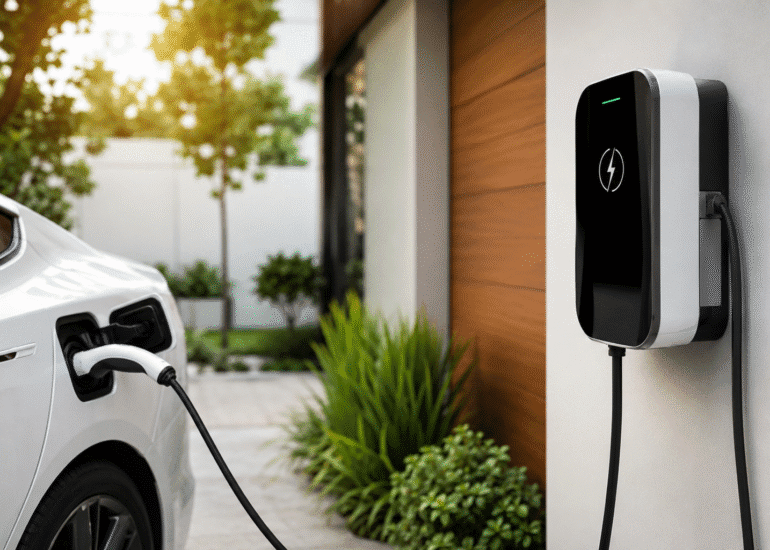
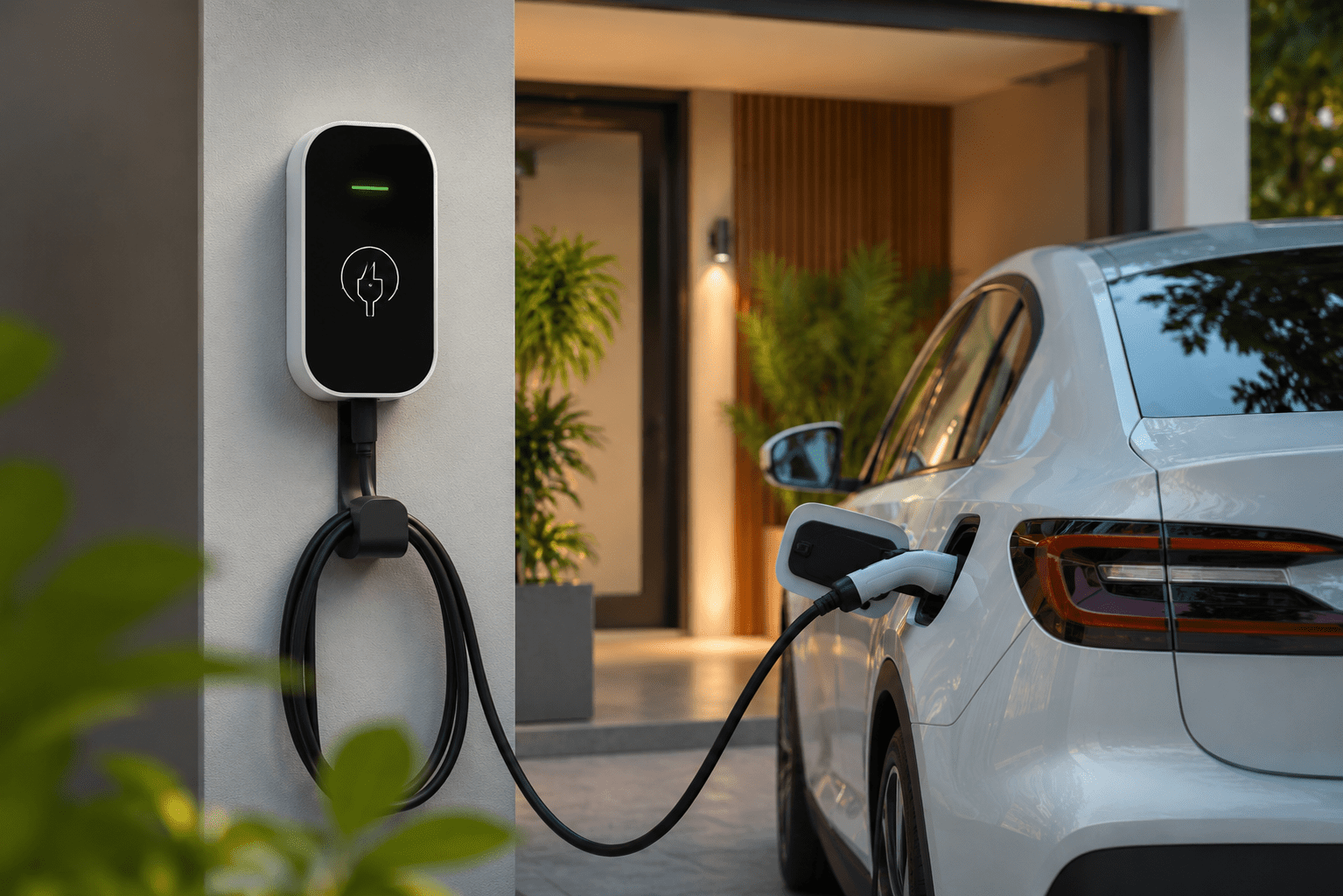
The charger unit mounts on a wall or post near your parking space. The electrician connects it to the dedicated circuit, ensures waterproofing and physical security, and performs continuity and insulation tests before energising the circuit.
Step 6 — Commission and Test the System
The installer activates the charger, connects it to the management app or platform, and conducts a live test session with your vehicle. You verify that the app displays charging status correctly, that the session stops and starts on command, and that the energy reading matches your vehicle’s dashboard. A signed commissioning report closes the installation.
Real Cost Breakdown: What You Actually Pay to Install EV Charger at Home
Understanding real costs — not just charger prices — helps you budget accurately and avoid mid-project surprises.
Charger Hardware: A smart 7.4 kW Level 2 wall box in India ranges from ₹15,000 to ₹45,000 depending on brand, features, and warranty terms. Basic non-networked chargers sit at the lower end; app-enabled, OCPP-compliant smart chargers with energy monitoring and scheduling occupy the higher range.
Electrical Wiring and Circuit: Running a dedicated 32-amp circuit from your distribution board to your parking bay typically costs ₹3,000 to ₹12,000 depending on cable length, conduit requirements, and whether the route passes through walls or ceilings.
MCB, RCCB, and Safety Components: A correctly specified safety board addition costs ₹2,000 to ₹5,000, including parts and labour.
Civil Work: If the charger mounts on a freestanding post, or if cable routing requires wall channelling and plastering, civil work adds ₹2,000 to ₹8,000.
Total Installed Cost: For most Indian homeowners, a complete smart home charging setup costs between ₹22,000 and ₹65,000 — a one-time investment that pays back through lower per-kilometre energy costs and elimination of public charging fees within 18 to 30 months for an average Indian EV user.
Government Subsidies That Reduce Your Home Charger Installation Cost
India’s central and state governments actively support home EV charging adoption through multiple financial incentive programmes.
FAME II Scheme: The Faster Adoption and Manufacturing of Hybrid and Electric Vehicles (FAME II) programme supports EV charging infrastructure deployment. While FAME II primarily targets public and semi-public stations, it has catalysed state-level home charging policies.
State-Level Incentives: Delhi’s EV Policy offers a direct subsidy of up to ₹6,000 on home charger purchase and installation. Maharashtra’s Maha EV Policy provides purchase incentives for EV owners that extend to charging infrastructure. Karnataka, Gujarat, Rajasthan, and Tamil Nadu all operate state EV policies with varying incentive structures — check your state DISCOM and transport department for current subsidy amounts and eligibility criteria.
Income Tax Deduction under Section 80EEB: Individual taxpayers who take a loan to purchase an electric vehicle can claim a deduction of up to ₹1,50,000 per year on interest paid. While this applies to the vehicle purchase loan, it reduces overall EV ownership cost and makes the accompanying charger investment more financially comfortable.
Expert Tips for a Smarter Home EV Charging Setup
These practical insights come from real-world installation experience across thousands of home charging setups in India.
Future-proof your circuit from day one. If you install a 7.4 kW charger today, run wiring capable of supporting 11 kW or 22 kW. Wiring upgrades later cost far more than buying slightly heavier cable at installation time.
Choose a charger with energy monitoring built in. A smart charger that tracks kWh consumed per session gives you real data on your actual per-kilometre energy cost — information that motivates smarter charging habits and accurate expense tracking.
Install where ventilation exists. Garages and parking bays with good airflow keep the charger and cable at lower operating temperatures, extending both component life and battery health.
Schedule overnight sessions for off-peak hours. Most Indian state electricity boards charge lower tariffs between 11 PM and 6 AM. A smart charger with time-scheduling shaves 15–25% off your monthly charging electricity cost automatically.
Use a certified installer, not a general electrician. EV charger installation requires knowledge of OCPP commissioning, earth fault protection, and EVSE-specific safety standards. A general electrician can run the cable, but charger configuration requires specialist expertise.
How ElectreeFi Delivers End-to-End Home Charging Setup Across India
ElectreeFi brings over seven years of EV infrastructure experience, 70,000+ charging points deployed nationally, and a team of certified installation professionals who handle every stage of your home charging project — from site assessment and charger selection through electrical installation, platform commissioning, and ongoing 24×7 support.
The platform covers charger procurement, compatibility assessment, load analysis, licensed electrician deployment, app onboarding, and post-installation maintenance — giving Indian EV owners a single point of contact for their complete home charging journey.
Whether you own an independent house, live in an apartment, or manage a gated community that wants to serve multiple residents, a proven infrastructure partner makes the process seamless, compliant, and future-ready.
Stop relying on public stations. Start waking up to a full charge every morning. Connect with a certified home charging specialist and get your installation quote today.
Frequently Asked Questions (FAQs)
What electrical requirements do I need to install EV charger at home in India?
A standard home charging installation for a 7.4 kW wall box requires a dedicated single-phase 32-amp circuit running from your main distribution board to the charging point. Your home needs a minimum sanctioned load of 5 kW above your existing consumption baseline — so if your current load approval is 10 kW and your average consumption is 4 kW, you have sufficient headroom without an upgrade application. The dedicated circuit requires a 32-amp MCB and a 30mA RCCB (earth leakage protection) for safety. For three-phase 11 kW or 22 kW installations, the requirements scale accordingly. A certified electrician assesses your existing panel during a site visit and identifies any upgrade needs before installation begins.
How long does the home EV charger installation process take in India?
For homes that already have adequate electrical capacity, the full installation — from site assessment to live charging test — completes in one to two days. The site assessment takes one to two hours. Wiring and charger mounting occupy four to six hours of skilled labour. Commissioning and app setup adds another one to two hours. If your home requires a load enhancement from the state DISCOM, that approval process adds two to four weeks depending on your state and local DISCOM’s processing speed. Apartments that require housing society approval may need additional time for RWA meetings and approvals. Planning ahead and working with a provider who handles all coordination reduces the total elapsed time significantly.
Can I claim a subsidy when I install an electric car charger for home use in India?
Yes, several financial incentives apply to home EV charger installation in India, though availability and amount vary by state. Delhi’s EV Policy provides a direct subsidy of up to ₹6,000 on home charger purchase and installation for registered Delhi EV owners. Maharashtra’s EV policy offers purchase rebates that extend to charging infrastructure. Gujarat, Karnataka, Rajasthan, and Tamil Nadu all maintain active EV incentive programmes — visit your state transport or energy department’s official portal for current details. Additionally, if your vehicle purchase involved a loan, you qualify for an income tax deduction under Section 80EEB on interest payments, reducing your overall EV ownership cost. Always retain purchase invoices and installation certificates, as these are required for subsidy claims and tax deductions.
Is it safe to install an EV charger at home, and what safety features should it have?
Home EV charging is completely safe when the charger carries BIS (Bureau of Indian Standards) certification, the installation follows IS 17017 standards, and a licensed electrician performs the electrical work. The charger itself must include built-in protections: over-voltage protection, under-voltage protection, over-current protection, short-circuit protection, earth fault detection, and temperature monitoring. The dedicated circuit must include a correctly rated RCCB to cut power within milliseconds of detecting earth leakage — protecting both people and property. The charging cable must carry a minimum IP54 weatherproof rating for outdoor or semi-outdoor installations. Never use a standard extension cord or multi-socket adapter for regular EV charging; the sustained current draw generates heat that creates genuine fire risk. Investing in certified hardware and professional installation removes all practical safety concerns.
What happens if I live in an apartment — can I still install an EV charger at home?
Apartment residents can absolutely install home EV chargers, though the process involves one additional layer of coordination: obtaining approval from the Resident Welfare Association (RWA) or the building management committee. Most state electricity boards, including BSES and BYPL in Delhi, MSEDCL in Maharashtra, and BESCOM in Karnataka, now provide dedicated guidelines for EV charger installation in multi-dwelling units. You submit a formal request to the RWA with the charger’s technical specifications, an electrical load report, and a proposed installation plan. Once the RWA approves, the DISCOM installs a separate sub-meter for your charging point, ensuring you pay only for the electricity your charger consumes — independent of the building’s common area supply. A reputable installation partner who has completed apartment installations before handles the documentation, DISCOM coordination, and society communication on your behalf, making the process far smoother than navigating it independently.
Published for ElectreeFi | Smart IoT & Electric Vehicle Charging Management Platform | Noida, Uttar Pradesh, India Contact: contact@electreefi.com | Business Enquiry: +91 97111 81070 | 24×7 Support: +91 70370 37013