End-to-end EV Charger Station Installation and Setup Solutions
At ElectreeFi, we offer comprehensive end-to-end solutions for EV charger station installation and setup, ensuring a seamless experience for our clients. Whether you’re an individual looking to venture into the business of charging stations or an organization seeking to expand your infrastructure, we provide expert EV consultation and one-stop solutions to meet your needs.
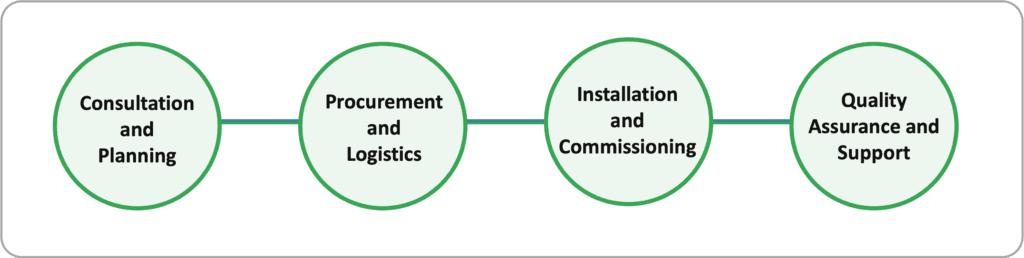
Comprehensive Consultation and Location Identification
Prime Location Selection
Charger Selection Assistance
Quality Charger Procurement
Seamless Electrical Connection
Installation, Commissioning, and Maintenance
Our team of experienced professionals ensures efficient installation and setup, adhering to industry best practices and safety standards. We oversee the entire process, from physical installation to system commissioning, to ensure that the charging station is up and running smoothly.
Efficient Shipping and Logistics
Professional Installation Services
Thorough Commissioning Process
Stringent Quality Assurance
Ongoing Support and Maintenance
What an ElectreeFi Installation Covers
Most EV charger installations go wrong on the electrical side, not the charger. A quotation that covers only hardware and mounting leaves the expensive parts — sanctioned load, transformer capacity, cable routing, earthing — to be discovered later. Our scope is deliberately end to end:
- Site survey and load study — available sanctioned load, spare transformer capacity, distance from the LT panel, cable route and parking layout.
- Charger selection — AC or DC, power rating and gun configuration matched to realistic dwell time, not to a catalogue.
- DISCOM liaison — commercial load application, EV tariff category, security deposit, service line and metering.
- Civil work — charger foundation, trenching, bollards, canopy, parking markings and signage.
- Electrical work — LT panel, cabling, dedicated earth pits, SPD, MCCB/RCCB and lightning protection.
- Commissioning — OCPP connection to the management platform, tariff configuration, payment integration and a live charging test on a real vehicle.
- Handover — as-built drawings, test certificates, warranty documentation and operator training.
Where We Install
Commercial and semi-public sites are where most of our work sits: fuel stations and highway plazas, shopping malls and retail parks, hotels and resorts, office campuses and IT parks, residential societies and gated communities, fleet and logistics depots, municipal parking, hospitals and educational campuses.
Each site type needs a different answer. A mall with three-hour dwell times is better served by several AC 22 kW points than one DC charger; a highway plaza is the opposite. We size the installation around how long vehicles actually stay.
The Installation Process, Step by Step
| Stage | What happens | Typical time |
|---|---|---|
| 1. Site assessment | Physical survey, load measurement, cable route planning, photographs and feasibility report. | 1–2 days |
| 2. Design and quotation | Single-line diagram, charger specification, bill of materials and a fixed-scope quotation. | 3–5 days |
| 3. DISCOM approval | Load sanction application, documentation, deposit and meter release. | 2–8 weeks |
| 4. Civil and electrical work | Foundation, trenching, panel, cabling, earthing and canopy. | 1–2 weeks |
| 5. Charger installation | Mounting, termination, insulation and earth-continuity testing. | 1–2 days |
| 6. Commissioning and go-live | Platform onboarding, tariff setup, payment testing, live charge test and training. | 1 day |
The DISCOM stage is almost always the long pole. Sites with adequate existing sanctioned load can go live in three to four weeks; sites needing a new connection or transformer should plan for two to three months. We begin the utility paperwork in parallel with design rather than after it.
Standards and Compliance
Installations are executed to Indian standards rather than generic practice: IS 17017 for conductive charging systems, BIS-certified charger hardware, OCPP 1.6J or 2.0.1 for platform communication so you are never locked to one charger brand, and the Ministry of Power’s charging infrastructure guidelines for public station requirements. Earthing, protection and cable sizing follow CEA safety regulations, and every commissioning is accompanied by test certificates.
This matters commercially as well as legally: chargers installed outside manufacturer specification routinely lose warranty cover, and non-compliant earthing is the most common reason a DISCOM withholds energisation.
What Installation Costs
Installation cost depends far more on the site than on the charger. As a planning guide, a commercial AC 22 kW point lands at ₹1.5–3 lakh, a 30 kW DC station at ₹12–18 lakh, and a 120 kW highway charger at ₹25 lakh and above — figures that include civil work, DISCOM connection and commissioning, not just hardware.
For the full line-by-line breakdown, including transformer costs, running costs and payback at different utilisation levels, see our detailed guide to EV charging station cost in India. For homes and small societies, see installing an EV charger at home.
After Installation
A charger that is installed but unmonitored stops earning the first time it faults. Every installation is connected to the ElectreeFi charging management platform for real-time monitoring, remote diagnostics, tariff control and settlement, and can be covered by our operation and maintenance services with 24/7 support and CAMC. Payment solutions for UPI, cards and QR are configured at commissioning.
Coverage Across India
We install nationwide, with concentrations in Delhi, Noida, Gurugram, Mumbai, Pune, Bengaluru, Hyderabad, Chennai, Ahmedabad and Kolkata. More than 32,000 charge points have been deployed across India on our platform, which means our cost and timeline estimates come from completed projects rather than assumptions.
Experience a hassle-free journey from conception to completion with our comprehensive solutions.
Frequently Asked Questions
Timelines depend on site readiness and charger type, but ElectreeFi manages the full process, from procurement to commissioning, to keep installation on schedule.
You need a suitable location, adequate electrical infrastructure, and the right charger specification. ElectreeFi’s consultants assess all three during site evaluation.
Costs vary with charger capacity, site conditions, and electrical upgrades required. Get in touch for a detailed installation estimate.
Most installations require compliance with local electrical and safety regulations. ElectreeFi’s team handles this coordination as part of the setup process.
Yes. ElectreeFi identifies prime locations based on foot traffic, accessibility, and electrical capacity to maximize return on investment.
Yes. We are charger-agnostic. We install and commission hardware from any BIS-certified manufacturer, and connect it over OCPP 1.6J or 2.0.1 so you are never locked to a single brand. If you have already purchased chargers, we can install and commission those.
Installations follow IS 17017 for conductive charging systems, use BIS-certified charger hardware, and comply with CEA safety regulations for earthing, protection and cable sizing. Platform communication uses OCPP. Every commissioning is handed over with test certificates and as-built drawings.
Typically two to eight weeks, depending on the state and whether a new connection or transformer is required. It is almost always the longest stage of a project, so we begin the utility application in parallel with design rather than after it.
Yes. Societies are one of our most common site types. These installations usually need RWA approval, a decision on shared versus individual metering, and a load study to confirm the existing connection can support the chargers. We handle all three as part of the scope.
Installation includes warranty support and handover training. Ongoing operation is covered separately through our operation and maintenance services, which provide 24/7 call support, on-site field support, remote diagnostics through the management platform, and Comprehensive Annual Maintenance Contracts.