Electric vehicle ownership in India has moved past the early adopter stage. Buyers in Delhi, Mumbai, Bangalore, and smaller tier two cities now ask one practical question before they sign the purchase papers. What does a proper EV home charging setup cost, and what does the process actually involve.
This guide breaks down the real numbers for 2026. It covers charger types, wiring costs, monthly electricity impact, and society approvals, so you can plan your budget with confidence.
Why EV Home Charging Setup Matters More Than Public Stations
Public charging stations remain useful for long trips, but they cannot match the convenience of plugging in overnight at home. You wake up to a full battery every morning without hunting for an available charge point.
Home charging also costs far less per kilometre than petrol or even public fast charging. Most owners save between two and a half and four rupees per kilometre once they shift to home charging on a normal domestic tariff.
Steps to Install EV Charger at Home
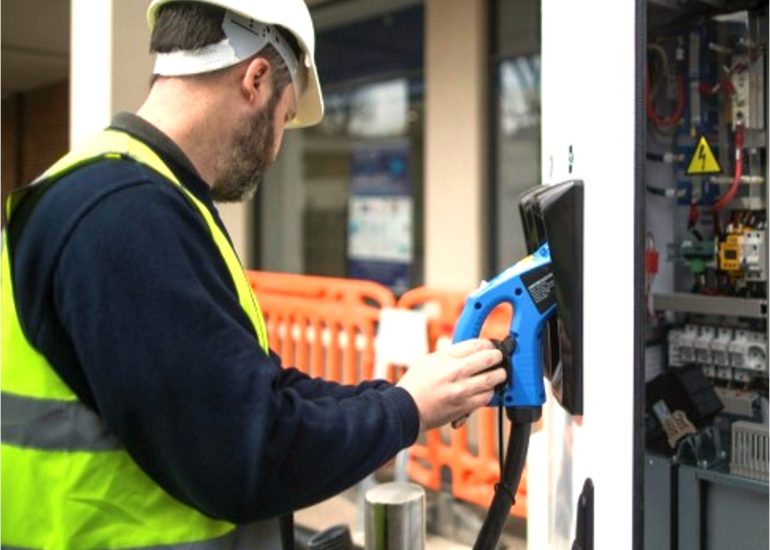
The process usually follows four stages. First, an electrician checks your sanctioned electrical load and panel capacity. Second, they run a dedicated circuit with proper earthing and a correctly rated RCCB. Third, the charger gets mounted and tested under full load. Fourth, you collect the society NOC and BIS certification proof for your records.
Many first time buyers choose to install EV charger at home instead of relying only on public stations, mainly because it removes daily range anxiety and cuts long term running costs. A qualified electrician should always handle this work. Home charging draws a heavy current for several hours at a stretch, often while you sleep, and a rushed or undersized job creates a genuine fire risk.
Charger Types and Their Real Cost
Most new EVs in India ship with a free 3.3 kW portable charger. This unit plugs into a standard 15A or 16A socket and works fine for owners who drive under 50 kilometres a day. Setting up a dedicated socket, MCB, and safe wiring for this portable option typically costs between three thousand and eight thousand rupees.
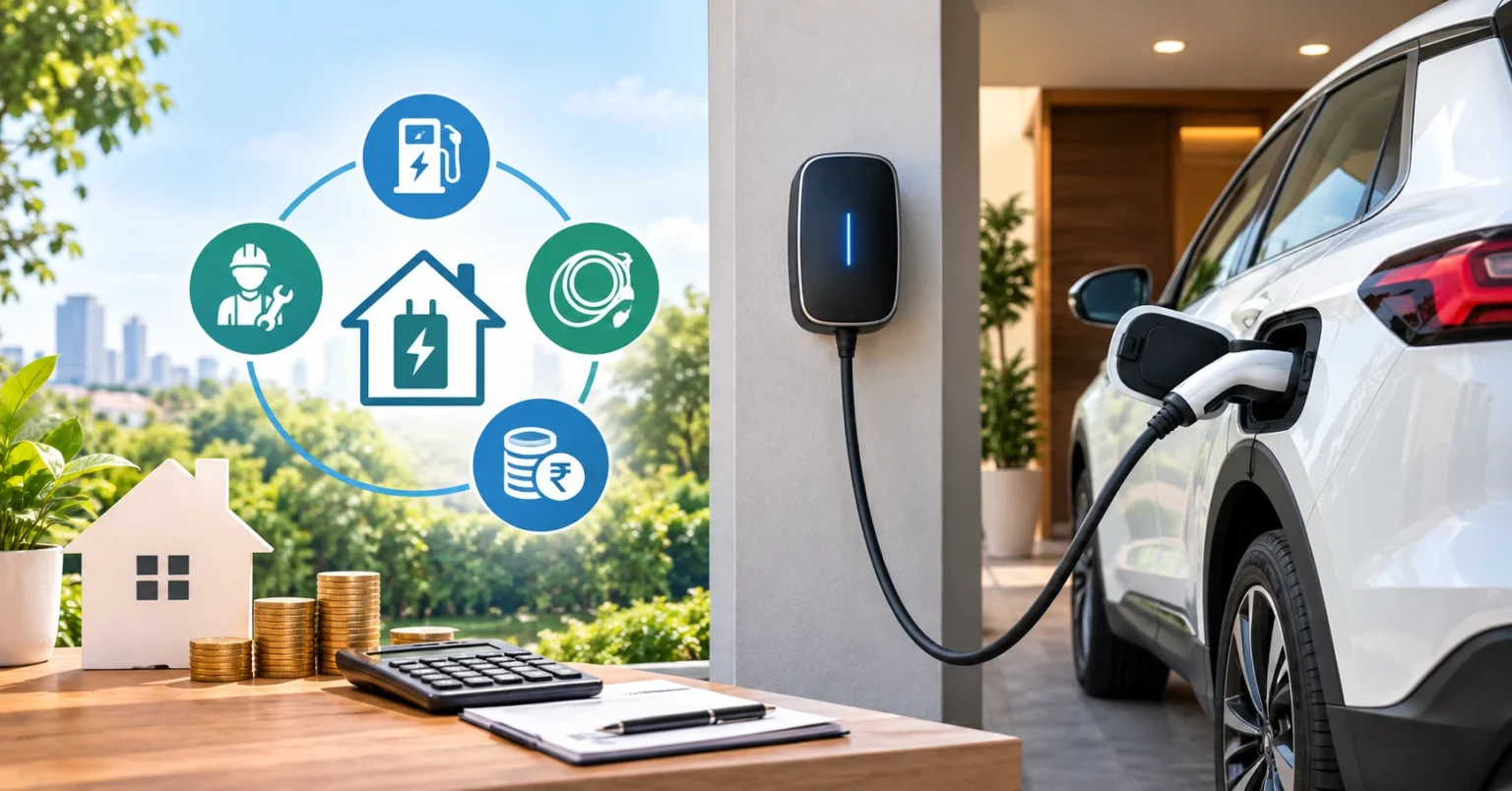
Owners who drive longer distances or own bigger battery EVs often upgrade to a 7.2 kW wall mounted charger. This cuts charging time from over twelve hours down to five or six hours. A basic wallbox from a known brand costs around thirty five thousand to forty five thousand rupees, while smart app connected models can reach sixty five thousand rupees.
Add cabling, protective switchgear, and labour, and a complete installed setup usually lands somewhere between forty thousand and one lakh twenty thousand rupees, depending on your city, cable run length, and whether your home needs a load upgrade from the local DISCOM.
Picking the Right Electric Car Charger for Home
Picking the right electric car charger for home depends heavily on your daily driving pattern rather than the flashiest specification sheet. A commuter who drives thirty to forty kilometres daily rarely needs anything beyond the bundled portable unit.
Someone who drives over one hundred kilometres a day, or who owns two electric vehicles in the same household, benefits from the faster 7.2 kW wallbox. Always confirm that your electrician uses a Type B RCCB rather than a cheaper Type A unit, since EV chargers can leak DC current that only Type B protection can detect safely.
Impact on Your Monthly Electricity Bill
Charging an EV at home adds a predictable and manageable cost to your monthly bill. A typical owner driving around one thousand kilometres a month adds roughly twelve hundred to sixteen hundred rupees to their electricity expense, depending on their state tariff and vehicle efficiency.
Several DISCOMs now offer concessional time of day tariffs for EV owners. Delhi BSES and Tata Power Delhi charge around four rupees fifty paise per unit on a separate EV meter, while states like Maharashtra and Karnataka offer similar discounted slabs during the ten in the evening to six in the morning window. Applying for a separate EV connection or sub meter through your DISCOM can lower your effective charging cost noticeably.
RWA Approval and Government Rules
Residents living in apartment complexes sometimes worry that their housing society will refuse permission. Under the Ministry of Power’s revised EV charging guidelines and the model building bye laws, RWAs cannot arbitrarily block a compliant EV charger installation in your allotted parking spot, provided you cover the cost and hire a certified electrician.
You are generally entitled to either use the common area meter with a sub meter, or apply for an independent EV specific connection from your DISCOM. New apartment buildings with twenty or more units, approved after 2022 in states like Delhi, Maharashtra, Karnataka, and Uttar Pradesh, must already reserve twenty percent of parking as EV charging ready under state EV policies. Getting written RWA approval before work begins avoids disputes later.
Smart Charging and Long Term Savings
A smart charger connected to a mobile app lets you schedule charging sessions during cheaper night time tariff windows automatically. This single habit change can meaningfully reduce your annual electricity spend without any change in your driving pattern.
Owners who pair home charging with rooftop solar panels push their running cost even lower, sometimes close to free charging during daylight hours. Over a five year ownership period, the combined savings from home charging and smart scheduling comfortably cross two lakh rupees compared to an equivalent petrol vehicle.
Managing Your Charging With the ElectreeFi App
Monitoring your charging sessions, tracking energy consumption, and locating nearby public stations becomes far simpler with the right mobile app. ElectreeFi offers a dedicated application that lets EV owners book chargers, monitor live charging status, and manage payments from one screen, whether you are charging at home, at work, or on the road.
The ElectreeFi app is available for download on both the Google Play Store and the Apple App Store, giving Android and iPhone users the same seamless charging experience across India’s growing charging network.
Final Thoughts
Setting up home charging in 2026 costs anywhere from a few thousand rupees for a basic socket to over a lakh rupees for a premium smart wall box with a full load upgrade. The right choice depends on your daily driving distance, your building’s electrical capacity, and whether you plan to add a second EV down the line.
Get a proper site assessment from a certified electrician before committing to any charger model. This single step protects your investment, keeps your home safe, and ensures your charging setup actually matches how you drive.
Frequently Asked Questions
How much does it cost to install an EV charger at home in India?
A basic setup with a portable charger and dedicated socket costs three thousand to eight thousand rupees. A full wall mounted charger installation with wiring and switchgear typically costs forty thousand to one lakh twenty thousand rupees, depending on charger capacity and load upgrade needs.
Can I charge my EV using a normal home socket?
You can use a standard 15A or 16A socket for the free portable charger that comes with most EVs. However, a licensed electrician must first verify your home’s wiring and earthing to ensure it safely handles sustained high current for several hours.
Do housing societies allow EV charger installation?
Yes. Under current Ministry of Power guidelines, RWAs cannot arbitrarily refuse a compliant installation in your allotted parking spot, as long as you bear the cost, use a certified electrician, and provide the required documentation.
How much does home EV charging add to my electricity bill?
A typical owner driving around one thousand kilometres monthly sees their bill rise by roughly twelve hundred to sixteen hundred rupees, though this varies by state tariff, charger efficiency, and whether you use a discounted EV meter.
Should I choose a portable charger or a wall mounted charger?
Portable chargers suit owners driving under fifty kilometres daily and cost far less upfront. Wall mounted 7.2 kW chargers suit longer commutes or multi EV households, since they cut charging time from twelve hours down to five or six hours.