You just drove your new EV home, and one big question hits you at the parking spot. Most EV owners in India charge overnight, so the right electric car charger for home shapes your daily drive more than any public station. Pick well, and you wake up to a full battery and a lower power bill every morning.
The market can feel confusing at first. You will see portable units, wall boxes, smart models and a long list of power ratings. Not every electric car charger suits every home, and a wrong pick can trip your mains, waste money or slow you down. This guide walks you through each factor in simple words, so you can buy with confidence.
Start With What Your EV Can Accept
Your car sets the top charging speed, not the wall unit. Every EV carries an onboard charger that converts AC power from your home into DC power for the battery. If your car accepts 7.2 kW, a 22 kW wall box will still deliver only 7.2 kW.
Open your owner’s manual and note two things: the onboard charger rating and the connector type. Most new electric cars in India use the Type 2 connector. A quick check here saves you from paying for speed your car can never use.
Pick the Right Power Rating for Your Electric Car Charger for Home
Home chargers in India usually fall into four groups. Each one suits a different car, budget and power supply.
- Portable charger (about 2.3 to 3.3 kW): It plugs into a 15A socket. It works well as a backup, but a full charge on a big battery can take more than 12 hours.
- 3.3 kW wall charger: It runs on a single phase supply and suits compact EVs and short city commutes.
- 7.4 kW wall charger: This option hits the sweet spot for most Indian homes. It fills a 40 kWh battery in roughly six hours, so one overnight session covers almost any daily drive.
- 11 kW or 22 kW wall charger: These need a three phase connection. Choose one only if your car’s onboard charger can take that much power.
Think about your daily distance too. If you drive 40 km a day, even a 3.3 kW unit refills that range in about two hours. Highway travelers and two EV families gain the most from a 7.4 kW model.
Check Your Home Electrical Load First
Your sanctioned load decides how much power you can safely draw. Many Indian homes run on a sanctioned load of 3 to 5 kW. A 7.4 kW charger running alongside two air conditioners can easily trip your main breaker or overload old wiring.
Before you buy, ask a licensed electrician to inspect your wiring, earthing, MCB rating and meter capacity. If your load falls short, you can apply to your DISCOM for a load increase. Several state DISCOMs also offer a special EV tariff or a separate meter for charging, so check the rules in your city. This small step keeps your bills clear and your home safe.
Never Compromise on Safety Features
Safety matters more than speed. A good wall charger protects your car, your home and your family at the same time. Look for these built in protections:
- Residual current protection (RCD) to stop earth leakage
- Over voltage, under voltage and over current protection
- Surge protection against monsoon lightning and grid fluctuations
- Temperature monitoring that cuts power when the unit overheats
- IP54 or higher rating if you park in an open or semi covered space
Also confirm that the brand follows Indian standards and provides proper certification papers. A certified electric car charger may cost a little more, but it pays you back through years of worry free use.
Choose Smart Features That Save Money
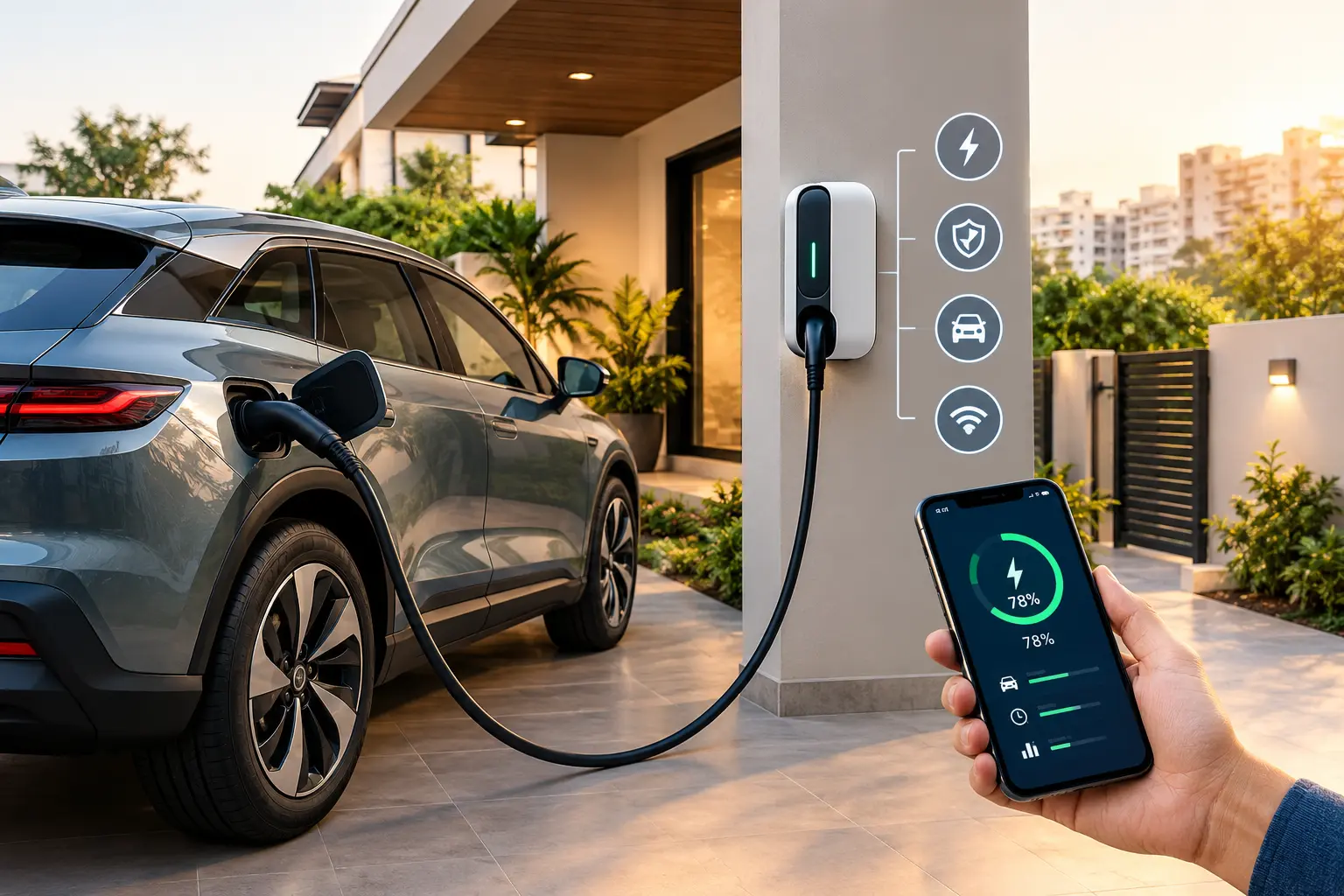
A smart charger connects to your phone through WiFi or a mobile network. It lets you start, stop and schedule sessions from anywhere. You can also track every unit of energy and see exactly what each charge costs you.
Scheduling brings the biggest savings. Several Indian states now offer time of day tariffs, which make late night power cheaper than peak hour power. Set your car to charge after midnight, and the app handles the rest. Smart charging with load management goes one step further. It balances power between your charger and your home appliances, so your mains never trip when the geyser and the AC run together.
Look for OCPP support as well. This open protocol lets your charger work with different software platforms, so you never get locked into one vendor. A companion EV charging app also helps you find public stations when you travel beyond your city.
Plan Installation for Your Type of Home
Independent houses make installation simple. Mount the wall box close to your parking spot, keep the cable run short and pick a spot away from direct rain. Most chargers come with a 5 metre cable, so measure the distance to your car’s charging port first.
Apartments need more planning. You will need approval from your RWA or society, a dedicated line from your own meter to the parking slot and a clear plan for cable routing. Many societies now prefer a shared setup, where residents use managed chargers and pay per session. A Park N Charge model makes this easy, because it handles access control, billing and fair usage for every resident.
Always hire trained technicians for the job. Professional EV charger installation and setup ensures correct wiring, proper earthing and a safe first test before you plug in.
Compare the Total Cost, Not Just the Price Tag
Most home wall chargers in India cost roughly ₹20,000 to ₹70,000, depending on power and features. Installation adds more, based on cable length, wiring upgrades and any meter work. Smart models cost a bit extra, but scheduled charging can recover that gap over time.
Do not judge an electric car charger by price alone. Ask about the warranty period, local service support and spare parts. A cheap unit with no service team nearby can leave your car stranded for days when a fault appears.
Quick Checklist Before You Buy an Electric Car Charger for Home
Run through this list before you place your order:
- Match the charger power to your car’s onboard charger
- Confirm the connector type (Type 2 for most new EVs)
- Check your sanctioned load and wiring condition
- Choose built in safety protection and the right IP rating
- Pick smart features like scheduling and app control
- Get society approval if you live in an apartment
- Compare warranty, service support and total installed cost
Power Up Your Home Charging the Smart Way
The right electric car charger depends on your car, your daily drive, your home wiring and your budget. Get these four factors right, and home charging becomes the easiest part of owning an EV.
ElectreeFi brings over seven years of experience in India’s EV ecosystem and connects more than 70,000 charging points across the country. Our team helps you pick the right model from our EV charger sales range, installs it safely and supports you long after setup. Talk to our experts today and find the perfect electric car charger for home for your EV. Contact us now and start every morning with a full battery.
Frequently Asked Questions
Which EV charger is best for home use in India?
A 7.4 kW wall charger suits most Indian homes. It works on a single phase supply and fills most car batteries overnight. Choose a smart model with safety protection and app control for the best value.
How much does it cost to install an EV charger at home in India?
Expect to spend roughly ₹20,000 to ₹70,000 on the charger itself. Installation costs extra and depends on cable length, wiring upgrades and meter work. A site check by a technician gives you the exact figure.
Can I charge my electric car from a normal 15A socket?
Yes, you can use the portable charger that comes with many EVs. Use a dedicated 15A socket with proper earthing. It charges slowly, so treat it as a backup rather than your daily option.
Do I need a separate meter for EV charging at home?
No, you can usually charge on your existing connection. However, several DISCOMs offer a separate EV meter with a lower tariff. Contact your local electricity board to check the rules and savings in your area.
How long does it take to charge an electric car at home?
A 7.4 kW charger fills a 40 kWh battery in about six hours. A 3.3 kW unit takes around 12 to 13 hours, while a portable charger can take even longer.