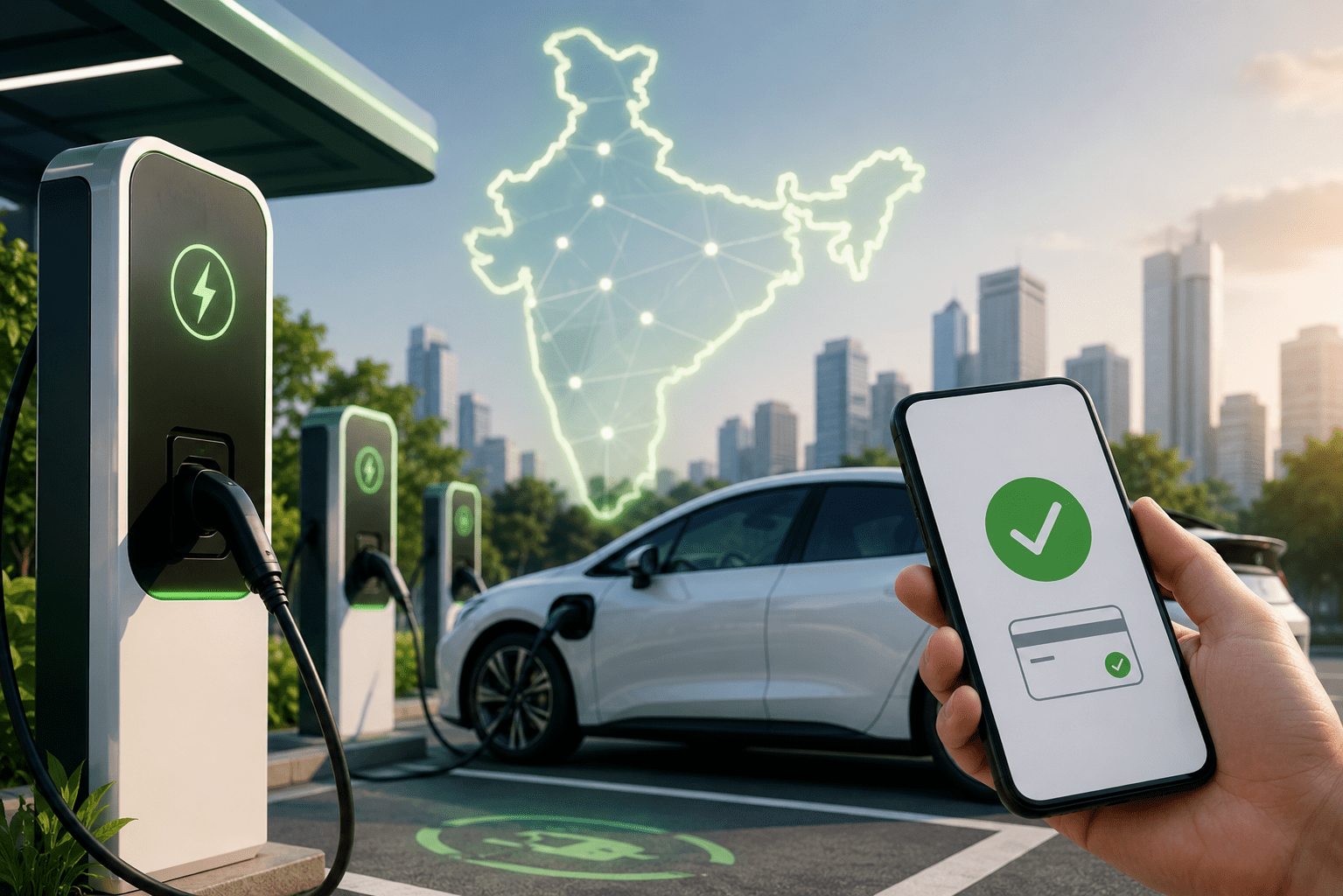
India’s electric vehicle revolution is no longer a distant promise — it is happening right now, on every highway, in every city, and across millions of driveways. EV sales in India crossed the 2 million mark in FY 2024-25, and that number continues to climb every quarter. But as the number of EVs on Indian roads grows, one critical challenge surfaces repeatedly: how do drivers pay for charging, and how do operators manage those payments efficiently?
The answer lies in deploying the right EV Charging Payment Solutions — technology that not only processes transactions but also builds trust, drives adoption, and keeps your charging network competitive in a rapidly evolving market.
Why Smart EV Charging Payment Solutions Drive Network Growth
A charging station without a seamless payment system is like a petrol pump with no billing counter. Drivers expect to arrive at any charger — whether at a mall, a highway, a fleet depot, or a residential complex — and pay instantly, securely, and conveniently. Operators, on the other hand, need real-time revenue tracking, automated settlements, and multi-site billing visibility.
When your payment infrastructure fails to deliver on either front, you lose customers and revenue simultaneously.
India’s charging landscape adds another layer of complexity. You serve EV users from different OEM ecosystems, different vehicle types (2-wheelers, 3-wheelers, 4-wheelers, and buses), and users with varied payment preferences — from UPI to wallets, RFID cards to app-based payments. A payment solution that cannot adapt to this diversity simply cannot scale across India.
Modern EV payment platforms solve this by combining IoT-enabled charger connectivity with cloud-based billing systems, giving operators total control and giving drivers complete convenience.
The Core Features That Make EV Charging Payment Solutions in India Work
If you evaluate EV Charging Payment Solutions in India, you will find that the most effective platforms share a common set of capabilities that set them apart from basic payment gateways.
- Multi-Modal Payment Acceptance
Indian users pay in multiple ways. A future-ready payment solution supports UPI, credit/debit cards, mobile wallets, prepaid RFID cards, and QR-code-based payments — all from a single platform. This flexibility reduces session abandonment rates and increases revenue per station.
- Real-Time Billing and Transparent Pricing
Drivers want to know exactly what they pay before a session begins. Smart payment systems display real-time per-unit pricing, estimated session costs, and final billing summaries. Transparent billing builds driver trust and reduces support queries for operators.
- RFID and App-Based Session Authentication
Operators serving fleet drivers or corporate users benefit from RFID-based access control. Fleet managers issue RFID cards or app credentials to drivers, enabling controlled access, cost centre billing, and detailed per-driver usage reports — all automated without manual reconciliation.
- Automated Revenue Settlement
Multi-site operators waste hours reconciling payments across locations. Automated settlement engines aggregate revenue across all charging points, deduct platform fees, and push settlements to operator bank accounts on a defined schedule — eliminating manual errors and speeding up cash flow.
- Dynamic Pricing and Time-of-Use Billing
Peak-hour pricing and time-of-use billing allow operators to incentivise off-peak charging, distribute load intelligently, and maximise revenue during high-demand windows. Payment platforms that support dynamic pricing rules give operators a genuine competitive edge.
- Roaming and Interoperability
India’s charging network spans multiple Charge Point Operators (CPOs). A driver who charges on one network should pay seamlessly on another. Roaming-enabled payment platforms allow drivers to use a single app or RFID card across partner networks — a feature that dramatically increases driver adoption and station utilisation rates.
How the Right Payment Solution Builds Operator Revenue
Every charging station represents a capital investment. Operators need that investment to generate predictable, growing returns. The right payment platform accelerates that return in three distinct ways.
First, it eliminates revenue leakage. Manual payment collection, cash-based systems, or poorly integrated gateways create gaps between energy delivered and revenue collected. Automated, meter-integrated billing captures every kilowatt-hour and converts it into an auditable transaction record.
Second, it expands your user base. Drivers actively avoid charging networks with poor payment experiences. When your station accepts every payment method, authenticates sessions in under five seconds, and never fails at checkout, word travels fast in EV communities. Your station becomes the preferred stop.
Third, it generates actionable data. Every transaction your platform processes creates a data point — session duration, energy consumed, peak hours, user demographics, and repeat visit rates. Operators who analyse this data make smarter decisions about pricing, expansion, and service improvements.
Serving Diverse Stakeholders Across India’s Charging Ecosystem
India’s EV charging market does not operate as a monolith. Different stakeholders have different requirements, and payment solutions must serve each one effectively.
Charge Point Operators (CPOs) need consolidated dashboards that show revenue across all sites, automate dispute resolution, and integrate with accounting software.
Fleet Operators require driver-level billing, kilometre-based cost tracking, and integration with fleet management software to calculate per-vehicle operating costs accurately.
Property Owners — whether malls, hotels, hospitals, or residential complexes — need white-labelled payment interfaces that carry their brand identity while running on a robust backend.
Government and Utility Partners need compliance-ready billing records, GST-integrated invoicing, and audit trails that satisfy regulatory requirements.
A truly enterprise-grade payment platform adapts its interface and reporting to match each stakeholder’s workflow, not the other way around.
Technology Backbone: What Powers a Reliable EV Payment Platform
Behind every smooth payment transaction at an EV charger is a stack of technologies working in perfect synchrony.
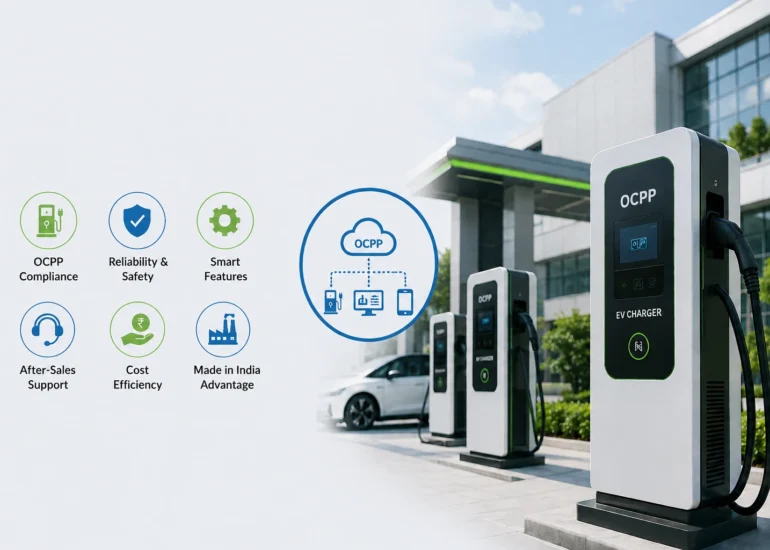
OCPP Compliance ensures that the payment platform communicates with chargers from any manufacturer. Without OCPP 1.6 or 2.0 compatibility, payment systems cannot trigger, monitor, or stop charging sessions reliably.
Cloud Infrastructure provides the uptime and scalability that charging networks demand. A payment platform hosted on resilient cloud architecture handles simultaneous transactions across thousands of stations without performance degradation.
PCI-DSS Compliance protects payment card data and ensures the platform meets international security standards — critical for building driver trust and satisfying banking partner requirements.
API-First Architecture allows the payment platform to integrate with third-party fleet management tools, ERP systems, loyalty programmes, and energy management dashboards without custom development for each integration.
AI-Powered Fraud Detection monitors transaction patterns in real time and flags anomalies before they result in financial losses — protecting both operators and drivers.
Why ElectreeFi Delivers the Most Comprehensive EV Charging Network Solutions
ElectreeFi brings over seven years of hands-on experience building and managing India’s EV charging ecosystem. With more than 70,000 charging points deployed across the country and over 15 million charging transactions processed, the platform understands what operators, fleet managers, and drivers actually need — not just in theory but in daily operational practice.
The platform supports the complete charging lifecycle: from charger procurement and station installation to IoT-enabled management, smart load balancing, roaming solutions, and seamless payment processing. Partners include India’s largest automotive brands, power utilities, fleet operators, and government agencies — a trust ecosystem built over years of consistent delivery.
Whether you operate a single charging hub or a national network spanning hundreds of sites, the right technology partner makes the difference between a charging business that struggles and one that scales.
The Right Time to Invest in Smart EV Charging Payment Solutions Is Now
India’s EV policy landscape strongly supports charging infrastructure development. FAME II subsidies, state-level EV policies, and the government’s push for green mobility are creating a historic window of opportunity for operators who act today.
The operators who build payment-ready, interoperable charging networks now will capture the lion’s share of India’s growing EV user base. Those who delay will spend the next decade catching up to networks that already own the driver relationship.
Choosing payment technology that scales, integrates, and adapts with the market is not just an operational decision — it is a strategic one that shapes your competitive position for the next decade.
Ready to Build a Future-Ready EV Charging Network?
If you are a charge point operator, fleet manager, property developer, or government agency looking to deploy or upgrade your EV charging infrastructure in India, the path forward starts with the right payment solution.
Explore how a complete, IoT-powered, payment-integrated charging platform can transform your network. Talk to an expert, request a demo, and discover the platform trusted by India’s leading EV stakeholders.
Your network. Your revenue. Your future. Start building it today.
Frequently Asked Questions (FAQs)
What payment methods do EV Charging Payment Solutions in India typically support?
Modern EV charging payment platforms in India support a wide range of payment methods to match user preferences across demographics and geographies. These include UPI (Unified Payments Interface), credit and debit cards, prepaid wallets, net banking, RFID card-based payments, and QR-code scanning through mobile apps. Enterprise platforms also support corporate billing accounts that allow fleet operators to centrally manage all driver-related charging costs without requiring individual drivers to carry separate payment instruments. The broader the payment acceptance, the higher the session completion rate and the stronger the station utilisation.
How do EV charging payment platforms handle billing for fleet operators in India?
Fleet payment platforms operate on a multi-layered billing architecture. Each driver or vehicle receives a unique identifier — either an RFID card, an app credential, or a QR code — which the payment system links to the fleet operator’s master account. Every charging session automatically records the driver ID, vehicle ID, energy consumed, session duration, and cost. The platform then generates consolidated billing reports at the fleet level, breaking down costs by vehicle, driver, site, or time period. Many platforms also integrate with fleet management software via API, enabling cost-per-kilometre calculations and seamless reconciliation with the operator’s existing accounting workflows.
What is roaming in the context of EV charging payments, and why does it matter for Indian operators?
Roaming in EV charging allows a driver registered on one charging network to access and pay for charging on a partner network using the same app or RFID card. For drivers, roaming eliminates the need to download multiple apps or carry multiple payment cards for different charging networks. For operators, roaming agreements expand the effective coverage area they offer drivers — making their network more attractive — while generating interoperability revenue from cross-network sessions. As India’s charging infrastructure grows across highways, cities, and rural corridors, roaming-enabled payment platforms become a critical tool for operators who want to serve a geographically mobile EV user base.
How do EV charging payment solutions in India protect operator and driver data?
Enterprise-grade EV payment platforms implement multiple layers of data security. Payment card data protection follows PCI-DSS standards, ensuring that card numbers and transaction details are never stored in plaintext. Drivers authenticate sessions through encrypted tokens, and all API communications between the charger, cloud platform, and payment gateway use TLS encryption. Operator dashboards enforce role-based access control, ensuring that staff members only access the data relevant to their function. Additionally, transaction records are stored with tamper-proof audit trails that satisfy both RBI guidelines and GST compliance requirements — a critical feature for Indian operators managing regulatory obligations.
How long does it take to integrate a payment solution with an existing EV charging network?
Integration timelines depend on the size of the network, the type of chargers deployed, and the level of customisation required. For networks using OCPP-compliant chargers — which most modern chargers in India support — a standard API integration with a cloud-based payment platform typically takes between two and six weeks. This includes charger onboarding, payment gateway configuration, dashboard setup, and user testing. White-labelled deployments or custom ERP integrations may take longer. The most important factor is whether the payment platform offers a well-documented API and a dedicated integration support team — both of which significantly reduce deployment timelines and post-launch technical issues.
Published by ElectreeFi | EV Charging Management & Payment Solutions | Noida, India Contact: contact@electreefi.com | Business Enquiry: +91 97111 81070