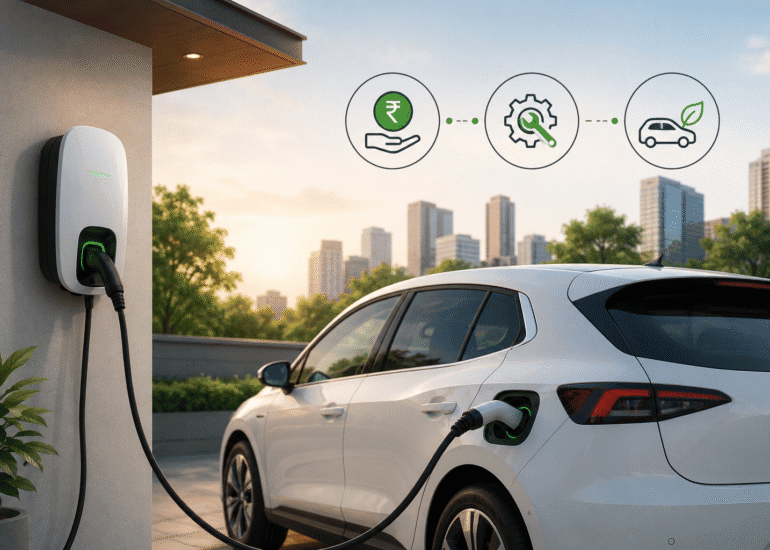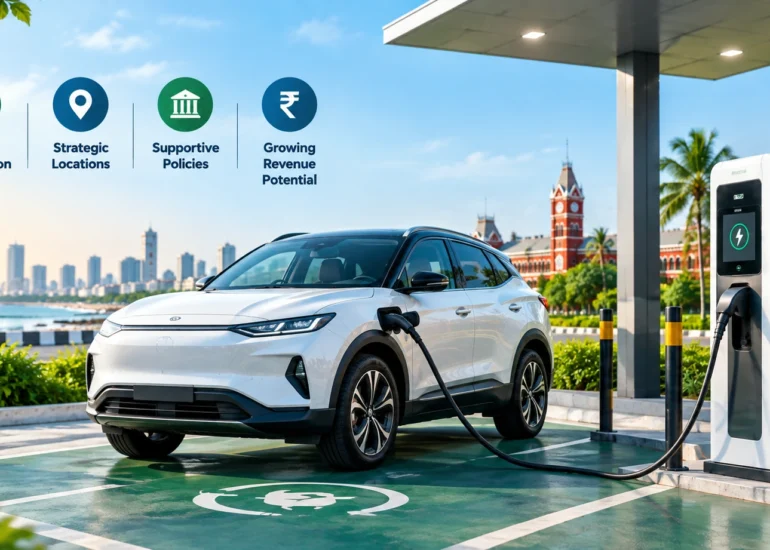
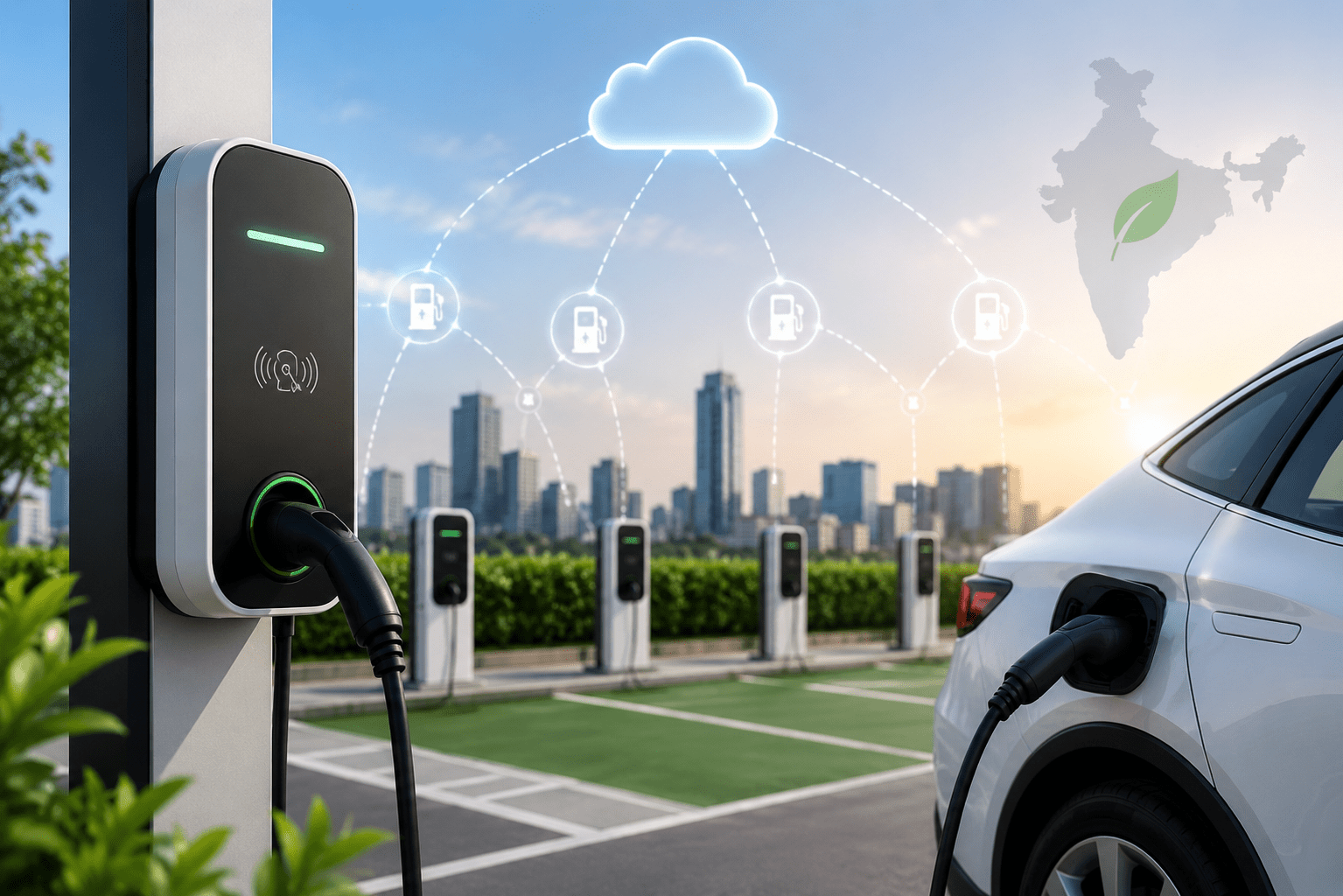
India’s EV charging industry is no longer in its pilot phase. Operators now manage networks spanning hundreds of stations across multiple cities. Fleet managers run dozens of vehicles through dedicated depot chargers every night. Property developers deploy smart charging bays across residential and commercial complexes. At every level of this expanding ecosystem, one technical question separates networks that scale from networks that stagnate: which communication protocol does your charger use?
The answer increasingly points to the OCPP 2.1 Lite EV Charger — the protocol standard that gives operators real-time control, hardware independence, and the interoperability backbone that growing charging networks demand. If you build, operate, or invest in EV charging infrastructure in India, understanding OCPP 2.1 Lite is not optional. It is the technical foundation on which every other capability rests.
What Is OCPP and Why Does It Define EV Charging Network Quality?
OCPP stands for Open Charge Point Protocol — an open-source communication standard developed by the Open Charge Alliance (OCA) that governs how EV charging stations (hardware) communicate with Central Management Systems (software). Think of OCPP as the common language that allows a charger from one manufacturer to report data, receive commands, and execute billing instructions from a management platform built by an entirely different company.
Without OCPP, charging networks lock operators into single-vendor ecosystems. A charger that only works with its manufacturer’s proprietary software forces you to stay with that vendor forever — regardless of whether their pricing, support quality, or feature roadmap serves your business. OCPP breaks that lock. It lets you choose the best charger hardware and the best management software independently, then connect them without custom integration work.
Since its original release, OCPP has evolved through several versions: OCPP 1.5, 1.6, 2.0, 2.0.1, and now 2.1. Each version expanded capabilities, added security improvements, and introduced new features that address the evolving complexity of commercial charging networks.
OCPP 2.1 Lite vs OCPP 2.0.1 EV Charger: Understanding the Difference
The transition from OCPP 2.0.1 to 2.1 represents a meaningful technical evolution, and understanding the differences helps operators make smarter procurement and deployment decisions.
The OCPP 2.0.1 EV charger introduced foundational improvements over OCPP 1.6 — most notably enhanced cybersecurity through TLS encryption, improved smart charging capabilities, more granular transaction reporting, and support for ISO 15118 plug-and-charge authentication. OCPP 2.0.1 became the baseline standard that serious operators adopted to future-proof their networks after the limitations of 1.6 became apparent at scale.
The OCPP 2.1 Lite EV Charger builds on that foundation with several targeted enhancements designed for large-scale network deployment. OCPP 2.1 introduces improved support for bi-directional charging (V2G and V2H), enhanced smart charging profiles that handle dynamic load balancing with greater precision, expanded ISO 15118-20 compatibility for Plug & Charge without QR codes or RFID cards, better tariff communication structures, and improved firmware update management for remote over-the-air updates across entire charger fleets.
The “Lite” designation in OCPP 2.1 refers to a streamlined implementation profile designed specifically for resource-constrained hardware — chargers that need full OCPP 2.1 functionality without requiring the processing power of enterprise-grade hardware. This makes OCPP 2.1 Lite particularly valuable for deploying cost-effective charging points at scale across India, where network operators must balance feature richness with hardware cost across large deployments.
For Indian operators currently running OCPP 1.6 chargers, the upgrade path to OCPP 2.1 Lite represents the single most impactful technical investment they can make to extend network longevity and competitive capability.
Five Reasons OCPP 2.1 Lite EV Charger Is Transforming Indian Charging Networks
- Genuine Hardware Independence Across 48+ Charger OEMs
India’s charging market features charger hardware from dozens of manufacturers — domestic brands like Exicom, Servotech, and Delta, alongside global names. Network operators who deploy across multiple locations rarely use chargers from a single manufacturer. OCPP 2.1 Lite creates a standardised communication layer that allows management platforms to control and monitor all of these chargers through a single dashboard without individual integration projects for each OEM. This independence gives operators genuine negotiating power on hardware pricing and eliminates the technical debt of managing multiple proprietary integrations.
- Advanced Smart Charging and Load Management
OCPP 2.1 introduces enhanced smart charging profiles — specifically, ChargingProfile and CompositeSchedule improvements — that allow management systems to issue more precise, real-time power allocation instructions to individual chargers or groups of chargers. For Indian operators managing multi-charger installations at apartment complexes, fleet depots, or commercial properties with shared electrical connections, this means the management platform distributes available power intelligently across all active chargers, prevents grid overloads, and prioritises charging sessions based on operator-defined rules. The result is higher charger utilisation, lower electricity demand charges, and a better experience for drivers.
- ISO 15118 Plug & Charge Readiness
ISO 15118 defines the digital communication standard between an EV and a charger that enables automatic authentication and billing without a driver touching a card or app. When a driver plugs in, the vehicle identifies itself to the charger, authenticates the session, and billing begins — completely automatically. OCPP 2.1 Lite’s expanded ISO 15118-20 compatibility positions networks for full Plug & Charge deployment as more Indian EVs adopt this capability. For operators, this means lower session friction, higher driver satisfaction, and reduced dependence on RFID card infrastructure.
- Built-In Cybersecurity for Enterprise-Grade Networks
OCPP 2.0.1 introduced TLS-based encryption, and OCPP 2.1 strengthens the security architecture further with improved certificate management, enhanced authentication mechanisms, and better protection against replay attacks and command injection. For commercial charging networks in India — where payment data, user credentials, and operational commands all flow through the same communication channel — this security architecture is not a nice-to-have. It is a fundamental requirement for regulatory compliance and driver trust.
- Remote Firmware Management at Fleet Scale
Managing firmware across hundreds of chargers distributed across multiple cities is one of the most time-consuming operational challenges for Indian CPOs. OCPP 2.1 introduces improved firmware update workflows — structured, reliable, and remotely triggered over-the-air updates that operators initiate from a central dashboard. When a manufacturer releases a security patch or a feature update, you push it to all affected chargers from a single interface rather than coordinating technician visits to each site. This capability alone reduces operational costs significantly for networks beyond 100 chargers.
Who Needs to Deploy an OCPP 2.1 Lite EV Charger in India Right Now?
The transition to OCPP 2.1 Lite matters most for specific stakeholder groups, each facing distinct operational challenges.
Charge Point Operators building highway corridors need chargers that remote-manage seamlessly, update automatically, and integrate with roaming platforms across partner networks. OCPP 2.1’s improved roaming support and firmware management directly address their biggest operational cost drivers.
Fleet depot operators running high-throughput overnight charging cycles need granular session-level data, dynamic load balancing across 10 to 100+ chargers, and per-vehicle billing — all capabilities that OCPP 2.1 Lite’s enhanced smart charging and transaction reporting deliver.
Commercial property developers building EV-ready infrastructure need chargers that work with any future management platform, not just the one available today. OCPP 2.1 Lite compliance guarantees that chargers you install today remain compatible with platforms five years from now.
Government-backed charging corridor projects require chargers that meet interoperability standards mandated by India’s Bureau of Energy Efficiency (BEE) and the Ministry of Power guidelines — both of which increasingly reference OCPP 2.0.1 and 2.1 as the expected baseline for publicly funded infrastructure.
Selecting the Right OCPP 2.1 Lite EV Charger for Your Network
Hardware selection for a compliant OCPP 2.1 Lite deployment requires evaluating five criteria simultaneously.
Protocol Compliance Certification: Verify that the charger carries Open Charge Alliance (OCA) certification for OCPP 2.1. Manufacturer claims of OCPP 2.1 compatibility without third-party certification often mean partial implementation — which breaks interoperability with management platforms that rely on full protocol compliance.
Power Output and Connector Configuration: Match charger output to your use case. A 7.4 kW AC wall box serves workplace and residential deployments. A 22 kW AC charger suits semi-public locations. DC fast chargers from 30 kW to 150 kW serve highway corridors and fleet depots with rapid turnaround requirements.
Hardware Durability Ratings: Indian deployment environments demand IP54 or higher weatherproofing for outdoor chargers, operating temperature tolerance from -10°C to 55°C, and vandal-resistant enclosures for high-traffic public locations.
Management Platform Compatibility: Confirm that your chosen CPMS (Charge Point Management System) fully supports OCPP 2.1 before purchasing hardware. A perfectly compliant charger paired with a platform that only partially implements OCPP 2.1 still produces integration gaps.
Local Service and Warranty Support: Hardware failures at remote locations drain operational budgets if the manufacturer lacks Indian service infrastructure. Prioritise OEMs with certified service centres in your deployment regions.
How ElectreeFi Powers OCPP-Compliant Charging Networks Across India
ElectreeFi’s IoT-based Charge Point Management System supports OCPP 1.6, 2.0.1, and 2.1 across 48+ charger OEMs — giving operators the freedom to deploy any compliant hardware while managing every station through a single, unified platform. With over 70,000 charging points active nationally, 15 million transactions processed, and integrations covering 15+ roaming networks, the platform delivers the technical depth and operational scale that serious charging network operators require.
From smart load management and real-time remote diagnostics to automated billing, payment processing, and 24×7 monitoring, every capability the platform offers builds on OCPP’s open communication foundation — ensuring your network stays interoperable, scalable, and future-ready regardless of how the hardware market evolves.
Build your OCPP 2.1-compliant charging network on a platform that has already proven itself at national scale. Get in touch with a charging infrastructure specialist today.
Frequently Asked Questions (FAQs)
What does OCPP 2.1 Lite mean, and how is it different from full OCPP 2.1?
OCPP 2.1 defines the complete communication standard between EV charging hardware and management software. The “Lite” profile within OCPP 2.1 is a defined subset of the full standard designed for chargers with limited embedded processing capability — typically AC wall box chargers and smaller DC units. The Lite profile includes all core communication, smart charging, security, and transaction management features while omitting certain advanced functions (such as some display communication messages) that only apply to high-end hardware with rich user interfaces. For most commercial deployments in India, an OCPP 2.1 Lite-compliant charger delivers 100% of the functionality operators need — remote monitoring, smart charging profiles, automated billing, firmware updates, and ISO 15118 readiness — without the hardware cost premium that full OCPP 2.1 edge-case features require.
Can I connect an OCPP 2.1 Lite EV charger to my existing OCPP 1.6 management platform?
OCPP versions are not backward-compatible in the sense that a charger and a management platform must speak the same protocol version to communicate fully. However, most enterprise-grade Charge Point Management Systems (CPMS) support multiple OCPP versions simultaneously — including 1.6, 2.0.1, and 2.1. If your management platform supports multi-version operation, you can add OCPP 2.1 Lite chargers to your existing network without replacing your platform. The new chargers operate in OCPP 2.1 mode, accessing advanced features, while your older chargers continue operating in OCPP 1.6 mode — all visible from the same dashboard. Before purchasing new OCPP 2.1 Lite hardware, confirm explicitly with your platform provider that they support 2.1 in production (not just on a development roadmap), as partial implementations create session management gaps that affect billing accuracy.
Does the OCPP 2.0.1 EV charger still make sense for new deployments in India in 2026?
The OCPP 2.0.1 EV charger remains a valid choice for specific deployment contexts — particularly where budget constraints exist and where operators do not yet need V2G capabilities or ISO 15118-20 Plug & Charge. OCPP 2.0.1 delivers significantly better security, smarter charging profiles, and better transaction reporting compared to OCPP 1.6, making it a strong upgrade from legacy infrastructure. However, if you plan to deploy infrastructure that will serve your network for the next five to eight years, specifying OCPP 2.1 Lite from the outset makes more strategic sense. The incremental hardware cost difference between OCPP 2.0.1 and OCPP 2.1 Lite chargers is narrowing rapidly as more manufacturers release 2.1-compliant units, and the long-term interoperability and V2G-readiness benefits justify the marginal additional investment.
How does OCPP 2.1 Lite improve smart charging and load management for apartment complexes in India?
OCPP 2.1 Lite introduces enhanced ChargingProfile structures and improved CompositeSchedule resolution that allow management platforms to issue power allocation instructions with greater precision and frequency than OCPP 1.6 or even 2.0.1. In an apartment context, where 20 to 50 EV charging points share a fixed electrical connection, the management platform continuously monitors total load, available capacity, and each active session’s requirements. It then issues updated power allocation commands to individual chargers every few seconds — dynamically redistributing energy as residents start and stop sessions throughout the evening. This prevents circuit breaker trips, eliminates demand charge spikes, and ensures that all residents receive fair, consistent charging access without requiring a grid capacity upgrade. For apartment developers and housing societies, this capability is the difference between a charging network that works reliably every night and one that causes electrical complaints.
What should I verify before buying an OCPP 2.1 Lite EV charger for a commercial charging station in India?
Verify six things before committing to any OCPP 2.1 Lite hardware purchase for a commercial deployment. First, confirm OCA (Open Charge Alliance) certification for OCPP 2.1 — not just a manufacturer’s self-declaration. Second, verify that your chosen management platform supports OCPP 2.1 in production environments, not just in beta. Third, check connector compatibility with the vehicles your station will serve — CCS2 for most Indian four-wheelers, Type 2 AC for AC chargers, and CHAdeMO if you serve older Japanese models. Fourth, confirm the charger’s IP rating (minimum IP54 for outdoor, IP65 for exposed highway locations) and its operating temperature range for your deployment region. Fifth, verify GST-compliant invoicing support within the management platform, as BIS and DISCOM compliance requirements in India mandate proper billing documentation. Sixth, confirm the manufacturer’s Indian service network — warranty terms mean nothing if the nearest service centre is in another region. An experienced infrastructure partner who has deployed OCPP 2.1 Lite chargers across multiple Indian sites can guide you through each of these checks systematically.
Published for ElectreeFi | Smart IoT & Electric Vehicle Charging Management Platform | Noida, Uttar Pradesh, India Contact: contact@electreefi.com | Business Enquiry: +91 97111 81070 | 24×7 Support: +91 70370 37013