India’s highways are changing faster than most drivers expected. Petrol pumps once ruled every stretch of national highway, but electric vehicles now share that same space with confidence. Long distance travel no longer feels like a gamble for EV owners, because charging points wait for them at regular intervals.
This shift did not happen overnight. Government policy, private investment, and smarter infrastructure planning came together to make it possible. Together they created the conditions for EV Charging Hubs to spread across major corridors connecting Delhi, Mumbai, Bengaluru, and dozens of other cities.
What Is Driving the Rise of EV Charging Hubs
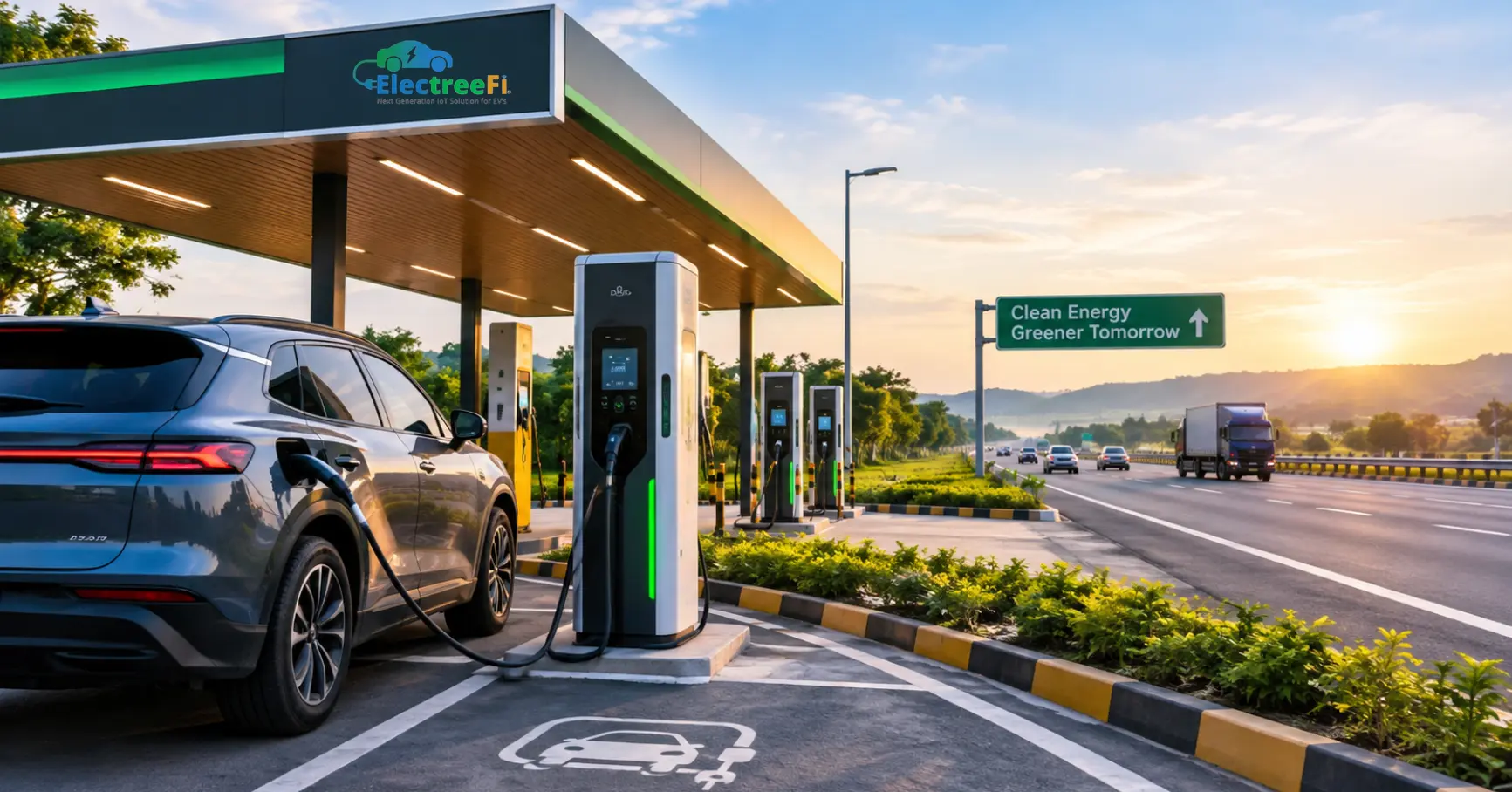
Highway corridors used to have a charger here and there, spaced too far apart for comfort. That pattern has flipped. Operators now cluster multiple fast chargers at a single site instead of scattering single connectors across a route.
A cluster model solves a real problem. Drivers arrive together during peak travel hours, and one lonely charger cannot serve five cars in a row. Multi gun hubs let several vehicles charge at once, cutting wait times and keeping traffic moving through rest stops.
Government norms now call for a charging point roughly every 25 kilometers on national highways. That benchmark pushed developers to treat highway charging as core infrastructure rather than an afterthought. Fuel retail outlets, logistics hubs, and highway rest stops became natural sites for this expansion.
Rising EV Adoption Fuels Highway Demand
Four wheeler EV sales have climbed steadily, and that growth changes travel habits. Families who once avoided long EV road trips now plan them, because they trust the charging network to show up when needed.
Fleet operators add pressure from another direction. Delivery companies and inter-city cab services run electric vehicles on fixed routes, and they need predictable charging stops to keep schedules on track. Their demand alone justifies dense charging clusters along busy corridors.
Two wheeler and three wheeler EVs dominate unit sales in India, yet four wheeler growth is what pushes highway hub expansion. Larger batteries need faster chargers, and faster chargers need dedicated real estate along the route.
Smart EV Charging Station Design Changes the Experience
A charging stop today looks nothing like the bare metal post from a few years ago. Modern EV Charging Station sites now include seating, food counters, and clean restrooms, turning a mandatory pause into something closer to a comfortable break.
Dwell time matters more than most people realize. Studies of site performance show that stations paired with retail or food service see notably higher utilization than standalone posts, because people naturally spend that time eating or resting anyway.
Smart load management adds another layer of value. Charging schedules now respond to real time grid conditions, which protects the local power supply during peak demand and keeps charging costs predictable for operators.
Why Charge Point Operators Are Investing Now
Return on investment used to worry every new operator entering this space. That hesitation is fading as utilization data proves out strong corridors between major cities.
Positive cash flow now arrives within three to five years for many operators, depending on location, charger type, and traffic volume. Analytics platforms help operators choose sites with confidence instead of guessing based on instinct alone.
Interoperability plays a growing role too. Roaming agreements let drivers access multiple networks through one app, so operators benefit from shared traffic instead of competing purely on brand loyalty. This cooperation accelerates growth across the whole highway charging ecosystem.
The Role of Technology in Scaling Highway Hubs
Manual monitoring cannot keep pace with a hub running dozens of sessions daily. Cloud based platforms now track every charger in real time, flagging faults before they turn into a stranded driver and a bad review.
Occupancy data, peak usage patterns, and revenue per charger all feed back into decisions about expansion. Operators who read this data correctly know exactly where the next hub should go, long before competitors catch up.
ElectreeFi supports this shift with a cloud based management platform built on open standards, connecting operators, chargers, and drivers across a growing highway network. The platform pulls live data from installed hardware so operators can manage pricing, uptime, and expansion from one dashboard instead of juggling separate tools for every site.
Challenges That Still Slow the Boom
Growth has not solved every problem yet. Tier two and tier three highway stretches still lag behind metro corridors, leaving gaps that frustrate long distance travelers heading away from major cities.
Charger reliability remains inconsistent across networks, and payment systems do not always talk to each other smoothly. A driver who hits a broken charger with no backup nearby loses trust quickly, even if the rest of the network performs well.
Grid capacity adds a quieter but serious constraint. Rural stretches of highway often lack the power infrastructure needed for multiple fast chargers running simultaneously, which limits how quickly hubs can scale in those areas.
What This Means for the Road Ahead
The direction is clear even with these gaps. Highway corridors connecting India’s biggest cities are becoming dependable EV routes, and that dependability changes buying decisions for everyday car owners.
Every new hub adds proof that electric road trips work in India, not just in theory but in daily practice. As more operators expand into underserved stretches, the remaining gaps will close faster than the first wave of infrastructure did.
Charge point operators who want a share of this growth need reliable technology behind every site. Contact ElectreeFi today to explore how a connected charging management platform can support your highway expansion plans.
Frequently Asked Questions
How many highway charging points does India have in 2026?
India crossed roughly 27,000 installed public charging stations by early 2026, with a large share concentrated along major highway corridors. Uttar Pradesh, Karnataka, Maharashtra, and Tamil Nadu lead installation numbers, driven by strong vehicle populations and active state policy support. Growth continues month over month as private operators expand beyond metro boundaries into connecting highway stretches.
Which highways in India have the best EV charging coverage?
Delhi-Mumbai, Delhi-Chandigarh, Mumbai-Pune, and the Bengaluru-Chennai corridor currently offer the strongest charging density. These routes benefit from high traffic volume and early operator investment. Coastal routes like Mumbai-Goa are improving too, though drivers should still plan stops carefully due to terrain and lower charger density in hilly sections.
How far apart are EV charging stations on Indian highways?
Government guidelines recommend one charging point roughly every 25 kilometers on national highways. In practice, coverage varies by corridor, with busier routes seeing tighter spacing and remote stretches still catching up. Multi gun hubs at key stops help reduce the practical wait time even where spacing looks sparse on paper.
What makes a highway charging hub profitable for operators?
Site selection drives most of the outcome, often deciding 60 to 70 percent of long term utilization. Locations paired with food service or retail see notably higher usage because charging time aligns with a natural break. Smart pricing, load management, and reliable uptime then convert that traffic into steady, predictable revenue.
Do highway charging stations support all EV brands and chargers?
Most modern platforms support open protocols like OCPP for charger communication and OCPI for roaming between networks. This means drivers are not locked into one brand, and operators can integrate chargers from multiple manufacturers. ElectreeFi, for example, works across 48 different charger OEMs, giving operators flexibility as their networks scale.