Every electric car owner asks the same question sooner or later: how fast can I top up? The answer depends on the electric car charger you plug into, because each type delivers power at a different speed. Some options suit a quiet night at home, while others suit a busy highway stop. This guide breaks down Level 1, Level 2, and DC fast charging in simple terms. You will see typical charging times, ideal use cases, and tips to protect your battery.
What Makes One Charger Faster Than Another
Speed comes down to power, measured in kilowatts (kW). Think of it as the width of a water pipe. A wider pipe fills a tank sooner, and a higher kW rating fills your battery sooner. Voltage and current set that rating, and the type of current matters too.
The grid supplies alternating current (AC), while your battery stores direct current (DC). With Level 1 and Level 2, the car converts AC to DC through an onboard charger. That small converter limits how much power the car can accept, often to 3.3 or 7.4 kW on many Indian models. DC fast chargers do the conversion inside the station, so they bypass that limit and push power straight into the battery.
Always match the charger to your car. Check the manual for the maximum AC and DC rates, plus the connector type. Most electric cars in India use a Type 2 plug for AC and a CCS2 plug for DC fast charging, so these two connectors cover most daily needs.
Level 1 Charger: Easy Power From a Wall Socket
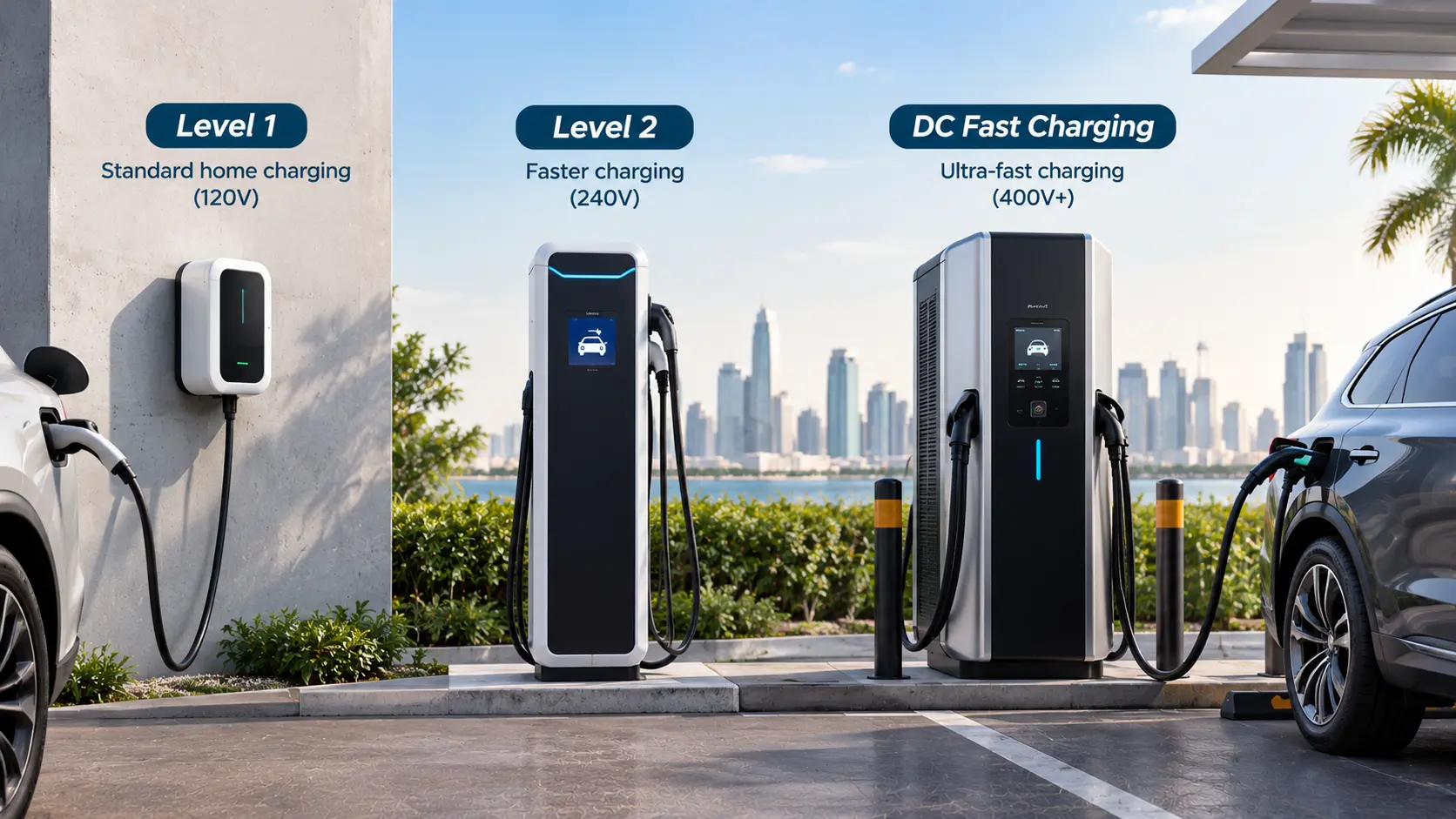
Level 1 is the simplest way to charge. You plug the portable cable that ships with many cars into a regular 15 amp socket. Indian homes run on 230 volts, so this setup delivers roughly 2.2 to 3.3 kW. Expect about 10 to 20 kilometres of range for every hour of charging.
Take a 40 kWh battery as an example, a common size in Indian electric SUVs. A full charge from empty on Level 1 needs roughly 14 to 20 hours. That sounds slow, but most owners never drain the battery fully. If you drive 30 to 40 kilometres a day, an overnight session usually covers it.
Level 1 needs no installation, which makes it a good fit for renters and light users. Keep safety in mind, though. Use a good quality, properly earthed socket, avoid extension boards, and let an electrician inspect old wiring before long sessions.
Level 2 Charger: The Daily Driver’s Favourite
Level 2 steps up the power with a dedicated wall mounted unit. Single phase home versions typically deliver 3.3 to 7.4 kW. Three phase units at offices, malls, and housing societies can reach 22 kW, though your car must accept that rate. At 7.4 kW, you gain around 40 to 50 kilometres of range per hour.
That same 40 kWh battery fills from empty in about 6 hours at 7.4 kW. Most drivers plug in after work and wake up to a full battery. This routine stays gentle on the battery, and it costs less than public fast charging because you pay your regular home tariff.
A certified electrician should install the unit. The professional checks your meter capacity, fits a dedicated circuit, and adds protection such as an earth leakage breaker. Housing society residents should also seek committee approval first, and shared chargers often work better in multi unit buildings.
DC Fast Charging: Rapid Power on the Road
DC fast charging, often called Level 3, delivers anywhere from about 30 kW to over 350 kW. Strictly speaking, SAE standards do not define a Level 3, but drivers use the term everywhere. At a 50 kW station, that 40 kWh battery climbs from 20 to 80 percent in roughly 30 to 45 minutes. Higher power stations cut the time further if your car supports the speed.
Charging slows after about 80 percent because the car manages heat to protect its cells. For that reason, smart drivers unplug at 80 percent on road trips and save time. The final stretch can take far longer than the first 60 percent.
Fast charging costs more per unit than home charging, and heavy daily use can add thermal stress over time. Treat it like a highway fuel stop. Use it for long journeys, urgent top ups, and fleet turnarounds, then return to Level 2 for everyday needs.
Which Electric Car Charger Fits Your Daily Routine?
Start with your daily distance and parking spot. A short city commute with private parking suits Level 2, with Level 1 as a fallback. Frequent highway travel calls for a mix: Level 2 at home plus DC fast stops on the road.
Apartment dwellers face different choices. If your society blocks private wall boxes, look at shared stations, workplace chargers, or nearby public hubs. Many owners combine two options, such as workplace Level 2 and weekend DC fast charging.
Compare the Three Charger Types
| Feature | Level 1 | Level 2 | DC Fast |
|---|---|---|---|
| Power | 2.2 to 3.3 kW | 3.3 to 22 kW | 30 to 350 kW |
| Current | AC | AC | DC |
| Time for a 40 kWh battery | 14 to 20 hours (empty to full) | About 6 hours (empty to full) | 30 to 45 minutes (20 to 80 percent) |
| Installation | None | Electrician needed | Commercial sites only |
| Best use | Backup | Daily routine | Highway trips |
Smart Habits for Safer EV Charging
Good habits protect your battery and your wallet. Charge to 80 percent for daily use, and go to 100 percent only before long trips. Avoid leaving the car at full charge for days. Park in shade during summer, because heat ages batteries faster.
Inspect your cable and plug often. Replace any damaged cable, and keep connectors dry. Use your car’s scheduling feature to start sessions at night, especially where your utility offers lower night rates. Pair that habit with an EV charging app to find stations, start sessions, and pay quickly.
How Smart Software Supports Better Charging
Behind every public or shared station sits software that keeps things running. It monitors charger health, starts sessions, handles payments, and balances power across many units. You notice it only when a station works on the first try.
Electreefi builds this layer for operators. Its cloud based charging management platform connects chargers from many brands through open protocols such as OCPP, shows live status and fault alerts, and accepts UPI, card, and QR payments. Smart charging with load management also schedules sessions around grid load, which keeps busy sites stable. Property owners who want to offer EV charging at malls, offices, or societies gain a smoother experience for every driver.
Final Thoughts: Choose Power That Matches Your Life
Level 1 gives you a simple backup, Level 2 powers your daily routine, and DC fast charging rescues long trips. Choose the right electric car charger for your habits, and your battery will last longer while your costs stay low.
Do you own a parking space, housing society, mall, or fleet and want to offer reliable charging? Request a demo today and see how a smarter setup works. You can also read about EV charging in India and browse more guides on the blog.
Frequently Asked Questions
1. What are the three types of electric car charging levels?
Level 1 uses a regular socket, Level 2 uses a wall mounted unit, and Level 3 means DC fast charging at public stations. Power rises at each step, so charging time falls.
2. How long does it take to charge an electric car?
Time depends on battery size and charger power. A 40 kWh battery needs about 14 to 20 hours on Level 1, 6 hours on Level 2, and 30 to 45 minutes for 20 to 80 percent on DC fast.
3. Is Level 2 charging worth it at home?
Yes, for most owners. It charges two to three times faster than Level 1 and fits an overnight routine easily. You can also schedule sessions for night hours, which suits most busy households.
4. Is DC fast charging bad for your battery?
Occasional fast charging is safe because cars manage heat. Frequent use adds stress, so charge daily on Level 2 and save fast charging for trips.
5. Can you charge an electric car in the rain?
Yes, when you use certified, weatherproof equipment. Keep connectors dry, check cables for damage, and avoid standing water. Stop charging if you notice damage.