A charger that sits idle earns nothing. Across India, EV drivers now plan their day around public chargers, and a single dead connector can send them to a rival network for good. A clear EV charging station maintenance plan keeps your sites live, protects your revenue and builds trust with every driver who plugs in. This checklist breaks the work into daily, weekly, monthly and yearly tasks, so your team always knows what to check next.
Indian conditions make this job tougher than in most markets. Summer heat, heavy monsoon rain and road dust wear chargers down fast. Many CPOs also run hardware from several brands at once, which adds another layer of work.
Why EV Charging Station Maintenance Matters for CPOs
Uptime drives everything in the charging business. When a charger goes offline, you lose sessions, drivers lose confidence and app ratings start to slide. Most drivers will not wait to see if a faulty charger comes back. They simply open their charging app and head to the next site on the map.
Prevention also costs far less than repair. A loose cable or a clogged air filter takes minutes to fix during a routine visit. Left alone, the same issue can burn out a power module and take a DC fast charger down for days.
Daily Checks: Catch Problems Before Drivers Do
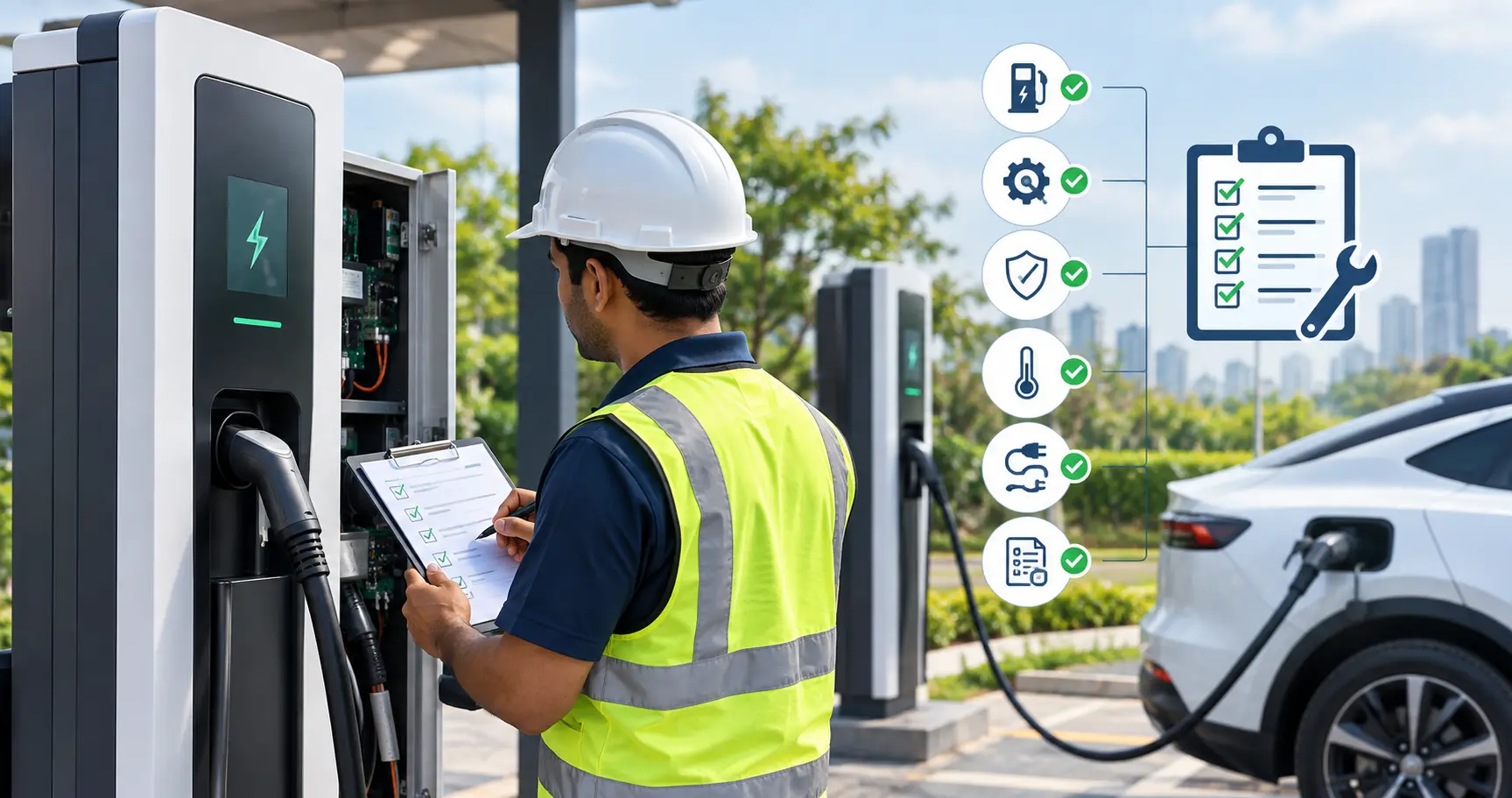
Your daily routine should start on a screen, not at the site. Check these points every morning:
- Confirm every charger shows “Available” or “Charging” on your dashboard
- Review overnight offline alerts and connectivity drops
- Look for failed or stopped sessions and note the error codes
- Check payment and wallet errors that stop drivers from starting a charge
- Read new driver complaints from your app and support line
Remote monitoring now handles a large share of daily EV station maintenance. Your team can reboot a frozen charger or push a configuration change in minutes, without sending a technician across the city.
Weekly Tasks for Safe and Clean Sites
Some problems only show up in person. Send a field technician to each site at least once a week to:
- Clean connectors, holsters and charging guns
- Inspect cables for cuts, kinks or cracked insulation
- Test the display, RFID reader and QR code on every unit
- Clear dust and leaves from air vents and filters
- Check signage, lighting and bay markings
- Report petrol and diesel vehicles that block EV bays
A clean, well lit site also feels safer, and drivers return to places they trust. Many CPOs add a photo log to each visit. This simple habit gives managers proof of work without an extra trip to the site.
Monthly EV Station Maintenance Checklist
Monthly checks go deeper into the electrical and software side. A licensed electrician should handle every task that involves live panels.
- Test earthing and residual current devices (RCDs)
- Tighten terminals and inspect busbars for heat marks
- Check cooling fans and liquid cooling levels in DC chargers
- Install firmware updates through your OCPP platform
- Match energy meter readings against billing data
- Review the monthly uptime and fault report for each site
Billing checks matter more than many operators think. A small meter drift across hundreds of sessions can quietly eat into your margins or spark disputes with site hosts.
Quarterly and Yearly Deep Checks
Every quarter, run a thermal scan on panels, contactors and cable joints. Hot spots reveal failing parts long before they trip a breaker. Schedule an insulation resistance test during the same visit.
Once a year, plan a full audit:
- Replace worn connectors, seals and gaskets
- Recalibrate energy meters
- Inspect fire extinguishers and emergency stop buttons
- Review safety compliance with your DISCOM and local authorities
- Renew or renegotiate your maintenance contract
Season Proof Your Chargers for Indian Weather
Summer brings the biggest risk for DC chargers. High heat forces chargers to cut their power output, and drivers notice slower sessions right away. Add canopies over exposed units, keep vents clear and service every cooling fan before April.
Monsoon brings water and short circuits. Check the IP rating of each charger, inspect door seals and make sure water drains away from the plinth. In flood prone areas, raise the charger base above the expected water line. Finish these checks in May, before the first heavy rain arrives.
Preventive, Predictive and Breakdown Maintenance
Smart CPOs mix three approaches. Preventive work follows a fixed calendar, like the checklist above. Predictive work uses charger data, such as rising temperatures or repeated error codes, to flag parts that may fail soon.
Breakdown work covers sudden faults that need a quick field response. You cannot avoid it fully, but strong preventive and predictive EV station maintenance keeps these calls rare and short. Track how fast your team closes each breakdown ticket, because drivers remember long outages far longer than smooth sessions.
Let Software Do the Heavy Lifting
Manual EV charging station maintenance tracking fails once your network grows past a few dozen chargers. An OCPP based charging management platform shows the live status of every unit, raises instant fault alerts and stores the full service history in one place.
ElectreeFi integrates with 48 charger brands in India and manages over 70,000 charging points, so CPOs can run mixed hardware from a single dashboard. The EV charging management platform pairs real time monitoring with field teams that handle preventive, predictive and breakdown work.
Track These Maintenance KPIs Every Month
Numbers show whether your EV station maintenance plan actually works. Watch these five metrics:
- Uptime: the share of hours each charger stays available
- Mean time to repair (MTTR): how fast your team fixes faults
- Session success rate: the share of sessions that start and finish without errors
- Fault frequency: repeat faults per charger or per brand
- Utilisation: hours of charging against hours available
Compare these numbers across sites. A site with low uptime and many repeat faults often points to a hardware or power supply issue, not a staffing one.
Pick the Right Maintenance Partner
Few CPOs can keep technicians in every city. An Annual Maintenance Contract (AMC) covers scheduled service and labour, while a Comprehensive AMC (CAMC) also covers spare parts. A CAMC costs more upfront, yet it makes yearly spending far easier to predict.
Look for a partner that offers EV charging station O&M with field teams near your sites and 24/7 EV call support for drivers. Ask for response time commitments in writing. If you plan to add new sites, read our guide on EV charging station setup costs, permits and timelines in Pune.
Turn This Checklist into Daily Practice
Print this checklist, assign an owner to each task and review your KPIs every month. Small, steady habits keep chargers live through heat, rain and rush hour traffic.
Ready to cut downtime across your network? Talk to our team about a complete EV charging station maintenance plan with remote monitoring, field support and round the clock service built for Indian conditions.
Frequently Asked Questions
How often should a CPO service an EV charger?
Run remote checks every day, a site visit every week and a deeper electrical check every month. Busy DC fast chargers on highways may need extra visits because heat and heavy use wear parts faster.
What is the maintenance cost of an EV charging station in India?
The cost depends on charger type, site location and contract model. DC fast chargers cost more to maintain than AC chargers because they carry cooling systems and power modules. Most CPOs pick a yearly AMC or CAMC to keep spending predictable.
What is the difference between AMC and CAMC for EV chargers?
An AMC covers scheduled service visits and labour. A CAMC adds spare parts and repairs, so the operator pays one fixed fee and avoids surprise bills.
How long does an EV charging station last?
A well maintained charger usually runs for 7 to 10 years. Regular cleaning, firmware updates and timely part swaps help you reach the upper end of that range.
Why does an EV charger go offline?
Weak internet, power cuts, outdated firmware and tripped safety devices cause most offline events. A charging management platform with live alerts helps your team find the cause and restore service fast.