
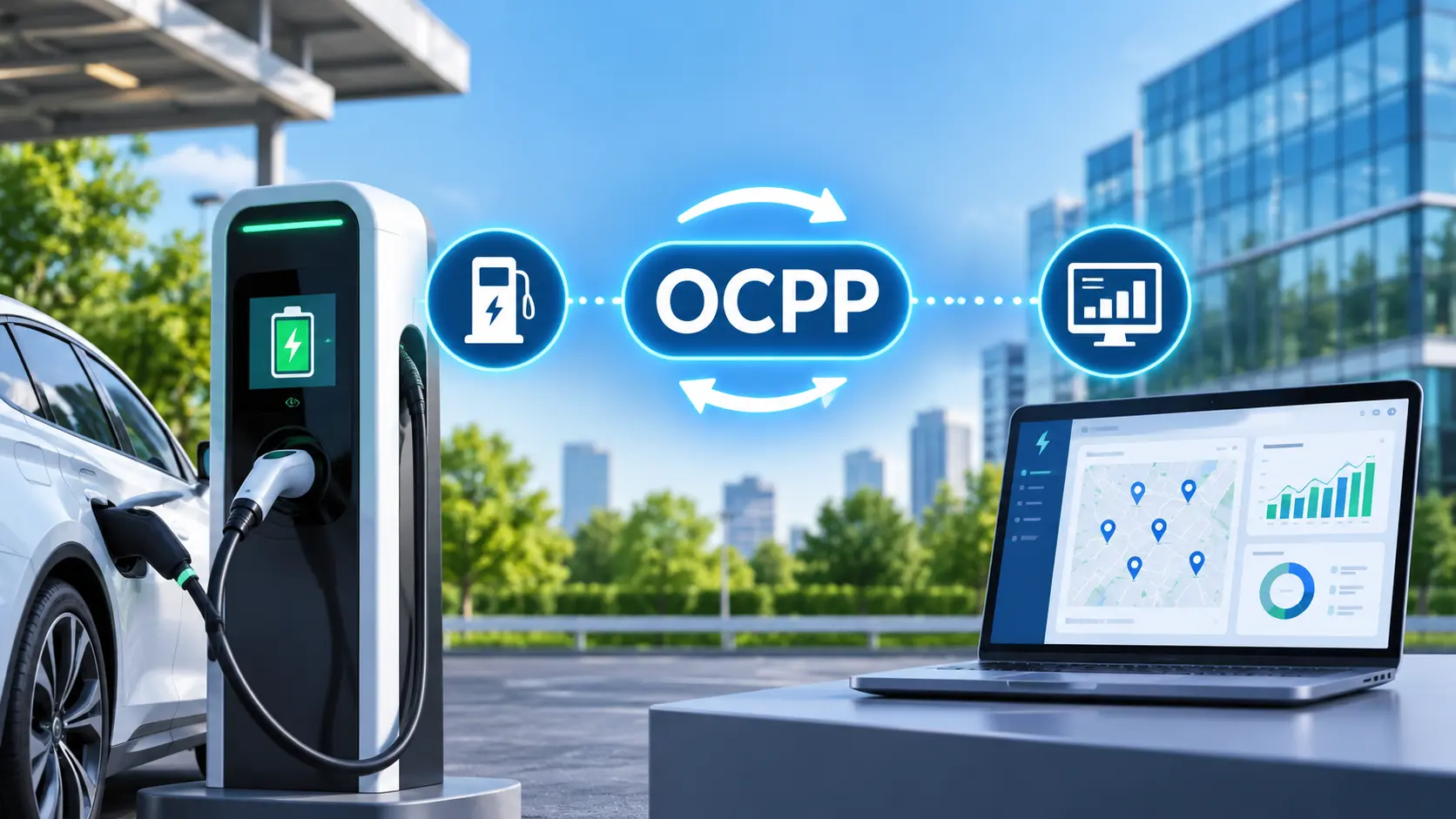
Every charge point operator hits the same wall sooner or later. A charger sits idle, the dashboard shows nothing, and the team cannot find the cause. Most often, the problem is a language gap, and OCPP exists to close it. This open protocol lets a charger and a management platform trade clear, standard messages. When both sides follow the same rules, sessions start on time, bills match the meter, and drivers return.
This guide explains how the protocol works, where its versions differ, and what CPOs should check before they buy hardware or software. You will also see why a move to 2.0 deserves a place on your roadmap.
What OCPP Does Between a Charger and a Network
The Open Charge Alliance maintains Open Charge Point Protocol as a free, open standard. It defines how a charge point talks to a central system, often called a charging station management system or CMS. Think of it as a shared dictionary. Both sides use the same words for the same events, so nothing gets lost in translation.
Here is a simple example. A driver scans a QR code and taps pay. The software sends a start command to the charger. The charger confirms, begins the session, and reports energy use every few minutes. When the driver unplugs, the charger sends a final reading, and the platform builds the invoice. Each step uses a defined message, so any compliant charger and any compliant platform can complete the cycle together. The most common release today, version 1.6J, sends these messages as JSON over WebSockets.
What Goes Wrong When the Two Sides Disagree
A mismatch rarely looks dramatic at first. A charger might connect but skip a status update. A platform might send a remote start that the firmware ignores. Over time, small gaps pile up and turn into real losses.
Consider a busy highway site. A connector faults, but the software still shows it as available. Drivers queue for a dead plug, leave angry reviews, and never return. Meanwhile, your team learns about the fault only when a customer phones support. Missed meter values create a second problem. If the platform loses energy readings, your billing and your reports drift apart, and finance teams spend days reconciling the numbers.
Custom, vendor specific messages make this worse. Some manufacturers add private features on top of the standard. Your software then needs special code for every brand, and each firmware update can break that code. Integration costs rise, and launch dates slip.
Lock in is the final risk. If your chargers speak only one vendor’s dialect, you cannot change software providers without replacing hardware. That is a heavy price for a language problem.
Why OCPP 2.0 Matters for Security and Control
OCPP 2.0 arrived as a major redesign rather than a small patch. Version 2.0.1 later cleaned up the first release and became the version most vendors now build on. It also became an international IEC standard.
Security gets the biggest upgrade. Version 1.6J left security mostly to add ons. OCPP 2.0 builds it in with defined security profiles, signed firmware updates, and certificate handling. That matters because chargers sit in public places and handle payments.
Device management improves too. Operators can read detailed charger settings, monitor components, and push configuration changes remotely. Better error reporting helps technicians diagnose faults before they dispatch a truck. Smart charging also grows more flexible, which helps CPOs balance site load and control power bills.
For CPOs, these changes cut truck rolls and shorten fault resolution. Faster fixes mean more uptime, and more uptime means more paid sessions.
The release also supports ISO 15118, which enables plug and charge. The driver connects the cable, and the car identifies itself and starts the session. No card, no app, no tap. As more vehicles ship with this feature, OCPP 2.0 gives CPOs a head start.
Version 1.6J and Version 2.0.1: A Practical Comparison
Version 1.6J remains popular because it is simple and widely supported. Most chargers in the Indian market ship with it, and it handles core tasks well. Authentication, session control, metering, and basic smart charging all work.
Version 2.0.1 takes more effort to adopt, but it rewards operators with stronger security, richer data, and cleaner error handling. One warning applies here. The two versions do not talk to each other directly. A charger on 2.0.1 needs a platform that supports 2.0.1, so you must plan the pair together.
How Open Standards Protect Your Hardware Investment
Charger hardware lasts for years, while software needs change fast. A standard protocol separates those two timelines. You can add features, switch platforms, or expand to new cities without touching every charger on site.
This also helps with mixed hardware. Many CPOs buy chargers from several makers over time. A platform that follows the standard, and does not depend on one brand, shows all of them in one dashboard. Operators see uptime, sessions, and revenue side by side, then compare site performance without manual exports.
Roaming benefits as well. When your network follows open standards, it connects more easily to partner networks through OCPI. Drivers from other apps can use your chargers, and your utilisation climbs without new construction.
How to Choose Software and Chargers That Speak Together
Start with the hardware. Ask every vendor which OCPP version the charger supports, and request a conformance or interoperability test report. A written answer beats a sales promise.
Next, test the platform. Run a pilot with two or three charger models before you sign a large order. Check that remote start, remote stop, firmware updates, and meter reporting all work as expected.
Then review the support model. Ask who fixes a message failure at two in the morning, and how fast. Look for a vendor that offers 24/7 support, since a silent charger earns nothing.
Finally, check the roadmap. Choose a platform that already supports both 1.6J and 2.0.1, so your network can grow in steps and avoid a painful switch later.
Build a Network That Speaks One Language
The protocol decides whether your chargers act like a connected network or a pile of isolated boxes. A shared language means faster launches, fewer faults, cleaner billing, and freedom to change vendors.
Electreefi gives CPOs a charger agnostic management platform that supports versions 1.6J and 2.0.1. The platform already works with 80+ charger makers across India and covers over 105,000 charging points. Operators manage monitoring, UPI, card and QR payments, roaming, and smart charging from one place.
Ready to connect your chargers and software without friction? Request a demo, share your charger models, and see how quickly your sites go live.
FAQs
What does OCPP stand for in EV charging?
It stands for Open Charge Point Protocol. The standard sets common rules for messages between a charger and a management platform, so CPOs can monitor, control, and bill sessions across brands.
What is the difference between OCPP 1.6J and OCPP 2.0?
Version 1.6J covers core session and meter tasks. Version 2.0 adds built in security, better device management, richer error data, and ISO 15118 plug and charge support. CPOs gain stronger control and safer payments.
Is OCPP 2.0 backward compatible with 1.6J?
No. The versions use different message structures, so a 2.0 charger needs a platform that supports 2.0. Choose software that handles both versions to protect your rollout.
Can one platform manage chargers from different manufacturers?
Yes, if the platform follows the open standard and avoids private vendor features. A charger agnostic platform shows every brand in one dashboard and cuts integration cost.
How can a CPO check that a charger supports OCPP?
Ask the vendor for the supported version and a conformance test report. Then pilot the charger, and test remote start, stop, firmware updates, and meter reports before you place a bulk order.
