
EV Charging Station Cost in India: At a Glance
| Charger type | Typical all-in cost | Charge time (typical car) | Best suited to |
|---|---|---|---|
| AC 3.3 kW (Bharat AC-001) | ₹25,000 – ₹45,000 | 8–10 hours | Homes, small societies, 2W/3W |
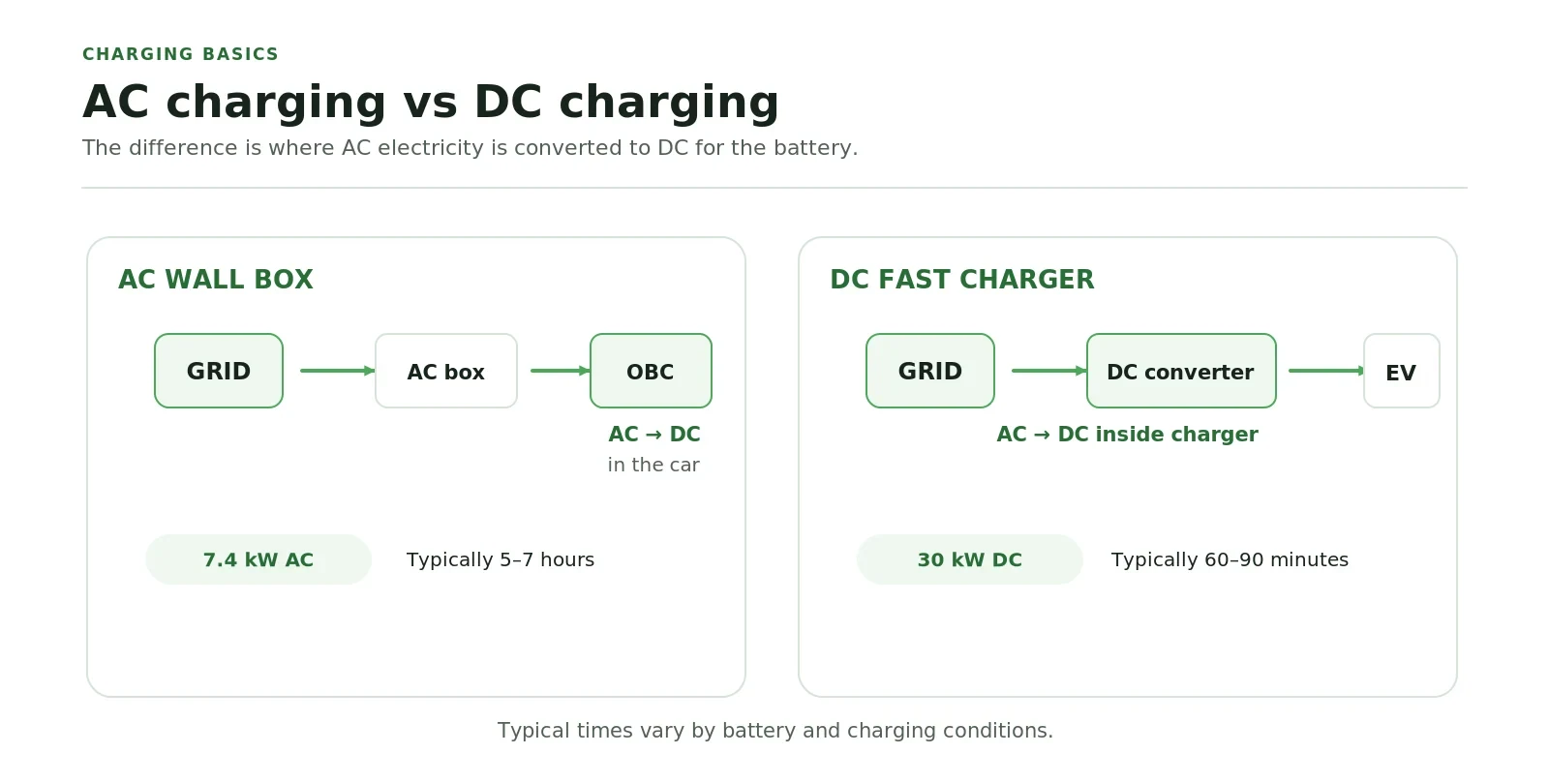
| AC 7.4 kW wall box | ₹35,000 – ₹80,000 | 5–7 hours | Homes, office parking bays |
| AC 22 kW (commercial, 2 guns) | ₹1.5 – ₹3 lakh | 2–4 hours | Malls, hotels, offices, destination charging |
| DC 15 kW | ₹2.5 – ₹5 lakh | 1.5–2.5 hours | Fleet depots, 3W hubs, small sites |
| DC 30 kW | ₹12 – ₹18 lakh | 60–90 minutes | Urban public charging, retail, fuel stations |
| DC 60 kW | ₹15 – ₹25 lakh | 35–50 minutes | High-traffic urban hubs, fleet charging |
| DC 120 kW+ | ₹25 – ₹40 lakh+ | 20–30 minutes | Highway corridors, intercity routes |
Ranges reflect hardware plus installation at a site with a reasonable existing power connection. Sites needing a new transformer or a long cable run from the nearest substation will sit above these figures. Always take written quotations from two or three suppliers and your DISCOM before committing.
What You Are Actually Paying For: Full Cost Breakdown
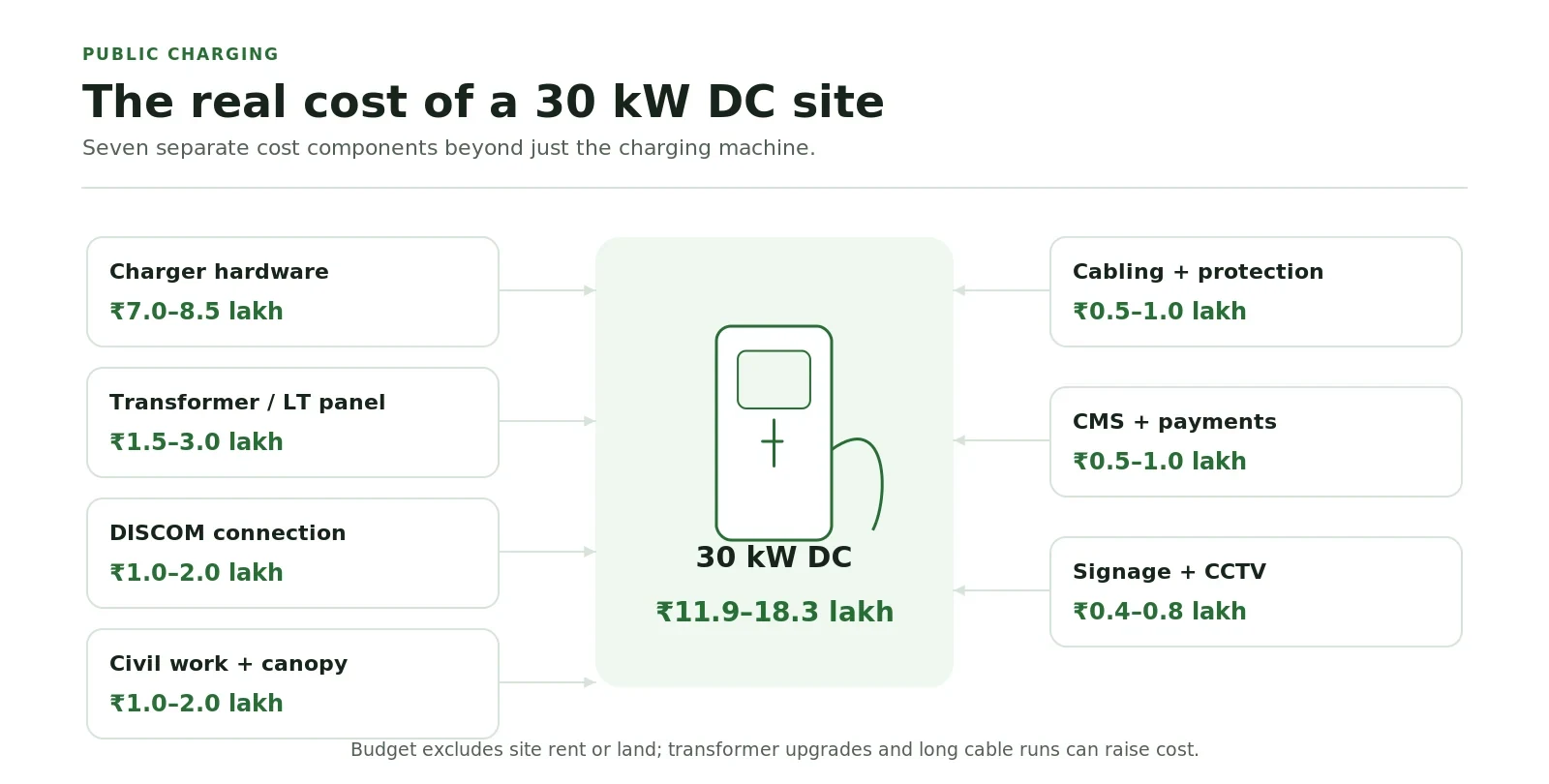
Below is the line-by-line cost of a single 30 kW DC fast charging station — the configuration most operators start with. This is where the gap between a charger price list and a real project budget becomes obvious.
| Cost component | Cost range | What it covers |
|---|---|---|
| Charger hardware | ₹7,00,000 – ₹8,50,000 | The 30 kW DC unit with CCS-2 gun, display and OCPP support. Usually 50–60% of the project. |
| Transformer / panel upgrade | ₹1,50,000 – ₹3,00,000 | Added transformer capacity, LT panel, metering cubicle. The single biggest variable between sites. |
| DISCOM load sanction & connection | ₹1,00,000 – ₹2,00,000 | Commercial load application, security deposit, service line and meter from the utility. |
| Civil work, foundation, canopy | ₹1,00,000 – ₹2,00,000 | Charger plinth, bollards, cable trenching, weather canopy, parking markings. |
| Cabling, earthing, protection | ₹50,000 – ₹1,00,000 | HT/LT cable, dedicated earth pits, SPD, MCCB/RCCB, lightning protection. |
| CMS software & payments | ₹50,000 – ₹1,00,000 | Charge point management system onboarding, app listing, UPI/card payment integration. Recurring fee after year one. |
| Signage, lighting, CCTV | ₹40,000 – ₹80,000 | Site branding, LED lighting, surveillance, fire extinguisher, safety signage. |
| Total project cost | ₹11.9 – ₹18.3 lakh | Excluding land cost or rent. |
You will often see a 30 kW station quoted at ₹11–15 lakh. That figure usually assumes the site already has adequate sanctioned load and needs no transformer work. Once a transformer upgrade enters the scope, ₹18 lakh is the more realistic planning number.
Three Real-World Scenarios
1. Housing society or office parking — ₹1.5 to ₹3 lakh
Two AC 22 kW units serving residents or staff overnight. Usually no transformer work is needed because the existing sanctioned load can absorb 44 kW, and the chargers mount on an existing wall. Civil work is minimal. This is the cheapest way to offer genuine charging rather than a 15 A plug point, and it suits residential complexes where cars sit parked all night.
2. Retail, hotel or fuel station — ₹12 to ₹18 lakh
One 30 kW DC charger with a CCS-2 gun, plus an AC 22 kW unit for longer dwell times. This is the standard public charging configuration in Indian cities. Expect a commercial load sanction, a transformer review, a canopy and full CMS integration with app listing and UPI payments.
3. Highway corridor site — ₹25 to ₹40 lakh+
A 120 kW or 240 kW charger, often with two guns, serving intercity traffic. Costs rise sharply here: HT connection, dedicated transformer, substantial civil work and in many cases a diesel or battery backup. Land rent on a highway frontage is a significant ongoing cost that does not appear in hardware quotations.
Running Costs: What It Costs to Operate
Capital cost is the question most people ask. Running cost is the one that determines whether the site makes money.
Electricity tariff
Most states have created a separate, concessional EV charging tariff. These are the input rates operators pay — not the retail price charged to drivers.
| State | EV charging tariff (LT) | Notes |
|---|---|---|
| Delhi | ₹4.50 / kWh | ₹4.00 / kVAh at high tension. Among the lowest in India. |
| Karnataka | ₹4.50 / kWh | Energy charge fixed by KERC through FY 2027-28. |
| Maharashtra | ₹6 – ₹9 / kVAh | Varies by tariff category and time of day. Electricity duty waived for EV charging. Check the current MERC order. |
| Tamil Nadu | ₹6.50 – ₹9.75 / kWh | Time-of-day slabs; off-peak charging is materially cheaper. |
| Madhya Pradesh | ₹7.44 / kWh | Energy charge per unit. |
Tariffs are revised annually by each state regulator. Confirm the current rate with your DISCOM before modelling returns — a ₹2/unit difference changes payback by years.
Recurring operating costs
- Electricity — the largest variable cost, typically ₹5–8 per unit all-in once fixed charges and duty are added.
- Annual maintenance (AMC/CAMC) — roughly 5–10% of hardware value per year, so ₹35,000–₹85,000 for a 30 kW unit.
- CMS subscription — ₹1,000–₹3,000 per charger per month for management software, app listing, remote diagnostics and settlement.
- Site rent — highly location-dependent, and often the deciding factor on highway sites.
- Manpower and housekeeping — unmanned sites still need periodic cleaning and attendance for faults.
- Payment gateway charges — typically 1–2% of transaction value.
Payback: Honest Numbers
Vendor brochures commonly promise payback in 20–26 months. For the rules, approvals and siting that sit around this, see our guide to public EV charging stations in India, and our explainer on what a Charge Point Operator does. That is achievable, but only at utilisation levels most sites do not reach in their first two years. Utilisation here means the share of the day the charger actually delivers its rated power.
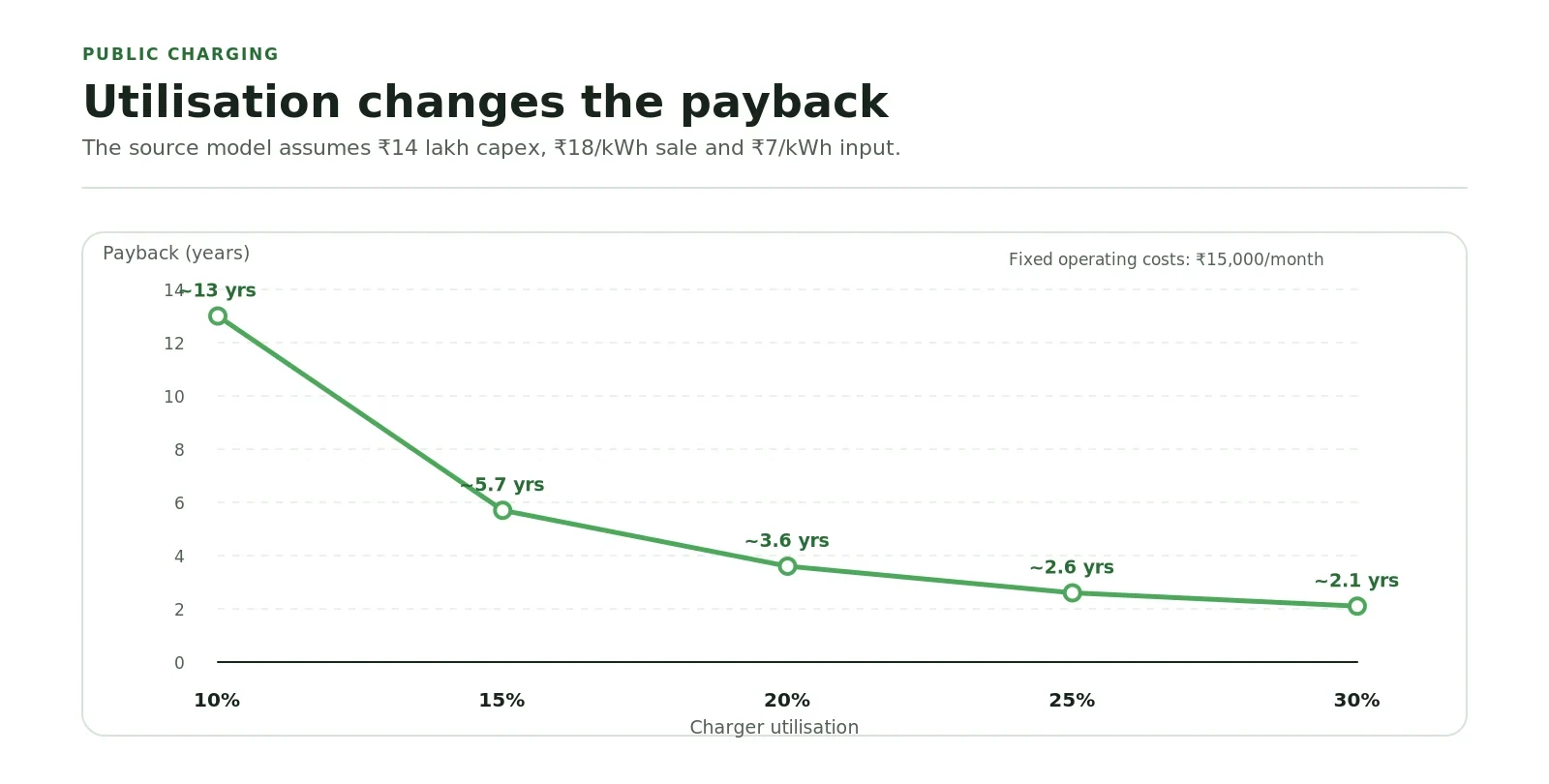
The table below assumes a ₹14 lakh project, a retail price of ₹18/unit, an input cost of ₹7/unit, and ₹15,000 a month in fixed operating costs.
| Utilisation | Units sold / month | Net monthly profit | Payback period |
|---|---|---|---|
| 10% | 2,160 kWh | ₹8,760 | ~13 years |
| 15% | 3,240 kWh | ₹20,640 | ~5.7 years |
| 20% | 4,320 kWh | ₹32,520 | ~3.6 years |
| 25% | 5,400 kWh | ₹44,400 | ~2.6 years |
| 30% | 6,480 kWh | ₹56,280 | ~2.1 years |
The lesson is simple: location decides the return, not the charger. A ₹12 lakh station at 25% utilisation outperforms a ₹9 lakh station at 10% by a wide margin. Before buying hardware, study the traffic, the dwell time and the EV density around the site.
Subsidies and Government Support in 2026
FAME II closed on 31 March 2024. Any cost estimate still quoting FAME II subsidies is out of date. The scheme now in force is PM E-DRIVE.
- PM E-DRIVE runs from 1 April 2024 to 31 March 2028, with a total outlay of ₹10,900 crore.
- ₹2,000 crore is earmarked specifically for public EV charging stations, against a target of roughly 72,000 chargers nationwide.
- As of mid-2026, proposals worth about ₹689 crore had been sanctioned covering some 6,562 stations, though the government has reported that disbursement against the charging component was still at an early stage.
- Funding is routed through nodal government entities, state governments and oil marketing companies rather than paid directly to private operators — so most private CPOs should budget without assuming a central subsidy.
Several states run their own EV policies with capital subsidies, electricity duty exemptions and concessional tariffs. Maharashtra, for example, waives electricity duty on EV charging for up to ten years. State policies change frequently, so verify the current notification for your state rather than relying on a summary.
What Pushes the Cost Up or Down
Costs rise when: the site needs a new or upgraded transformer; the nearest substation is far away and cable runs are long; you choose higher power or multiple guns; the location requires a canopy, backup power or heavy civil work; or land is rented at a premium frontage.
Costs fall when: existing sanctioned load is already sufficient; the site has usable covered parking; you begin with AC charging and add DC later as demand proves out; you standardise on one charger model across sites; or you share infrastructure across several chargers on one connection.